To chop, dice, and mince like a pro, focus on proper grip and technique, such as using a claw grip and smooth rocking motion, to guarantee safety and precision. Choose a sharp, well-maintained knife and a stable, non-slip cutting surface. Practice even, controlled cuts while keeping your fingers tucked under to avoid injuries. Mastering these basics helps you work efficiently and safely—stay with us to discover even more expert tips to elevate your skills.
Key Takeaways
- Use the correct grip, such as the claw grip, to maintain control and safety during chopping, dicing, and mincing.
- Keep your knives sharp to ensure clean cuts and reduce the effort needed, enhancing safety and precision.
- Maintain a stable, non-slip cutting surface positioned at a comfortable height for better control.
- Master fundamental techniques like slicing, dicing, and mincing using a smooth rocking motion.
- Curl your fingers under your hand to protect them and improve accuracy while cutting.
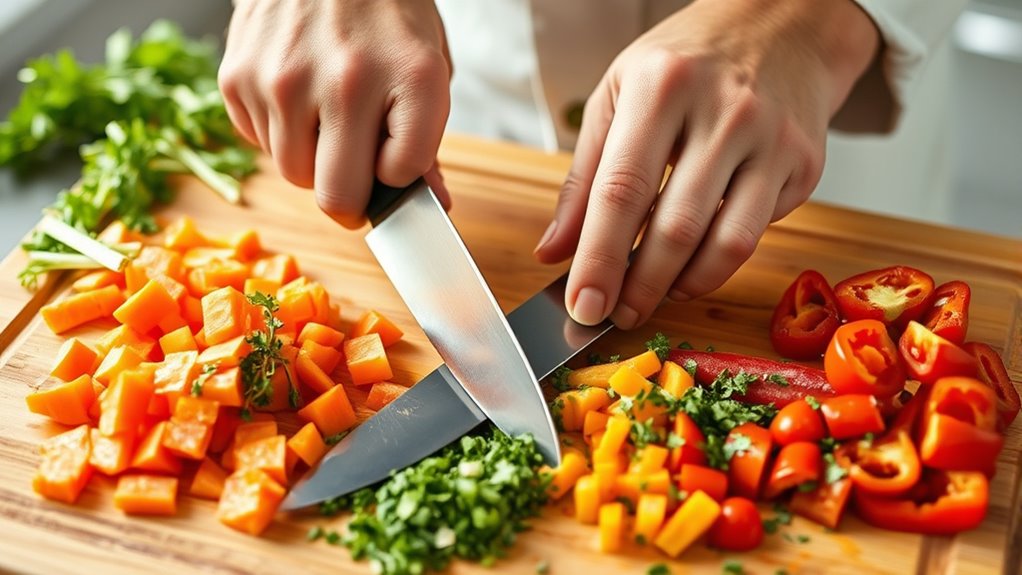
Mastering essential knife skills is crucial for every home cook who wants to prepare food efficiently and safely. When you practice regularly, you’ll notice your precision and speed improve, making meal prep less stressful and more enjoyable. The first step is understanding that the right grip and technique make all the difference. You should master grips like the claw grip, which keeps your fingers curled under and away from the blade, and the pinch grip, which offers better control for more delicate cuts. Using the correct grip helps you apply even pressure and prevents accidents. Equally important is selecting the right knife for each task. A chef’s knife is versatile for slicing and dicing, while a paring knife excels at peeling and intricate work. Choosing the proper knife ensures cleaner cuts and reduces effort, especially when combined with a stable cutting board placed at a comfortable height. This stability keeps your hand steady and helps you maintain control, making your cuts more uniform and safer. Additionally, maintaining a sharp knife is essential for both precision and safety, as sharp blades require less force and are less likely to slip. Keeping your knives sharp not only improves cutting efficiency but also prolongs their lifespan and keeps them safe to use. Focusing on fundamental cuts like slicing, dicing, and mincing forms the foundation of good knife skills. Slicing involves cutting into thin, even pieces, perfect for vegetables and fruits. Dicing creates small, uniform cubes—ideal for salads and stews—while mincing turns ingredients into tiny pieces, perfect for herbs and garlic. To execute these cuts properly, you should use a smooth rocking motion, moving the knife back and forth while maintaining a consistent angle. This technique allows for clean, efficient cuts without applying excessive force. Keep your grip firm and consistent, and always make sure your knife is sharp. A dull knife requires more force, increasing the risk of slips and injuries. Remember to keep your fingers curled under and away from the blade, especially when working with small or slippery items like garlic or herbs. Proper technique and a steady hand are key to safety and precision. Using proper cutting techniques can significantly improve your results and reduce fatigue over time. Avoid common mistakes such as holding the knife incorrectly, using dull blades, or chopping aggressively. These errors can lead to uneven cuts and potential injuries. A proper cutting surface, like a stable, non-slip board, is essential for safety. Regularly inspecting your knives for damage and maintaining their sharpness through proper cleaning and sharpening prolongs their lifespan and keeps them safe to use. If you want to take your skills further, learning advanced techniques like julienne, tourne, or brunoise can elevate your presentation and efficiency. Watching online tutorials, attending cooking classes, and consulting cookbooks can help you refine your skills. Incorporating visual cues and proper technique can significantly boost your confidence and precision. By mastering these basic yet essential knife techniques, you’ll become more confident, efficient, and safe in the kitchen, transforming simple ingredients into beautifully prepared dishes every time.

imarku Japanese Chef Knife – Sharp Kitchen Knife 8 Inch Chef's Knives HC Steel Paring Knife, Unique Gifts for Men and Women, Gifts for Mom or Dad, Kitchen Gadgets with Gift Box, Mothers Day Gifts
High-Carbon Stainless Steel Blade: It is manufactured from high-quality stainless steel that maintains its functionality for a long…
As an affiliate, we earn on qualifying purchases.
As an affiliate, we earn on qualifying purchases.
Frequently Asked Questions
What Type of Knives Are Best for Beginners?
You’re wondering which knives are best for beginners. Start with a versatile chef’s knife, ideally around 8 inches, because it handles most tasks easily. A santoku knife offers a lighter, balanced option for slicing and chopping. Pair these with a paring knife for peeling and a serrated knife for bread. Choose brands like Victorinox for affordability or Wüsthof for quality. Prioritize comfort, balance, and sharpness for a confident start.
How Often Should I Sharpen My Kitchen Knives?
Sharpening schedules stay specific to your slicing and dicing routine. For casual cooks, you should sharpen your knives about once or twice a year, depending on usage. Daily honing with a steel rod can keep edges in excellent shape, extending the time between sharpenings. If you notice dullness or difficulty cutting, it’s time to sharpen. Regular care, including proper storage and honing, promotes prolonged sharpness and peak performance.
What Safety Tips Should I Follow When Using Knives?
When using knives, you should always follow safety tips to prevent injuries. Always handle knives by their handles and cut away from your body. Keep your fingers curled and stay focused on your task. Use a stable cutting surface, and avoid distractions like conversations or TV. Keep your knives sharp to reduce force and control. Never catch a falling knife, and avoid overconfidence — safety first keeps you safe.
How Do I Choose the Right Knife for Different Tasks?
When choosing the right knife, consider the task at hand, the material, and your comfort. For chopping vegetables, pick a chef’s knife with a sharp, curved blade. For peeling or detailed work, opt for a paring knife that offers precision. For deboning or slicing meat, use a flexible boning or carving knife. Always prioritize a handle that fits comfortably and a blade that’s durable and easy to maintain.
What’s the Proper Way to Store My Knife Collection?
When storing your knives, consider ease, safety, and blade longevity. You might choose a magnetic strip for quick access and hygiene or a knife block to keep blades organized and protected. For portability, a knife roll works best. If you prefer concealed storage, an in-drawer organizer keeps knives safe and out of sight. Avoid leaving knives loose in drawers to prevent accidents and blade damage.

GORILLA GRIP BPA-Free Reversible Kitchen Cutting Board Set of 3, US Designed, Nonporous, Juice Grooves Catch Liquid, Slip Resistant Border, Dishwasher Safe, Durable Large Food Chopping Boards, Black
ULTRA DURABLE STRENGTH: 3rd Party Tested for durability, thick cutting boards have a nonporous surface that won’t splinter…
As an affiliate, we earn on qualifying purchases.
As an affiliate, we earn on qualifying purchases.
Conclusion
Now that you’ve mastered these essential knife skills, imagine effortlessly gliding through vegetables, the crisp sound of your blade meeting produce, and vibrant colors dancing on your cutting board. With each precise chop, dice, and mince, you’re transforming ingredients into culinary art. Feel the confidence grow in your hands as you prepare meals with ease and flair. Keep practicing, and soon, your kitchen will be filled with the enticing aroma of perfectly crafted dishes—crafted by your skillful, confident touch.

Intelitopia Complete Knife Sharpening Stone Set – Dual Grit Whetstone 400/1000 3000/8000 Knife Sharpener with Leather Strop, Flattening Stone, Bamboo Base, 3 Non-slip Rubber Bases & Angle Guide
【Complete Knife Sharpening Stone Kit】You don't need to be a Pro to sharpen your blades, all you need…
As an affiliate, we earn on qualifying purchases.
As an affiliate, we earn on qualifying purchases.

VITUER Paring knife, 4PCS Paring knives (4 Knives and 4 Knife cover), 4 Inch Peeling Fruit and Vegetable Knife, Ultra Sharp Kitchen Knives, German Steel, PP Plastic Handle
PARING KNIFE SET: 8 Piece Paring Knives including 4 of Paring Knives and 4 of Knife Sheath, it’s…
As an affiliate, we earn on qualifying purchases.
As an affiliate, we earn on qualifying purchases.