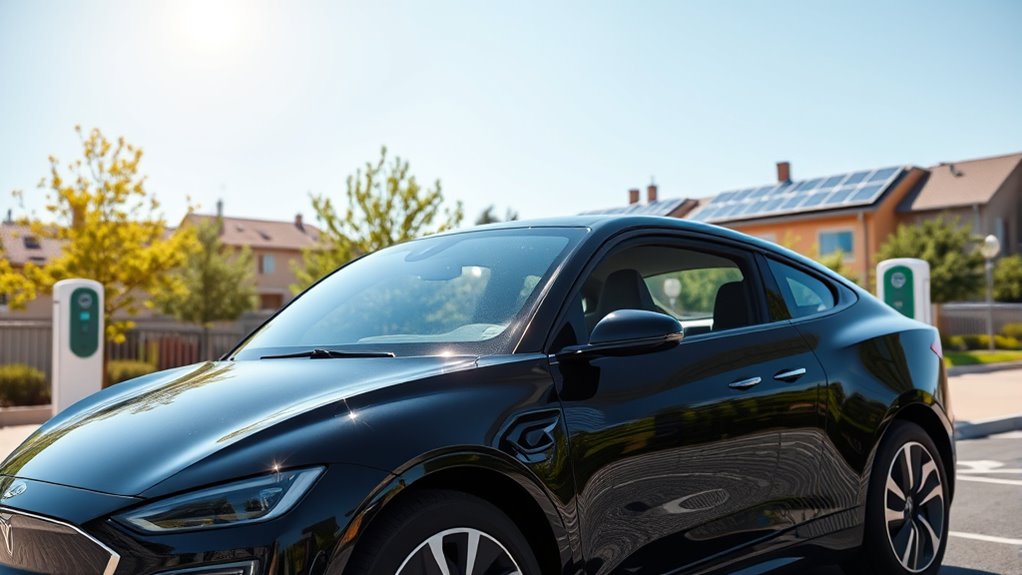

In 2025, you can qualify for up to a $7,500 federal EV tax credit for new cars and $4,000 for used ones, but eligibility depends on several factors. Your vehicle must be assembled in North America, and its price must stay below certain caps. Battery sourcing rules are changing, affecting which models qualify. Since eligibility can shift with supply chain updates, staying informed will help you maximize your benefits. Discover what else you need to know to make the most of these credits.

Get everyday essentials delivered free with Prime
- Fast, free delivery on millions of items
- Prime Video, Amazon Music and more included
- Member-only deals all year
Key Takeaways
- The federal EV tax credits offer up to $7,500 for new and $4,000 for used vehicles, available only until September 30, 2025.
- Eligibility depends on vehicle assembly in North America and price caps—under $55,000 for sedans and $80,000 for trucks/SUVs.
- Battery sourcing rules impact model eligibility, with automakers updating supply chains to meet strict requirements.
- The list of qualifying EVs can change frequently as automakers adapt to sourcing and regulatory updates.
- Leasing EVs can allow lease providers to claim credits, potentially lowering lease payments for buyers.

If you’re contemplating buying an electric vehicle in 2025, understanding the federal EV tax credits can considerably lower your costs. The government offers up to $7,500 in tax credits for new EVs and up to $4,000 for used models, but these benefits come with specific conditions. To qualify, your vehicle must be purchased before September 30, 2025, since the tax credit program ends after that date due to the One Big Beautiful Bill Act (OBBBA). If you lease an EV, the leasing company or bank can claim the credit, which might lower your lease payments. Keep in mind, there are also additional deductions like a $10,000 auto loan interest deduction, but these have limited applicability and may not benefit every buyer.
Vehicle eligibility hinges on several criteria. The EV must be assembled in North America—meaning in the U.S., Canada, or Mexico—to qualify for the credit. There are also MSRP caps to consider: sedans and hatchbacks under $55,000, and SUVs, pickups, and vans under $80,000. Some popular high-end EVs, such as the Tesla Model S, Lucid Air, and GMC Hummer EV, don’t qualify because they exceed these price limits. Additionally, the specific trim level or model year can influence eligibility, as not all versions of a vehicle might meet the criteria. The EPA’s vehicle classification plays a role here, especially when determining the vehicle’s category and corresponding price caps. Manufacturers are also adjusting their supply chains to meet battery sourcing requirements, which can impact the availability of qualifying models.
Battery sourcing requirements introduced in 2024 have added complexity to the program. Automakers must meet strict sourcing thresholds for batteries and components, which change annually as manufacturers update models. These rules aim to reduce dependency on foreign supply chains but can cause shifts in which EVs qualify over time. As automakers adapt, some models that initially qualified might lose eligibility, and new models might gain it, making the qualification landscape dynamic and sometimes confusing. [Automakers are actively updating their vehicle models to meet these evolving criteria, which means the list of eligible EVs can change frequently.
best electric vehicles under $55000
As an affiliate, we earn on qualifying purchases.
As an affiliate, we earn on qualifying purchases.
Frequently Asked Questions
Are Used Electric Vehicles Eligible for Tax Credits in 2025?
Yes, used electric vehicles are eligible for tax credits in 2025 if you buy from a licensed dealer, and the vehicle is model year 2023 or earlier. You must spend $25,000 or less, meet income limits, and use the vehicle for personal purposes. The credit covers 30% of the price, up to $4,000, but it’s only available once every three years.
How Do Income Limits Affect Electric Vehicle Tax Credits?
Imagine your eligibility for EV tax credits is like a gate guarded by income thresholds. If your Modified Adjusted Gross Income (MAGI) exceeds these limits—$300,000 for married couples, $225,000 for heads of household, or $150,000 for singles—you won’t pass through to claim the credit. Your income acts as a key, and if it’s too high, the gate stays closed, preventing you from accessing those savings.
Can I Claim Multiple EV Tax Credits for Different Vehicles?
You can claim multiple EV tax credits for different vehicles if each one qualifies separately. Each vehicle you purchase must meet the eligibility criteria, and you’ll need to file IRS Form 8936 for each, including their VINs. Keep in mind, the credits are applied individually, so buying multiple EVs within the same year can maximize your benefits, provided you follow all IRS rules and documentation requirements.
Are There State-Specific Incentives Supplementing Federal Credits?
You’ll find that many states offer additional incentives that complement federal tax credits, boosting your savings on an EV. These can include rebates, tax credits, lower registration fees, or access to HOV lanes. Eligibility and programs vary, with some targeting low- to moderate-income buyers. Keep in mind that these incentives often require separate applications and may have limited funding, so it’s smart to explore your state’s current offers before purchasing.
What Documentation Is Required to Claim the Tax Credit?
Ever wondered what paperwork you need for your EV tax credit? You’ll need a seller-provided report with details like seller and buyer TINs, sale date, vehicle VIN, battery capacity, and confirmation of original use for new vehicles. Additionally, you must file IRS Form 8936 with your tax return, including your VIN. Be prepared to provide proof of income, primary U.S. use, and meet vehicle eligibility requirements.
Conclusion
As you consider buying an electric vehicle in 2025, remember the new tax credits can save you money. For example, imagine you choose a qualifying EV and claim a $7,500 credit on your taxes, making your car more affordable. Staying informed about eligibility and deadlines guarantees you don’t miss out. By doing your homework now, you can drive off with a greener car and extra savings, making your switch to electric both smart and budget-friendly.
Halloween Picks
halloween
As an affiliate, we earn on qualifying purchases.