
TL;DR
A November 22 explainer from Thorsten Meyer AI describes how large language models turn prompts into tokens, process them through transformer layers and generate answers one token at a time. The guide says that fluent output can still be wrong because the model predicts text rather than retrieving verified facts.
Thorsten Meyer AI published an explainer on November 22 describing how large language models turn a user’s prompt into a response, from tokenization through next-token prediction. The guide’s central point is that a model generates likely text rather than looking up a verified answer, a distinction that helps explain both its usefulness and its confident errors.

Get everyday essentials delivered free with Prime
- Fast, free delivery on millions of items
- Prime Video, Amazon Music and more included
- Member-only deals all year
The explainer describes a five-step process. A model divides text into tokens, converts them into numerical representations called embeddings, and processes them through transformer layers. Those layers allow tokens to draw on information from other tokens in the prompt. The model then scores possible next tokens, selects one and adds it to the text. It repeats the process until the response is complete.
Token counts vary by model and tokenizer. The article cites OpenAI’s estimate that an English token averages about four characters, or roughly three-quarters of a word, while stressing that these are approximations. Tokens matter because they shape input and output limits and are used to count usage. The article also points to tokenization as one reason a model may struggle with tasks that appear simple to people, such as counting letters in a word.
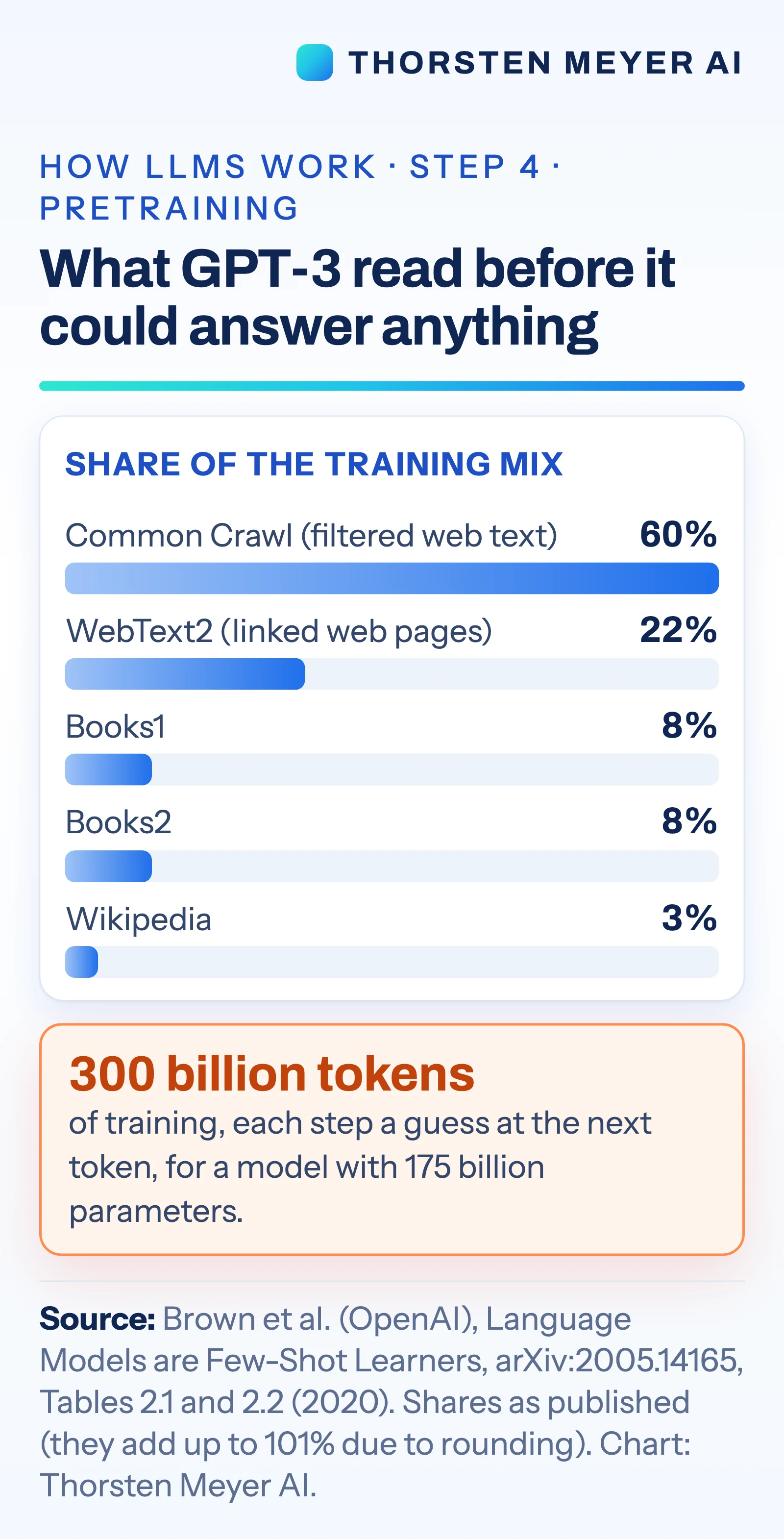
The guide distinguishes pretraining, in which a model learns to continue text from a large corpus, from post-training intended to make it follow instructions. It names human feedback (RLHF) and AI feedback guided by written principles (RLAIF) as approaches used in that later stage. It also says reasoning models can spend additional compute generating hidden reasoning tokens before providing an answer; those tokens count as output usage, according to the article.
Why Generated Answers Need Checking
Understanding the generation process affects how people use these systems at work. A fluent response is not, by itself, evidence that the model checked a source or confirmed a fact. The explainer says that the same text-prediction process can produce a useful answer or a confident error. Users making decisions from an output should verify factual claims against reliable material, especially when accuracy matters.
The mechanism also helps explain practical limits. The model’s output is built one token at a time, and sampling can produce different continuations from the same prompt. The article identifies temperature as a control over how adventurous the next-token choice is. It says models can make things up, may lack information after their training data ends, and incur costs for each token. These are design-related concerns, rather than proof that every answer will be wrong.
That distinction matters for businesses weighing where to use a chatbot. The guide presents language models as tools that can generate and follow instructions, while making verification part of responsible use. It does not provide a benchmark of accuracy across products or a universal threshold for deciding when an answer is safe to rely on.
Popular right now

Ninja Luxe Café Pro 4-in-1 Espresso, Drip Coffee, and Cold Brew Machine

Breville Barista Pro Espresso Machine with Grinder, Brushed Stainless Steel

Samsung 48-Inch S90F OLED 4K Smart TV (2025)
As an affiliate, we earn on qualifying purchases.
From Transformer Research to Assistants
The explainer situates transformers in a research timeline, saying the architecture was introduced in 2017. Its process diagram cites the paper Attention Is All You Need by Vaswani and colleagues, along with OpenAI’s token guidance and Anthropic’s glossary. The article also references 2016 work by Rico Sennrich and colleagues on representing rare or unknown words as sequences of subword units.
As an example of post-training, the guide cites an OpenAI study from 2022. It reports that a 1.3 billion parameter model trained with human feedback was preferred to the 175 billion parameter GPT-3. That comparison is presented as an example from the cited study, not a general finding that smaller models are always better. The source also notes that newer Claude tokenizers can produce about 30 percent more tokens for the same text than earlier ones, illustrating why token counts depend on the model.
The post labels itself as an AI-assisted explainer and part of a series on how AI works. It says detailed treatments of neural-network arithmetic and context windows appear elsewhere in that series. The available source material focuses on the route from prompt to answer and the trust questions raised by that process.
“The model never looks up an answer.”
— Thorsten Meyer AI explainer
Limits the Explainer Leaves Open
The source does not specify the training-data cutoff for any particular model, quantify how often models make factual errors or compare the reliability of named products. It says that models know nothing after their training data ends, but the cutoff and any additional information available through tools depend on the model and deployment. The article does not give product-specific details on those points.
It also does not identify which reasoning models it discusses or provide comparative measurements showing how much extra compute improves performance on different tasks. Its statement that additional reasoning can help with hard problems is a general description from the guide. The supplied material does not establish when that benefit outweighs cost or delay.
The source mentions tools a model can call as part of the guide’s scope, but the available text does not explain their operation or how tool results are checked. Readers therefore cannot use this article alone to judge a particular system’s access to current information or the reliability of its tool use.
Further Explainers in the Series
The article points readers to separate explainers on neural-network arithmetic, deep learning and context windows. Those topics address how computations work inside a network and how much text a model can process at once. The November 22 guide itself does not announce a release date for another article or a product change.
For readers applying the explanation, the immediate next step is to treat generated answers as drafts that may need source checks. The guide recommends verification as part of using the technology and identifies training cutoffs, token limits and sampling as factors that shape what comes back. It offers no formal checklist or accuracy standard, so the appropriate level of checking remains dependent on the task.
Key Questions
Does a large language model retrieve an answer from a database?
Not by default, according to the explainer. It describes the model as predicting and selecting the next token repeatedly. A system may use tools, but the available source does not detail how a specific tool-enabled system retrieves or verifies information.
What is a token?
A token is a piece of text that may be a character, part of a word, a whole word or punctuation. Tokenizers differ, so the same passage can have different token counts across models.
Why can an answer sound confident and still be wrong?
The guide says that models generate likely text rather than confirm facts through retrieval. Fluency therefore does not establish that a claim is accurate; users may need to check it against reliable sources.
What do reasoning models add?
The explainer says they can spend additional compute generating hidden reasoning tokens before producing an answer. It notes those tokens count as output usage, but the supplied material does not quantify their effects across tasks.
Source: Thorsten Meyer AI