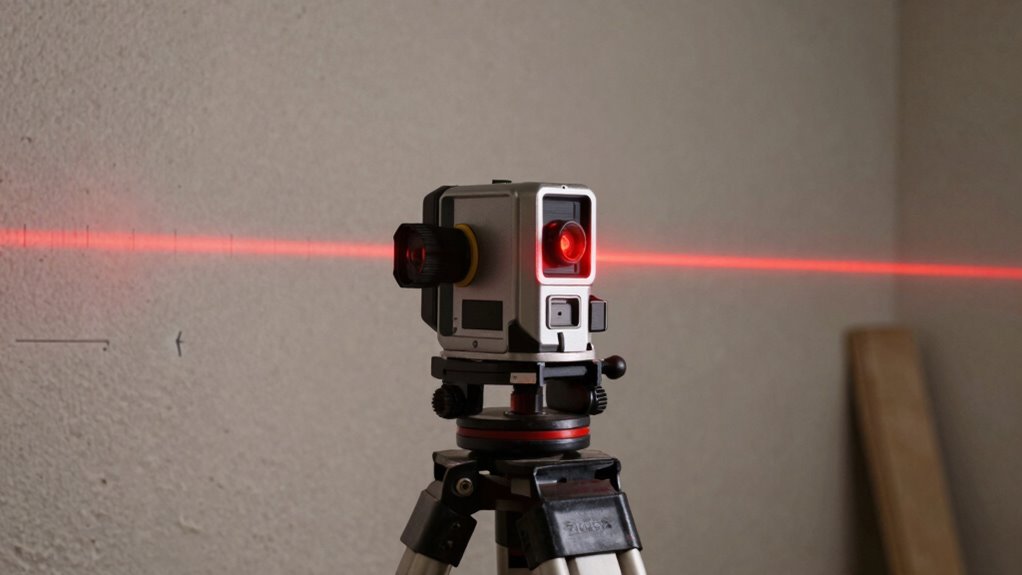

Laser level accuracy is measured in millimeters per meter, showing how straight and true your lines will be. If it says ±1 mm/m, it means the line might deviate by no more than 1 millimeter over a meter. The lower the number, the more precise your alignment will be, which is important for tasks like hanging cabinets or tiles. Want to know how these details impact your projects? Keep going to discover more.
Key Takeaways
- Alignment accuracy shows how precisely the laser lines stay straight, measured in millimeters per meter (mm/m).
- A lower deviation number (e.g., ±1 mm/m) means more precise and reliable laser lines for detailed tasks.
- Higher accuracy ensures your measurements are true, reducing mistakes and rework during projects.
- Accuracy specs help you choose a laser level that matches your project’s need for precision.
- Understanding these specs makes it easier to pick the right laser level without confusing technical terms.
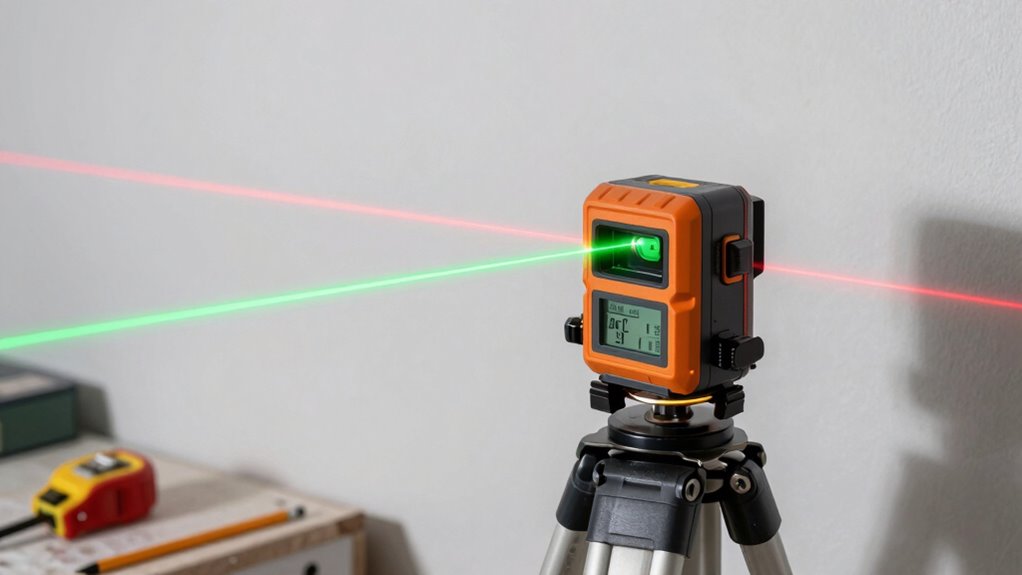
Have you ever struggled to keep lines straight during home projects or construction tasks? If so, you’re not alone. Achieving perfect alignment can be tricky without the right tools, but laser levels are designed to make that job much easier. When choosing a laser level, understanding the specs related to alignment accuracy and battery life can considerably impact your experience and the results you achieve.
Alignment accuracy refers to how precisely the laser level can project a straight line or point. It’s usually measured in millimeters per meter (mm/m). For example, a laser level with an accuracy of ±1 mm/m will produce a line that deviates by no more than 1 millimeter over a meter. This might sound technical, but it’s essential because it determines how reliable your measurements are. If you’re hanging cabinets, installing tiles, or aligning shelves, high alignment accuracy ensures your lines are true and your work looks professional. Lower accuracy levels might be acceptable for rough tasks, but for detailed or precision work, you’ll want a laser level with a minimal deviation—ideally around ±1 mm/m or better.
Battery life is another key factor that often gets overlooked but can make or break your project. Most laser levels run on batteries, whether rechargeable or disposable, and knowing how long they last is important. A laser level with short battery life can leave you stranded mid-project, forcing you to pause and recharge or swap batteries. Look for models that offer extended battery life—some can last for 8 hours or more on a single charge, which is especially important for larger projects or when working outdoors where power sources are limited. Additionally, check if the device has a battery indicator; it helps you monitor remaining power and avoid surprises. For convenience, many modern laser levels feature rechargeable batteries, saving you money and hassle in the long run.
Frequently Asked Questions
How Long Do Laser Levels Typically Last on a Single Battery Charge?
A laser level typically lasts between 4 to 12 hours on a single battery charge, depending on the model and usage. You can extend its battery life through effective power management, like turning off the laser when not in use or using energy-efficient settings. Keep an eye on the battery indicator, and carry spare batteries if you’ll need prolonged use, ensuring your project stays on track without interruptions.
Are Laser Levels Safe for the Eyes During Regular Use?
Sure, laser levels are generally safe for your eyes during regular use, but don’t get cocky. Their laser emissions are low-powered, meaning they won’t instantly turn you into a sci-fi villain. Still, eye safety matters—avoid staring directly into the laser beam, especially at close range. Think of it like sunglasses: a little protection keeps your eyes happy, even if the laser’s not deadly.
Can Laser Levels Be Used Outdoors in Bright Sunlight?
Yes, you can use laser levels outdoors in bright sunlight, but sunlight interference can make the laser beam hard to see. To improve outdoor visibility, opt for laser levels with a higher laser class or brighter, green beams, which are more visible in sunlight. Additionally, using a laser detector or receiver helps you accurately follow the laser line, ensuring precision despite challenging outdoor lighting conditions.
What Is the Typical Accuracy Range for Professional-Grade Laser Levels?
Most professional-grade laser levels have a precision range of about ±1/8 inch at 30 feet, making them highly reliable for precise work. Their tolerance levels typically stay within this range, ensuring accuracy across various projects. An interesting fact is that some advanced models can even achieve a precision of ±1/16 inch, giving you the confidence needed for detailed tasks. So, you can trust these tools for accurate measurements every time.
Do Laser Levels Require Calibration Before Each Use?
Laser levels generally don’t need calibration before each use if they maintain factory accuracy standards. However, some models with self calibration features may need periodic checks to guarantee precision. You should follow the manufacturer’s instructions for calibration and maintenance, especially if the device is bumped or dropped. Regularly verifying the laser’s alignment helps you maintain accuracy and ensures your measurements stay reliable throughout your project.
Conclusion
Now that you understand laser level accuracy specs, you’ll make smarter choices for your projects. Did you know that some laser levels can be accurate within just 1/8 inch over 100 feet? That’s precision you can trust, saving you time and frustration. With this knowledge, you’re ready to pick the right tool for your needs, ensuring your work stays level and on point every time. Happy leveling!