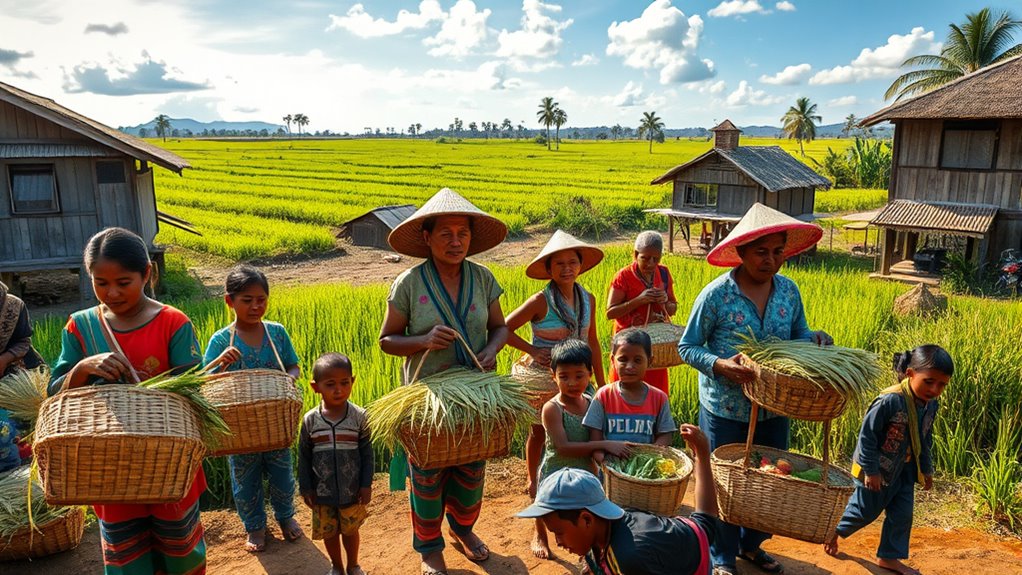

Gotong royong is the Indonesian value of working together and helping each other to build a strong, united community. It’s about neighbors sharing efforts to clean, repair, or organize local events, fostering a sense of belonging and mutual responsibility. This spirit runs deep in Indonesia’s culture, encouraging social bonds and resilience through collective actions. Understanding this often reveals how community life thrives on cooperation and shared effort—uncover more about this enduring cultural tradition below.
Key Takeaways
- “Gotong Royong” is a cultural practice emphasizing mutual assistance and collective effort within Indonesian communities.
- It fosters social cohesion, belonging, and shared responsibility, deeply embedded in Indonesia’s social identity.
- Historically, it has played a vital role in nation-building and community development efforts.
- The concept promotes trust, solidarity, and resilience through activities like neighborhood clean-ups and traditional ceremonies.
- As a core value, it encourages voluntary cooperation to strengthen social bonds across generations.

When you think about “gotong royong,” picture communities coming together to clean shared spaces, build public facilities, or maintain communal infrastructure. It’s not just about getting things done; it’s about fostering a sense of belonging and mutual responsibility. In Indonesia, this ethos is deeply woven into social life and is considered a fundamental part of the national identity. It promotes neighborliness and a “kampung” spirit, even amid urbanization, encouraging people to see their neighbors as part of a larger family. Whether it’s helping to repair a neighbor’s house or organizing community events, you’re participating in a tradition that values collective effort over individualism.
Historically, “gotong royong” has played a significant role in nation-building and governance. Leaders like Sukarno highlighted it in political rhetoric, and during the New Order era, community programs like Siskamling aimed to strengthen neighborhood security through civic cooperation. Even Jakarta’s government, under Ali Sadikin, sought to revive this spirit to recreate village-like social bonds in urban settings. The concept has also been used in various political contexts, including Megawati’s Gotong Royong Cabinet, to symbolize unity and shared responsibility. Recognizing the importance of community involvement can help foster stronger social bonds and collective resilience. Furthermore, the government has promoted social cohesion initiatives that emphasize the value of mutual assistance and collaboration.
Practically, “gotong royong” benefits society by boosting social cohesion and reducing individual burdens. When you participate in communal activities, you help create a sense of shared purpose and strengthen resilience. It encourages active participation and helps communities pool resources, making them better equipped to face challenges together. Whether it’s a neighborhood clean-up or a traditional ceremony like the *slametan*, you’re contributing to a collective effort that nurtures trust and solidarity. Additionally, understanding the cultural significance of collective effort enhances appreciation for how collective efforts can improve social well-being. Recognizing the importance of collaborative action can lead to more effective community development initiatives. As communities embrace this tradition, they often find that it enhances social bonds and fosters a sense of pride and ownership. The phrase has many English translations, such as “mutual assistance,” “joint labor,” or “working together for the common good,” but these only partially capture its cultural depth. It embodies reciprocity, harmony, and voluntary cooperation, transcending literal words to become a crucial part of social fabric. Across regions, “gotong royong” remains a powerful symbol of community resilience and shared humanity—an enduring reminder that together, you can overcome challenges more effectively than alone.
Frequently Asked Questions
How Has “Gotong Royong” Evolved Over Indonesia’s History?
You might wonder how “gotong royong” has changed across Indonesia’s history. It started in ancient Javanese culture, emphasizing community cooperation. Over time, governments promoted it for nation-building, sometimes controlling it for political goals. Today, it adapts to modern challenges like disasters, maintaining cultural relevance. Despite risks of misuse, it still embodies unity, resilience, and shared responsibility, shaping Indonesia’s collective identity through centuries of social evolution.
Are There Modern Equivalents of “Gotong Royong” in Other Countries?
Did you know that many countries have modern equivalents of “gotong royong”? For example, in the Philippines, bayanihan still thrives, with 70% of communities participating in collective efforts. In Finland, talkoot fosters teamwork for community projects, and in Western countries, cooperative living and mutual aid societies promote shared responsibilities. These practices strengthen social bonds, encourage volunteerism, and cultivate a sense of belonging, just like “gotong royong.”
What Challenges Threaten the Practice of “Gotong Royong” Today?
You see that the practice of “gotong royong” faces many threats today. Funding shortages, shifting priorities, and inconsistent government support make it hard to sustain. Modernization and urbanization reduce community participation, while reliance on voluntary efforts challenges long-term commitment. External issues like economic inequality and climate change further strain traditional communal activities. To keep “gotong royong” alive, communities need adaptable strategies, better support, and integration with modern development efforts.
How Can Younger Generations Be Encouraged to Participate in “Gotong Royong”?
Imagine yourself as the next chapter in a long story of community strength. To encourage your generation’s participation in Gotong Royong, get involved through school programs, social media campaigns, and community events. Take leadership roles and collaborate across ages. When you see the impact of mutual aid, you’ll realize how your actions strengthen the fabric of your community, inspiring others to join and carry on this essential tradition.
What Role Does “Gotong Royong” Play in Disaster Response and Recovery?
You see, gotong royong plays a crucial role in disaster response and recovery by promoting community-led efforts. You can mobilize local resources, work with organizations like the Red Cross, and participate in training to strengthen resilience. Your involvement helps rebuild communities faster, guarantees everyone’s needs are met, and fosters a sense of solidarity. By embracing gotong royong, you contribute to a more resilient, united community capable of overcoming challenges together.
Conclusion
You’ve seen how gotong royong embodies Indonesia’s spirit of togetherness, where communities come together to help each other. Did you know that over 70% of Indonesians participate in communal activities regularly? This shows how deeply rooted this value is in everyday life. By embracing gotong royong, you’re part of a tradition that strengthens bonds and builds resilient communities. Keep fostering this spirit—you’re helping preserve a essential part of Indonesian culture.