
TL;DR

Get everyday essentials delivered free with Prime
- Fast, free delivery on millions of items
- Prime Video, Amazon Music and more included
- Member-only deals all year
IdeaClyst is a local-first platform that acts as a war room for your ideas, combining AI-driven critique, discovery, and structured planning. It helps founders make better decisions faster, without sacrificing control or privacy.
Ever sit with three tabs open, each holding a different idea, and feel that knot tighten in your stomach? That’s the real challenge: deciding which idea to pour your time and money into. Most founders rely on gut feeling, a few conversations, and hope. But what if you had a digital war room—an environment that forces your ideas to face sharp, structured scrutiny?
That’s what IdeaClyst offers. It’s not just a tool; it’s a strategic arena where your ideas are tested, challenged, and refined—all on your own machine. No cloud, no data leaks, just pure control. If you’re tired of flying blind, this platform could change how you decide what’s worth building.
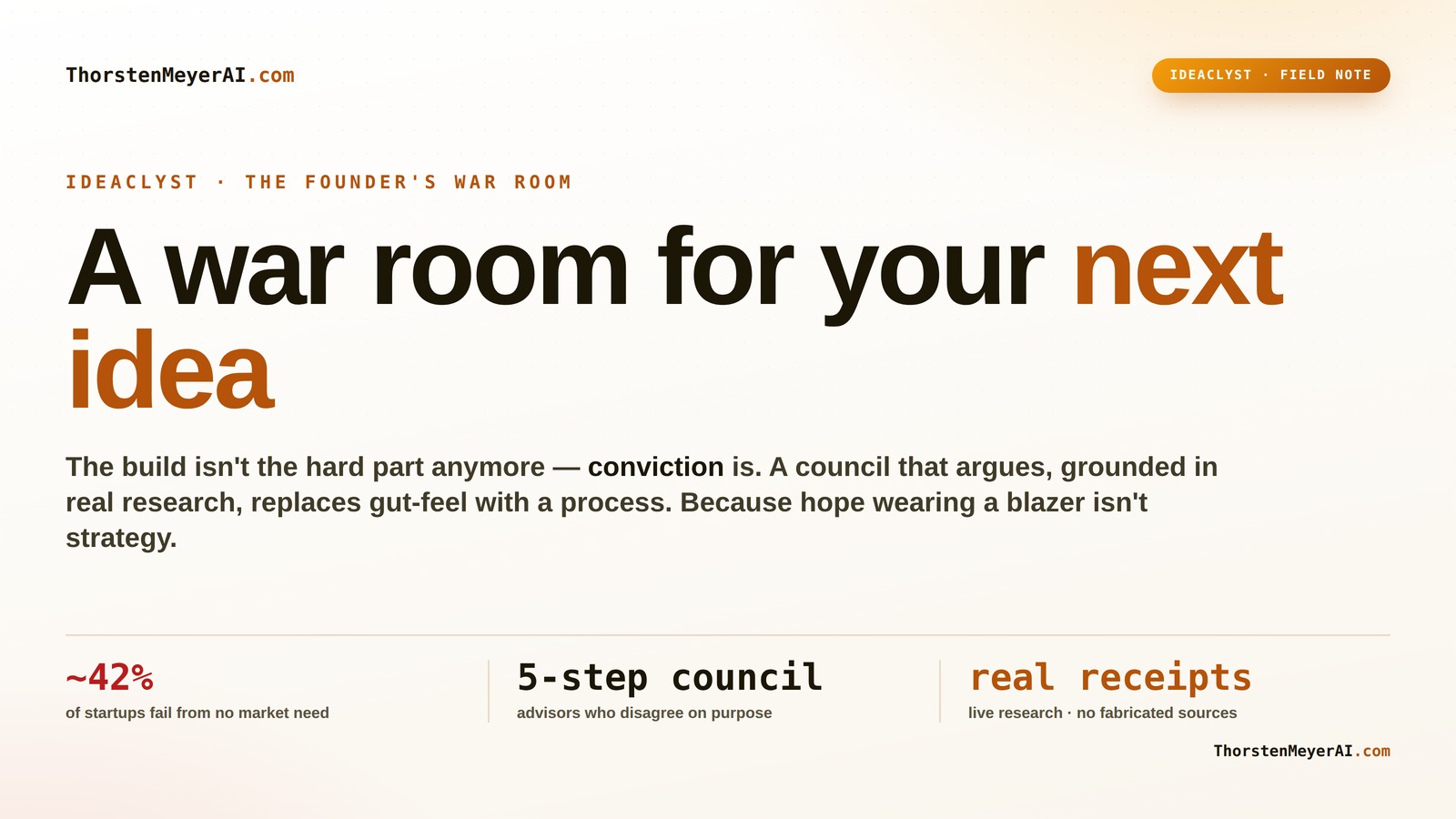
A war room for your next idea
The build isn’t the hard part anymore — conviction is. Knowing which idea deserves the next six months, and being able to defend it. Most founders answer with gut feel and optimistic math. That’s hope wearing a blazer. IdeaClyst replaces it with a process.
The most expensive decision is what to build
The single most valuable thing a tool can do is talk you out of the wrong six months. The numbers make the case better than any pitch.
Three tools in one — on your own machine
Strip away the framing and IdeaClyst is three things at once, all running locally with nothing leaving your laptop.
An AI council
Pressure-tests an idea you bring it — advisors who argue on purpose.
A discovery engine
Finds ideas you didn’t know to look for by hunting real demand signals.
A founder’s workspace
Carries winners from “interesting” all the way to “ready to build.”
Advisors who disagree on purpose
Not one confident, agreeable answer — a structured five-step deliberation where models play different roles and turn on their own work. The disagreement is the feature.
The five-step deliberation
A council that leads with the bad news surfaces the objections you’d otherwise find the expensive way, on month five.
Product strategy
Who’s it for, what’s the wedge, why now, what’s the business model.
Technical architecture
What would it actually take to build — and where’s the risk.
Critique pass
The council turns on its own work. Where’s the hand-waving? What kills this?
Second, independent critique
A different voice, a different angle — so blind spots don’t survive.
Final synthesis
Everything into one coherent founder packet: strategy, architecture, validation, plan.
When IdeaClyst cites a source, it actually fetched it
The hard departure from “ask an AI what it thinks of my startup.” It runs in a strict, real-data-only mode — if it can’t gather genuine evidence, it says so plainly rather than inventing a plausible paragraph.
Confidence with receipts
No fabricated statistics, no imaginary competitors, no made-up citations. The packet survives a skeptical co-founder or a sharp investor because the reasoning has receipts.
Market research first
Scouts the landscape before the council reasons about anything.
Competitor read
Real positioning, pricing signals, feature claims — differentiation vs. reality.
Validation with links
Not “talk to customers” — concrete signals & sources you can click.
From the blank page to build-ready
Evaluation is half the problem; the blank page is the other half. And a plan is worthless if it dies in a tab you never reopen.
Bring a space, not an idea
“AI for accountants,” “tools for indie game studios” — plus your goal and real capacity. It hunts demand signals across HN, Reddit, Product Hunt, GitHub, pricing pages.
- An honest market read — leads with the bad news when a space is hard
- An opportunity map — high pain, thin competition
- Ranked candidates — wedge, who pays, effort, risk, confidence
- each with KILL CRITERIA — when to walk away
A home and a forward path
Every promising idea gets carried forward, with every artifact in plain files on your disk.
- Validation tooling — sprint board, interview list, evidence browser
- Founder profile — a personal-fit lens; same discovery, different advice
- Build workspaces — funnel, personas, landing draft, version history
- “Build this idea” → a PRD + task queue, ready for a coding agent
Key Takeaways
- IdeaClyst’s structured AI council debates surface hidden risks and objections, saving you from costly mistakes.
- The platform’s local-first design keeps your raw ideas private, giving you full control over sensitive information.
- Grounding the council in real-time web research ensures your decisions are based on current, factual data.
- Transform fuzzy concepts into detailed, actionable plans—ready for engineering, funding, or pitching.
- Using IdeaClyst reduces the risk of startup failure by providing disciplined, evidence-backed decision-making.
As an affiliate, we earn on qualifying purchases.
Why a War Room Makes Smarter Decisions Than Your Gut
In startup land, decisions built on instinct are a gamble. The real danger? Building something nobody needs. According to CB Insights, 42% of startup failures trace back to “no market need.” That’s a gut-wrenching waste of six to twelve months and thousands of dollars.
Imagine you’re pitching a new SaaS tool. You think it’ll revolutionize team collaboration. But what if a quick, AI-fueled research session reveals competitors with similar features, a niche market too small, or regulatory hurdles? That’s the kind of clarity a digital war room provides—fast and grounded in real data.
IdeaClyst’s approach is to turn chaos into clarity, helping you avoid the classic trap of convincing yourself your idea is gold without evidence.
What Is IdeaClyst? The 3 Pillars of a Digital War Room
IdeaClyst is a local-first platform that combines three core features: an AI council that pressure-tests your ideas, a discovery engine that surfaces overlooked opportunities, and a founder’s workspace that moves ideas from “interesting” to “ready to build.”
Picture it: You draft a product idea. The platform hosts a council of AI advisors—each with a different role—who dissect your concept from multiple angles. They challenge assumptions, highlight risks, and suggest improvements. All of this runs entirely on your laptop, with no cloud data leaving your machine.
It’s like having a team of expert advisors sitting in your pocket, ready to argue, critique, and refine your plan anytime you need.
How the AI Council Debates Your Idea — & Why That Matters
Most AI tools tell you what they think, then stop. IdeaClyst takes a different route: it stages a structured debate. Think of five steps: strategy, architecture, critique, second critique, and final synthesis.
For example, you might start with a product strategy critique—who’s the customer? Why now? Then move to technical risks—what’s the challenge in building this? The council’s disagreements highlight blind spots or flawed assumptions you might miss alone.
The result? A detailed, Markdown-formatted report that covers every angle—ready for your pitch deck or team discussion. This process turns fuzzy ideas into clear, defendable plans.
Grounding Advice in Real Data — Not Just Model Vibes
AI models tend to agree with you because they’re trained to generate confident-sounding answers. But that confidence often isn’t backed by evidence. IdeaClyst stands out because it connects your idea with live web research, making suggestions based on real, current data.
For instance, if you’re exploring a new market, IdeaClyst pulls recent articles, trends, and competitor info—giving you a fact-based picture. This approach prevents the common trap of “confirmation bias,” where you only see what supports your idea.
By anchoring the council in live research, you gain insights you can trust—faster and more reliably than traditional methods.
Why Local-First Security Matters to Founders
Every founder worries about privacy. Sharing ideas on cloud platforms feels risky. IdeaClyst keeps everything on your local machine, encrypting no data—nothing leaves your disk.
Imagine brainstorming your next big idea at midnight, knowing it’s safe from leaks or hacks. Your raw ideas, strategic plans, and critiques stay private, under your control. This local-first approach isn’t just a feature; it’s a foundation of trust and control, especially when your ideas are still raw and fragile.
It’s like having a secret vault right on your laptop—secure, accessible, and completely yours.
From “Interesting” to “Ready to Build”: Turning Ideas Into Action
Getting from a vague idea to a clear plan is a marathon. IdeaClyst’s workspace guides you step-by-step. You start with a rough sketch, then run your idea through the council, gather critiques, and finally—assemble a plan.
Imagine you’re developing a new API tool. The platform helps you categorize features, identify technical risks, and validate market assumptions—all stored as Markdown files on your disk. It’s a living document, ready to be handed off to engineering or investors.
This isn’t just about ideation; it’s about execution. The platform turns fuzzy concepts into concrete blueprints, saving months of back-and-forth and guesswork.
Practical Tips for Making the Most of IdeaClyst
- Start with a clear, concise idea—avoid vague ambitions.
- Use the council to challenge your assumptions—don’t skip this step.
- Leverage the live research feature to ground your strategies in real data.
- Keep all your files locally—this isn’t just about privacy, it’s about control.
- Regularly revisit and update your reports as new insights emerge.
Frequently Asked Questions
How does IdeaClyst compare to traditional brainstorming tools?
Unlike basic mind-mapping or note-taking apps, IdeaClyst provides a structured debate environment, real-time critique, and grounded research—all stored locally. It turns raw ideas into validated plans, not just scattered thoughts.Can I integrate IdeaClyst with tools like Slack or Jira?
IdeaClyst is designed as a standalone platform focused on local-first control. While it doesn’t natively integrate with cloud tools, you can export Markdown files and manually share updates or use automation scripts to connect parts of your workflow.Is it suitable for small teams or solo founders?
Absolutely. Its local-first approach makes it perfect for solo founders who want full control. Small teams benefit too, as it provides a central, private space for collaborative critique and planning without cloud dependencies.What’s the learning curve for new users?
The platform is designed to be intuitive, with guided workflows. Expect a few hours of familiarization, especially with Markdown and the council process, but most users find it straightforward once they get started.How much does IdeaClyst cost?
Since it’s open source and runs locally, there’s no subscription fee. Costs mainly involve your time and effort to set up and customize your workspace—making it a cost-effective choice for serious founders.Conclusion
In a world where your next big idea can make or break your startup, having a dedicated war room changes everything. IdeaClyst turns chaos into clarity, making sure your decisions are based on real data, honest critique, and full control. It’s a game-changer for founders tired of flying blind.
Remember, the best ideas don’t win because they’re the loudest—they win when they’re the clearest, most validated, and fully prepared. That’s what IdeaClyst offers: a private, disciplined battlefield for your boldest ideas. Ready to turn your chaos into a strategic advantage?
Halloween Picks
halloween
As an affiliate, we earn on qualifying purchases.