TL;DR
A manifesto published November 16 by European game union representatives urges workers to avoid generative AI where possible, employers not to use it, players to support games made without it and regulators to require consent and fair compensation for training data. The document reflects the unions’ position; no public studio or trade-body response to it was identified in the source material.
The manifesto, titled “On Generative AI Usage in the Games Industry,” says generative AI is harming workers and the games they make. The IWGB Game Workers page identifies contributors from its own branch and members of Game Workers Unite Ireland, CSVI in Spain and the FIOM-CGIL Milan Work Council. Rock Paper Shotgun and Kotaku also report that France’s STJV and Germany’s GDRT are among the groups behind the document, bringing the reported total to six unions.

Get everyday essentials delivered free with Prime
- Fast, free delivery on millions of items
- Prime Video, Amazon Music and more included
- Member-only deals all year
Its recommendations cover four audiences. Workers are urged to avoid genAI services where possible, negotiate company agreements and organize. Employers are told to avoid the technology entirely, never require workers to use it and label any use that cannot be avoided. Players are asked to support games made without genAI. Regulators, meanwhile, are urged to bar the use of people’s work in training datasets without consent and fair compensation, and to let workers withdraw their work.
The document covers AI use in visible game content such as art, sound, code and dialogue, as well as behind-the-scenes work including concept art, reference material and pre-translation. The unions argue that genAI can worsen working conditions, weaken employer-worker relations, use third-party work without permission, reproduce bias and carry hidden costs for studios. Those are the manifesto’s arguments; the document does not establish that each effect applies to every game company or AI system.
How the Demands Could Affect Game Work
The manifesto asks studios to make decisions about AI use subject to worker choice and collective agreements. Its proposed restrictions reach beyond assets that appear in a finished game: a studio using genAI for prototypes or internal references would still be using the technology covered by the unions’ position.
That approach could shape negotiations over job duties, disclosure and the use of creative work as training data. It also gives players a proposed way to exert pressure by favoring games made without genAI. The extent of any practical effect will depend on whether studios, workers, regulators and consumers act on the recommendations.
Popular right now

Dyson Airwrap i.d. Multi-Styler with Bluetooth Connectivity

Vitamix VX1 Professional-Grade Blender, 64 oz, Black

De'Longhi Stilosa Compact Manual Espresso Machine with Manual Milk Frother
As an affiliate, we earn on qualifying purchases.
A Debate Already Under Way
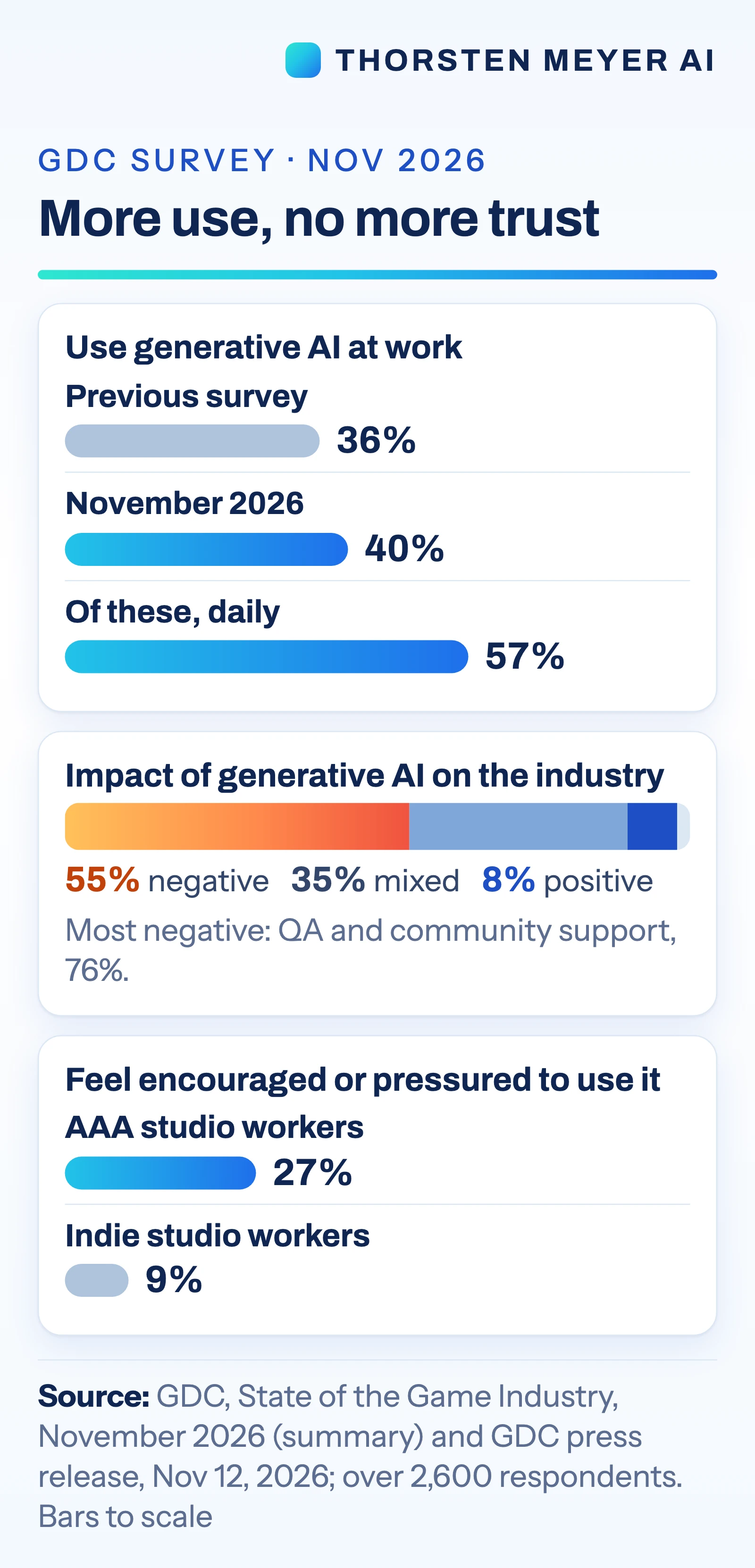
The manifesto appeared amid broader disagreement about genAI’s role in game development. The source material cites the GDC State of the Game Industry survey, published November 12, which found that 40% of respondents used genAI at work, up from 36% in the prior survey, while 55% said the technology was having a negative effect on the industry. The same survey reported that 34% had been laid off in the previous two years; it did not establish that AI caused those layoffs.
Other developments that week included a statement by a group of Independent Games Festival jurors that they would not vote for games using genAI “in any capacity,” and a disclosure from the studio behind Big Walk that large language models touched “well under 0.1%” of its code. Separately, Video Games Europe, the industry’s European trade body, argued in 2024 that genAI was widely expected to advance game development and opposed AI labels in games. These positions illustrate the dispute; they do not amount to responses to this manifesto.
““Games are best made by people.””
— The manifesto’s authors
Studios’ Response and Impact Remain Unknown
The source material reports no public response from a studio or trade body to the manifesto by the time it was written. It also does not say how many workers the unions represent, whether any employer will change its policies, or whether the recommendations will lead to company agreements or regulation.
The unions link genAI to job losses, fewer junior roles and other workplace harms. The cited survey reports layoffs but does not attribute them to AI, so the relationship between genAI adoption and job cuts remains unestablished here. The legality of using third-party work in training datasets also remains contested, according to the source material.
Whether Employers Take Up the Demands
The next developments to watch are any responses from game studios, trade groups or regulators, and whether workers secure agreements that limit or disclose genAI use. The manifesto does not announce a deadline, formal negotiation process or specific regulatory action, so no next milestone is confirmed.
Further reporting may clarify which unions formally endorse the text, how many workers they represent and whether any company adopts its recommendations. Until then, the document is a statement of the unions’ demands rather than evidence of a change in industry practice.
Key Questions
What are the game unions asking employers to do?
The manifesto urges employers to avoid genAI entirely, never require workers to use it and precisely label any use that cannot be avoided.
Does the manifesto cover AI used only during development?
Yes. It covers visible content and behind-the-scenes uses such as concept art, reference materials and pre-translations.
Which groups are named as contributors?
The IWGB Game Workers page names members of IWGB Game Workers, Game Workers Unite Ireland, CSVI in Spain and the FIOM-CGIL Milan Work Council. Rock Paper Shotgun and Kotaku also list France’s STJV and Germany’s GDRT.
Has a studio agreed to follow the manifesto?
The source material identifies no studio commitment and says no public response from a studio or trade body had been found at the time of writing.
Source: Thorsten Meyer AI