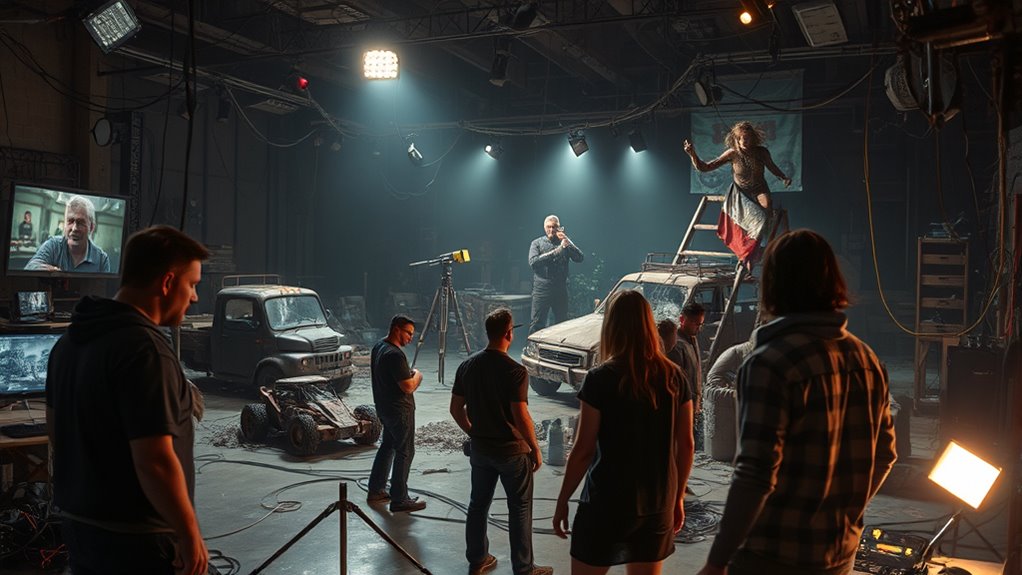

To create *The Last of Us* series, the team carefully balanced staying true to the game’s story with creative enhancements. They collaborated closely, expanding certain plot points and character backgrounds to deepen emotional impact. Techniques like realistic set design, innovative visual effects, and skilled performances brought the post-apocalyptic world to life. If you’re curious about how they turned gameplay into compelling TV, you’ll find fascinating behind-the-scenes details ahead.
Key Takeaways
- The adaptation was developed through close collaboration between Neil Druckmann and Craig Mazin, balancing source fidelity with storytelling innovation.
- Visual storytelling combined game-inspired environments with realistic design, utilizing practical effects, digital effects, and innovative lighting.
- The series expanded character backgrounds and emotional depth, with performances by Pedro Pascal and Bella Ramsey emphasizing nuanced portrayals.
- Originally planned as a film, the project transitioned to a TV series after rights reverted, leading to a joint production by PlayStation, Sony, and HBO.
- Creative decisions aimed to enhance emotional impact and realism, respecting the original game’s essence while adding narrative depth.
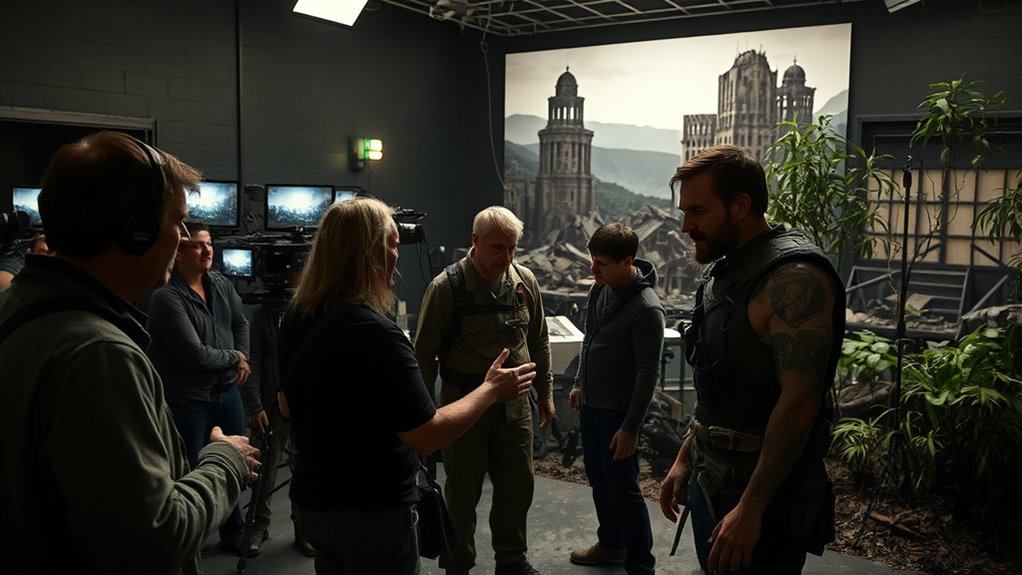
Behind the Scenes of The Last of Us reveals how the acclaimed adaptation came to life through a collaborative effort between innovative creators and meticulous planning. Neil Druckmann, Naughty Dog’s Studio Head and co-creator of the original game, teams up with Craig Mazin, the showrunner, to bring a fresh yet faithful interpretation of the story. Their combined expertise guarantees that Season 1 adapts the entire first game, providing a complete story arc without major changes, while Season 2 explores significant but partial story content, requiring creative expansion. This collaboration focuses on character-driven storytelling and balancing fidelity to the source material with the flexibility needed to craft a compelling TV narrative. Executive producers like Asad Qizilbash and others from PlayStation Productions and HBO oversee the project, guaranteeing it meets high standards of quality and vision.
Behind the scenes of The Last of Us highlights a collaborative effort ensuring a faithful yet fresh adaptation.
As you watch, you’ll notice that the showrunners carefully respect the original game’s essence but are open to modifications that enhance storytelling. They only implement changes if they improve or enrich the narrative. An example is the expanded exposition on the Cordyceps outbreak, which adds scientific plausibility and emotional depth. The show’s creators also considered the post-COVID audience’s familiarity with pandemics, shaping how the outbreak’s origins are depicted. These adjustments aim to keep the story realistic and forge a stronger emotional connection between you and the characters. Every choice reflects a desire to deepen audience engagement while maintaining the story’s integrity. Incorporating visual storytelling techniques from the game, such as environmental design and shot composition, helps achieve this immersive effect.
The adaptation’s development history underscores its careful evolution. Initially announced as a film adaptation in 2014, the project stalled, and the rights reverted by 2019. Recognizing that a film couldn’t do justice to the complex narrative, the creators transitioned it into a television format. HBO greenlit the series in November 2020, initially planning for ten episodes but ultimately producing nine. The joint production involves PlayStation Productions, Sony Pictures Television, and Naughty Dog, with an expanded executive team that includes Carolyn Strauss, Evan Wells, and Greg Spence, who bring diverse expertise to the project.
Visual storytelling plays an essential role, led by production designer John Paino. He extends the game’s environments into naturalistic, immersive settings, crafting interiors and quarantine zones that feel authentic and lived-in. The design team works closely with the creators to ensure these visuals align with the narrative tone. Cinematography echoes the game’s visual motifs but incorporates new filming techniques, balancing tension and emotion. Practical and digital effects bring infected creatures and decay to life realistically, heightening immersion. Lighting and shot composition are carefully crafted to support the story’s mood and pacing, making every scene visceral and compelling. Furthermore, the production team employs innovative techniques to enhance realism, such as detailed prosthetics and advanced digital effects, ensuring every element contributes to the immersive experience. This meticulous attention to detail helps bridge the gap between video game and television storytelling, creating a seamless narrative experience.
Casting plays a key role in translating the game’s characters into real actors. Pedro Pascal as Joel and Bella Ramsey as Ellie were selected for their ability to embody the characters’ depth and complexity. The performances aim to capture the essence of the game while adding nuances that deepen your emotional connection. The character development extends beyond the original, including backstories and subtle traits that enrich the narrative, making the adaptation not just a retelling but a reimagining that respects its roots and elevates the story for television.

Ring Battery Doorbell, Home or business security with Head-to-Toe video, Live View with Two-Way Talk, and Motion Detection & Alerts, Venetian Bronze
See more at your home or business — Get 66% more vertical coverage with the latest version of...
As an affiliate, we earn on qualifying purchases.
Frequently Asked Questions
How Were the Original Game’S Voice Actors Involved in the Adaptation?
You might wonder how the original voice actors contributed to the adaptation. You’ll see Troy Baker, who played Joel, in a minor role as James, adding depth without overshadowing new leads. Ashley Johnson, the original Ellie, makes a voice cameo, honoring the game’s roots. Others like Merle Dandridge and Misty Lee return for key roles and sound effects, blending nostalgia with fresh storytelling to create an authentic experience.
What Challenges Did the Creators Face in Adapting Gameplay to Storytelling?
You might think adapting gameplay into TV storytelling is straightforward, but it’s not. The challenge lies in transforming player-driven tension and exploration into compelling, visual narratives. You have to find creative ways to evoke emotional engagement without interactivity, using cinematic techniques, detailed worldbuilding, and character development. Balancing fidelity with fresh storytelling demands careful pacing, restructured arcs, and visual storytelling to keep audiences immersed and emotionally connected.
Were Any Scenes Changed Significantly From the Original Game?
You’ll notice that several scenes changed markedly from the game. For example, Tess’s death shifts from FEDRA soldiers to infected, creating a more visceral threat. The series introduces new characters like Kathleen and expands on existing ones like Isaac, adding political layers. Emotional scenes, such as Ellie’s immunity reveal, are reimagined for dramatic impact. These changes deepen the story, making it more cinematic and character-driven compared to the game’s more gameplay-focused narrative.
How Much of the Story Was Developed Through Improvisation?
So, you think every story is perfectly scripted, huh? In ‘The Last of Us,’ improvisation actually played a key role. Actors added spontaneous dialogue and natural interactions, especially in emotional scenes, making characters more authentic. The creators embraced this unpredictability to deepen relationships and enhance realism. While the core plot stayed intact, these unscripted moments gave the story a genuine, human touch, proving that even in fiction, spontaneity fuels heart.
What Future Projects Are Planned Based on ‘The Last of Us’ Universe?
You’re curious about future projects in the ‘The Last of Us’ universe. The creators plan to expand the series over four seasons, covering the full story from the games. They might also develop spin-offs focusing on characters like Abby or explore other parts of the post-apocalyptic world. Although no official spin-offs are announced yet, the franchise’s popularity and storytelling depth strongly suggest more adaptations could come, including movies or mini-series.

TEEHO TE001 Keyless Entry Door Lock with Keypad - Smart Deadbolt Lock for Front Door with 2 Keys - Auto Lock - Easy Installation - Satin Nickel
Passcode Entry: This keypad lock offers 20 access codes for family use and a temporary code for single-use...
As an affiliate, we earn on qualifying purchases.
Conclusion
As you step back from the behind-the-scenes secrets, one thing becomes clear: there’s more to this story than meets the eye. The team’s dedication and innovation have only scratched the surface of what’s possible. But with each breakthrough, new questions arise—what’s next for The Last of Us? The journey isn’t over yet. Stay tuned, because the most intriguing chapters are still waiting to be revealed, just beyond the horizon.

TEEHO TE001 Keyless Entry Door Lock with Keypad - Smart Deadbolt Lock for Front Door with 2 Keys - Auto Lock - Easy Installation - Matte Black
Passcode Entry: This keypad lock offers 20 access codes for family use and a temporary code for single-use...
As an affiliate, we earn on qualifying purchases.

EUHOMY 60 Inch Electric Fireplace Wall Recessed and Wall Mounted with Adjustable Flame Color, Fireplace Heater with Remote Control, Linear Fireplace with Timer, Touch Screen, Log & Crystal, 750/1500W
Package Inclusions & 2-Year Technical Support: : The EUHOMY electric fireplace is equipped with 1* carbon log, 1*...
As an affiliate, we earn on qualifying purchases.