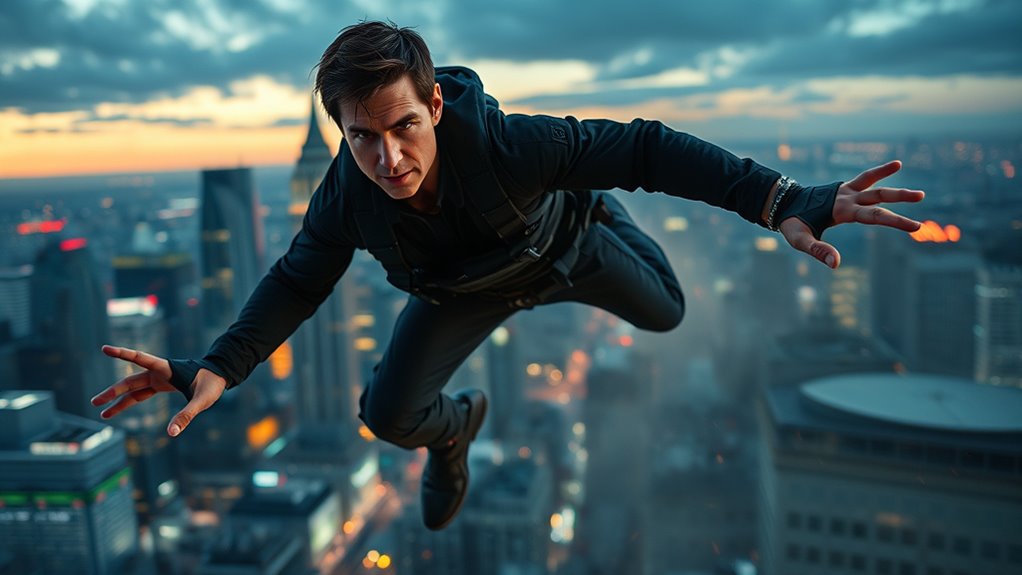

The secrets behind Cruise’s latest moto stunts reveal intense planning, real danger, and incredible skill. He performs many sequences himself, pushing limits on rugged terrains and high-speed chases, often using practical effects and wires for realism. Aerial feats involve precise coordination, with some jaw-dropping, dangerous maneuvers kept under wraps until the right moment. Underwater scenes demand silence and endurance, making it clear that every stunt is meticulously crafted. Continue exploring to uncover more of these adrenaline-pumping behind-the-scenes details.
Key Takeaways
- Cruise performs many stunts himself, including high-speed vehicle and rugged terrain chases, for authentic action.
- Complex underwater scenes involve silent communication, breath-hold techniques, and strict safety protocols.
- Aerial stunts feature meticulous planning, mastery, and a secret jaw-dropping final sequence kept under wraps.
- Safety measures include expert coordination, specialized training, and controlled use of pyrotechnics and wirework.
- Realism is achieved through practical effects, rigorous preparation, and seamless integration of dangerous sequences.
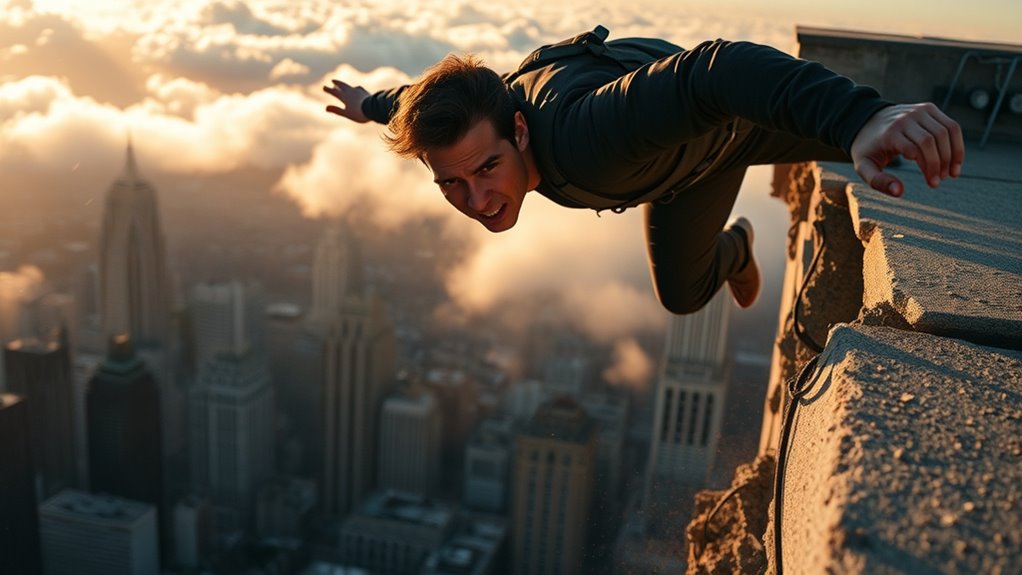
Cruise is known for pushing the limits, especially with extreme aerial stunts. He has performed some of the most dangerous feats in Hollywood, like clinging to planes during takeoff or executing complex biplane maneuvers. These aerial sequences require meticulous planning, mastery, and intense physical and mental endurance. The latest film features a secret, jaw-dropping final aerial stunt that’s been kept under wraps for maximum impact. These airborne scenes aren’t just spectacles—they’re a testament to Cruise’s commitment to realism. They elevate the franchise beyond standard action movies, immersing you in high-stakes, edge-of-your-seat moments that seem almost impossible to achieve.
Cruise’s daring aerial stunts push boundaries, delivering jaw-dropping, realistic action scenes that elevate the franchise to new heights.
Underwater scenes add another layer of complexity. They demand extensive safety protocols, specialized hand signals, and physical conditioning. During underwater takes, actors communicate silently through hand signals, and they often hold their breath for long periods, performing under pressure. The locations are complex and dangerous, adding realism but also difficulty to each shot. You can appreciate the skill and courage needed to perform these scenes, knowing that every underwater stunt involves significant risk and meticulous planning. Submerged environments require precise coordination to ensure safety and realism, which adds to the challenge of filming such sequences. Moreover, training in breath control and safety procedures is essential for these demanding sequences.
High-impact explosions and physical injuries are part of Cruise’s reality. He’s sustained broken ribs and other injuries while performing explosive stunts, which combine pyrotechnics and wirework to control movement and impact. Safety measures are strict, but the danger remains real. Cruise’s dedication to authenticity drives him to undertake these risky sequences, even if it means enduring pain. His willingness to push through injuries underscores his commitment to delivering visceral, believable action that keeps you engaged and immersed.
Finally, vehicle stunts and terrain challenges demand expert coordination. Cruise drives many of these vehicles himself, adding authenticity to high-speed chases on rugged terrain. The vehicles are pushed to their limits, and the locations are carefully chosen to maximize realism. Wires and practical effects are also used to simulate impacts and force, blending seamlessly with real-world effects. All these elements come together through rigorous physical and mental preparation, ensuring the stunts aren’t just impressive—they’re convincing enough to make you feel like you’re right there in the action.
Frequently Asked Questions
How Does Tom Cruise Prepare Physically for These Stunts?
You prepare physically for stunts by focusing on building strength, stability, and endurance. You do core exercises to stay balanced during mid-air maneuvers and resistance workouts to strengthen your arms, shoulders, and legs. Cardiovascular training helps you recover quickly and endure long sessions. Flexibility and agility routines ensure you can make precise movements. You also train extensively in specialized skills, like skydiving and motocross, to master the technical aspects of each stunt.
Are Any Stunts Performed Without Safety Harnesses or CGI?
You might think all stunts are just CGI illusions, but Tom Cruise defies that! He performs jaw-dropping feats entirely without CGI or safety harnesses—like gripping aircraft or scaling skyscrapers—using real physical skill and daring. These stunts are executed with meticulous planning, safety gear, and expert crew, making every breath-taking moment genuine. Cruise’s commitment to authenticity pushes the boundaries of reality, proving that true courage and skill create the most spectacular action scenes.
What Is the Most Dangerous Stunt Tom Cruise Has Ever Attempted?
You’re asking about Tom Cruise’s most dangerous stunt. It’s the motorcycle cliff jump in Norway, where he rides off a 7,000-foot-high ramp, freefalls, and deploys a parachute. Multiple takes were necessary, and the margin for error was tiny—failure meant death. This stunt is considered the most perilous in the series, showcasing Cruise’s daring spirit and dedication to authentic, live-action filmmaking.
How Long Does It Take to Plan and Rehearse Each Stunt?
You might wonder how long it takes to plan and rehearse each stunt. It’s a lengthy process, often taking years of preparation. You’ll train intensively, practicing thousands of jumps and refining techniques. Multiple rehearsals, safety checks, and incremental testing happen over days or months. Every detail is meticulously coordinated with experts, ensuring safety and precision. This thorough approach minimizes risks and guarantees that each stunt can be performed confidently and flawlessly.
Are Stunt Doubles Ever Used for Specific Sequences?
Yes, stunt doubles are used for specific sequences, but sparingly. You’ll see them mainly in dangerous or complex scenes where safety is paramount, like cliff-hanging or high-altitude stunts. They handle those risky tasks so you can enjoy the action without risking the actor’s safety. For minor tasks or sequences that don’t impact realism, stunt doubles might step in briefly, ensuring smooth filming while keeping risks minimized.
Conclusion
As you step back from the edge of these daring stunts, you can almost hear the rush of wind and see Ethan Hunt’s calculated grace against the skyline’s glittering chaos. The secrets behind these feats reveal not just skill, but a masterful dance with danger—each move a brushstroke on a canvas of adrenaline. You’re left with a vivid sense of wonder, watching the impossible become real, driven by precision, courage, and the relentless pursuit of the extraordinary.