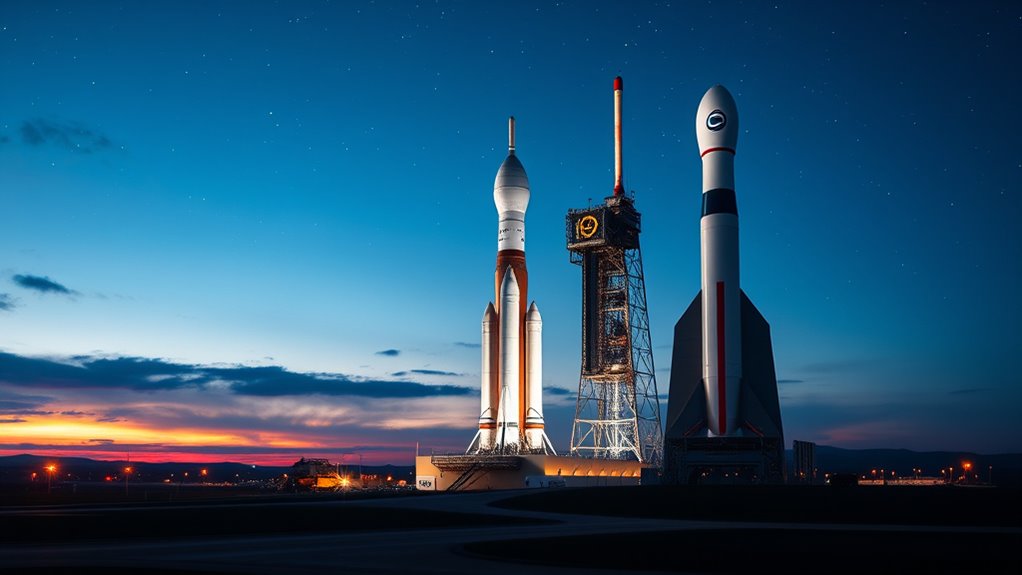

In 2025, the billionaire space race is hotter than ever. Musk’s SpaceX is expanding orbital missions and planning future Mars settlements, while Bezos’s Blue Origin continues launching crewed flights with reusable rockets. Virgin Galactic, led by Branson, increases suborbital tourism flights for wealthy clients. Competition drives down costs and boosts flight frequency, transforming space travel into a booming industry. If you want to uncover more about their latest missions and future plans, keep exploring these trending developments.
Key Takeaways
- SpaceX continues rapid expansion with frequent orbital missions and plans for Mars colonization, maintaining industry leadership in 2025.
- Blue Origin has completed 11 crewed missions, including Jeff Bezos crossing the Kármán line, emphasizing reusable rocket technology.
- Virgin Galactic operates VSS Unity flights for space tourists, increasing flight numbers despite technical challenges.
- Market competition drives down costs and boosts flight frequency among Blue Origin, SpaceX, and Virgin Galactic.
- Industry faces sustainability debates, but billionaire-led ventures dominate the ongoing space race in 2025.

As of 2025, the billionaire space race continues to accelerate, with companies like Blue Origin, SpaceX, and Virgin Galactic pushing the boundaries of space tourism and exploration. You’ve probably heard about Jeff Bezos’s Blue Origin, which was founded in 2000 with the goal of enabling millions to live and work in space. By mid-2025, Blue Origin completed 11 crewed missions, flying 58 civilians into space. Notably, Bezos himself flew aboard New Shepard in July 2021, becoming the first billionaire to cross the Kármán line. Their focus remains on cost-efficient, reusable rockets designed to reduce heavy industry on Earth, making space travel more accessible over time. Blue Origin has launched its third crewed mission in three months, marking its rapid activity levels and commitment to frequent spaceflights. This increased flight activity reflects the evolving space tourism market, which is rapidly expanding as technology improves and costs decrease.
Meanwhile, SpaceX continues to lead in orbital launches and Mars colonization efforts, but it’s also making strides in space tourism. Their Crew Dragon spacecraft now regularly conducts private astronaut missions to the International Space Station, including all-civilian orbital flights. Revenue from both government contracts and private sector deals fuels their rapid expansion. Elon Musk’s long-term vision for Mars remains central, aiming to establish a self-sustaining human settlement. The company’s technological advancements have lowered costs and increased mission frequency, positioning SpaceX as a dominant force in the industry.
SpaceX advances in space tourism with private astronaut missions and aims for Mars colonization, lowering costs and expanding mission frequency.
Virgin Galactic, founded in 2004 by Richard Branson, focuses on suborbital space tourism. Their spaceplane, VSS Unity, has been operational for commercial flights since 2021. Over 65 individuals have flown above the Kármán line, with roughly two-thirds paying between $250,000 and $450,000 per ticket. Virgin Galactic faces ongoing technical and regulatory hurdles but leads in the number of commercial spaceflights. Their approach emphasizes passenger experience and safety, aiming to position space tourism as a luxury experience. Despite challenges, Virgin Galactic remains a key player, steadily increasing flight numbers and customer interest.
The market dynamics in 2025 show suborbital flights priced between $250,000 and $450,000, while orbital missions are considerably more expensive, targeting wealthy clients. Competition among the billionaires’ companies is fierce, with each endeavoring to lower costs, increase flight frequency, and improve safety. As more flights become reliable, space tourism revenue grows, driven by technological breakthroughs and passenger demand. Critics, however, question the environmental impact of frequent rocket launches and the ethics of billionaire-funded tourism amid global needs. Public discourse intensifies over sustainability, regulation, and whether the industry serves broader societal benefits or remains an exclusive luxury.
Industry consolidation continues, with some former rivals like Stratolaunch suspending orbital ambitions after Paul Allen’s death. Virgin Orbit and others face ongoing financial and technical challenges, but Blue Origin, SpaceX, and Virgin Galactic dominate the scene. Partnerships and collaborations are increasing as the industry matures. Expect to see more frequent crewed missions—both suborbital and orbital—throughout 2025, with the billionaire space race firmly establishing itself as a key chapter in human space exploration.

DeskShow Electric Standing Desk Adjustable - 60x28 Inch Sit Stand Desk with 1 Inch Thick Tabletop, Double Beam Frame, 3 Memory Height Adjustment, Cable Management for Home Office
Rock-solid Stability : DeskShow standing desk is engineered with a heavy-duty 2.5mm steel base and a reinforced double-beam...
As an affiliate, we earn on qualifying purchases.
Frequently Asked Questions
What Are the Long-Term Environmental Impacts of Space Tourism?
Your question about the long-term environmental impacts of space tourism highlights concerns like increased emissions, black carbon, and ozone depletion. As you participate or support space tourism, you should consider how more launches can disrupt atmospheric circulation and raise temperatures. Reusable rockets help reduce waste, but the growing number of flights could threaten orbital pollution and Earth’s climate over time. Staying informed helps you understand and address these environmental challenges.
How Do Billionaire Space Projects Benefit Scientific Research?
You see, billionaire space projects boost scientific research by providing new platforms for experiments. For example, SpaceX’s Crew Dragon allows scientists to conduct zero-gravity studies more frequently and cost-effectively. These projects often partner with universities, enhancing collaboration. Such efforts lead to advancements in understanding our universe, improving satellite technologies, and developing innovations that benefit Earth, ultimately fueling scientific progress and inspiring future generations in STEM fields.
What Safety Measures Are in Place for Space Tourists?
You should know that safety measures for space tourists include rigorous health screenings and extensive training to prepare you for microgravity effects. You’ll undergo safety briefings and psychological support to manage stress. Spacecraft are equipped with radiation shielding and advanced cybersecurity systems to protect your data. Regulatory agencies oversee your safety, and companies implement risk-based inspections and safety protocols to minimize hazards, ensuring your journey is as secure as possible.
Are There Plans to Make Space Travel More Affordable?
You’re probably wondering if space travel will ever be affordable, right? Well, big plans are in motion! Companies are slashing prices for suborbital flights below $200,000 by 2025, and balloon rides could cost just $50,000 by 2030. Technological breakthroughs and fierce market competition are driving costs down fast. Soon, space trips might be as common as plane tickets—making the cosmos accessible to many, not just the ultra-rich!
How Will Space Race Advancements Influence Global Geopolitics?
Your question about how space race advancements influence geopolitics is insightful. As private companies push technological boundaries and increase launch capabilities, you’ll see shifts in global power dynamics. Countries and corporations will compete to control space resources and strategic positions, leading to new alliances and rivalries. These advancements could redefine national prestige, foster economic growth, and create security concerns, ultimately shaping international relations and space governance in profound ways.

ErGear Height Adjustable Electric Standing Desk, 48 x 24 Inches Sit Stand up Desk, Memory Computer Home Office Desk, Black
Electric Height Adjustable Standing Desk for Comfortable Work - Switch effortlessly between sitting and standing with this electric...
As an affiliate, we earn on qualifying purchases.
Conclusion
As you watch this space race unfold, it’s like witnessing a thunderstorm of ambition and innovation. Musk, Bezos, and Branson are lighting up the sky with their relentless pursuit of the stars. While the journey’s fierce and unpredictable, it’s also a demonstration of human spirit pushing boundaries. Stay tuned, because this celestial race isn’t just about reaching space—it’s about igniting dreams that could forever change your world.

OffiGo 71 Inch Executive Electric Standing Desk, Height Adjustable Desk with Power Outlet & 1.38" Thick 3-Piece Desktop, Sit Stand Computer Desk for Home, Office, Conference Room, Rustic Brown
【Electric Sit-Stand Height Adjustment】This electric standing desk offers smooth height adjustment from 29.1” to 48”, allowing effortless switching...
As an affiliate, we earn on qualifying purchases.

FLEXISPOT EN2 Whole-Piece Standing Desk with Clamp Power Strip, 55 x 28” Electric Stand Up Height Adjustable Desk with Cable Management (Black Frame + 55" Black Top, 2 Packages)
REMOVABLE DESKTOP POWER OUTLET: To ensure you can conveniently charge your electronic devices, the desktop is equipped with...
As an affiliate, we earn on qualifying purchases.