Choosing among news media microphones comes down to one question: are you chasing interviews on the street or capturing ambient coverage from your camera? For most working reporters, the COMICA Revo S Wireless Handheld is the best overall pick because it plugs straight into an iPhone or USB-C phone, records at 48kHz/24bit, and runs up to 15 hours — enough for a full day of vox pops. If budget matters more than battery, the COMICA HRM-S delivers clean handheld interview audio for a fraction of the price, while the Sennheiser MKE 600 is the standout for camera-mounted news gathering. The main tradeoff in this category is wireless convenience versus audio control: wireless handhelds free you from cables but add pairing and battery management, while wired XLR and shotgun setups sound more predictable but demand more rigging. Keep reading for the full breakdown, including who each mic is for and who should skip it.

Get everyday essentials delivered free with Prime
- Fast, free delivery on millions of items
- Prime Video, Amazon Music and more included
- Member-only deals all year
Complete the kit

Key Takeaways
- Wireless handheld interview mics dominated this comparison because modern news gathering happens on smartphones — the COMICA Revo S led on recording quality (48kHz/24bit) and battery life (15 hours), while the CVM-WS50 variants won on multi-device flexibility.
- Smartphone-native connectivity is the biggest differentiator in 2026: mics that switch between iPhone (Lightning/USB-C), Android, and camera inputs earned higher rankings than single-connection models at the same price.
- Shotgun mics like the Sennheiser MKE 600 and MKE 400 serve a different job than handhelds — they cover press conferences and ambient scenes from a distance, but they cannot replace a handheld mic for one-on-one street interviews.
- The budget tier (Movo VXR10, COMICA HRM-S) is genuinely usable for student journalists and starting freelancers, but all make tradeoffs in build quality and off-axis rejection that become obvious in noisy breaking-news environments.
- XLR-based options like the Jiawu interview mic reward reporters who already own a recorder or mixer with better long-term upgrade paths, but they are the wrong first purchase for phone-only reporters.
- Clip-on systems like the Hollyland Lark M2 fill a gap none of the handhelds cover — anchored, hands-free audio for solo reporters filming their own standups — which is why direct comparisons between handhelds and lavaliers miss the point.
| COMICA Revo S Wireless Handheld Microphone for iPhone, USB-C |  | Best Overall for Mobile Journalists | Wireless Transmission Range: 65 ft | Recording Quality: 48kHz/24-bit | Battery Life: 15 hours | VIEW LATEST PRICE | See Our Full Breakdown |
| RØDE Interview PRO Wireless Handheld Condenser Microphone |  | Best Premium Pick | Type: Wireless handheld condenser microphone | Capsule: Broadcast-grade omnidirectional | Onboard Recording: 40+ hours, 32-bit float | VIEW LATEST PRICE | See Our Full Breakdown |
| COMICA HRM-S Handheld Interview Microphone for Smartphone | 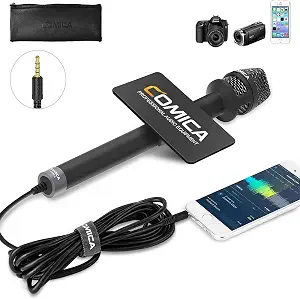 | Best Budget Pick | Polar Pattern: Cardioid | Frequency Response: 60Hz–20kHz | Construction: All-metal | VIEW LATEST PRICE | See Our Full Breakdown |
| Jiawu XLR Interview Microphone for Journalism and Live Sound |  | Best for Traditional Broadcast Setups | Pick-up Pattern: Super cardioid | Connection: XLR | Cable Length: 16.4 ft | VIEW LATEST PRICE | See Our Full Breakdown |
| COMICA CVM-WS50(H) Handheld Wireless Microphone for iPhone & Android |  | Best Long-Range Wireless | Wireless Range: Up to 197 ft | Connectivity: UHF, 3.5mm jack | Channels: 6 | VIEW LATEST PRICE | See Our Full Breakdown |
| COMICA Revo S Wireless Handheld Microphone for iPhone, Android, PC |  | Best Wireless Pick for Mobile Journalists | Connectivity: USB Type-C wireless | Capsule: 14mm condenser, cardioid | Audio Quality: 48kHz/24bit | VIEW LATEST PRICE | See Our Full Breakdown |
| Sennheiser MKE 600 Shotgun Microphone for Video Cameras | 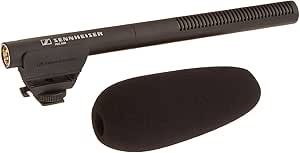 | Best Premium On-Camera Shotgun | Polar Pattern: Super cardioid | Connectivity: Wired | Power: 1 AA battery | VIEW LATEST PRICE | See Our Full Breakdown |
| Sennheiser MKE 400 Directional On-Camera Shotgun Microphone |  | Best Compact On-Camera Pick | Type: Shotgun microphone | Connectivity: 3.5mm TRS and TRRS | Features: Wind protection, internal suspension, low-cut filter, sensitivity switch, headphone output | VIEW LATEST PRICE | See Our Full Breakdown |
| Movo VXR10 Universal Shotgun Microphone for Camera |  | Best Budget Starter Mic | Connectivity: 3.5mm auxiliary | Polar Pattern: Unidirectional | Power: No battery required | VIEW LATEST PRICE | See Our Full Breakdown |
| COMICA CVM-WS50 Wireless Handheld Microphone with 6 Channels for iPhone, Android, and Camera |  | Best for Live Event Reporting | Connectivity: UHF wireless, 3.5mm jack | Channels: 6 selectable UHF channels | Working Distance: Up to 100m (60m typical) | VIEW LATEST PRICE | See Our Full Breakdown |
| Hollyland Lark M2 Wireless Microphone for iPhone, Camera, Android, PC |  | Best for Hands-Free Field Reporting | Weight: 9g | Audio Format: 48kHz/24-bit | Range: 300 meters | VIEW LATEST PRICE | See Our Full Breakdown |
| news media microphone | Polar Pattern | Connectivity |
|---|---|---|
| COMICA Revo S Wireless Handhel | — | — |
| RØDE Interview PRO Wireless Ha | — | — |
| COMICA HRM-S Handheld Intervie | Cardioid | — |
| Jiawu XLR Interview Microphone | — | — |
| COMICA CVM-WS50(H) Handheld Wi | Omnidirectional | UHF, 3.5mm jack |
| COMICA Revo S Wireless Handhel | — | USB Type-C wireless |
| Sennheiser MKE 600 Shotgun Mic | Super cardioid | Wired |
| Sennheiser MKE 400 Directional | Directional (highly directional) | 3.5mm TRS and TRRS |
| Movo VXR10 Universal Shotgun M | Unidirectional | 3.5mm auxiliary |
| COMICA CVM-WS50 Wireless Handh | Omnidirectional | UHF wireless, 3.5mm jack |
| Hollyland Lark M2 Wireless Mic | — | — |
More Details on Our Top Picks
COMICA Revo S Wireless Handheld Microphone for iPhone, USB-C
The COMICA Revo S hits the sweet spot between price, portability, and audio quality for phone-first news gathering. Its 48kHz/24-bit recording puts it ahead of the older COMICA CVM-WS50(H), which relies on analog UHF transmission and a 3.5mm connection that adds noise and loses fidelity. The 15-hour battery means a full day of vox pops and field interviews without charging anxiety, and the full-metal body survives being passed between strangers on a sidewalk. Compared with the Jiawu XLR, it trades a little broadcast polish for total freedom of movement within its 65-foot range. The main tradeoff is that USB-C is the only way in — Lightning iPhone owners need an adapter, and there’s no case included for kit bags.
Pros:- 48kHz/24-bit digital audio noticeably cleaner than analog UHF alternatives
- 15-hour battery covers a full field day
- Stable digital wireless up to 65 feet
- Durable all-metal construction for rough handling
Cons:- USB-C only — Lightning and some devices need adapters
- 65-foot range is shorter than UHF systems like the WS50(H)
- No carrying case included
Best for: Mobile journalists and content creators who record interviews directly to a USB-C phone or laptop and need all-day battery life
Not ideal for: Lightning iPhone users without adapters, or crews working beyond 65 feet from the recorder
- Wireless Transmission Range:65 ft
- Recording Quality:48kHz/24-bit
- Battery Life:15 hours
- Capsule:14mm condenser, cardioid
- Build Material:Full metal
- Compatibility:iPhone, Android smartphones, iPads, laptops, computers
Our verdict“If your newsroom workflow is phone-based and USB-C, this is the most complete wireless handheld for the money.”
RØDE Interview PRO Wireless Handheld Condenser Microphone
This is the professional broadcast option in the lineup, and the gap between it and everything else here is mostly about safety features. 32-bit float onboard recording means clipping is nearly impossible — a career-saver when a one-time interview subject gets loud. GainAssist automatically levels audio, so an untrained intern can run it without wrecking levels. The catch is structural: the Interview PRO only reaches full potential when paired with RØDE Series IV receivers like the Wireless PRO or RØDECaster Pro II, so it’s really the heart of an ecosystem purchase rather than a standalone buy. Compared with the COMICA Revo S, it costs several times more but delivers timecode sync, 40+ hours of recording, and broadcast-grade capsule quality that COMICA can’t match. Beginners will find the setup steep.
Pros:- 32-bit float onboard recording eliminates clipping risk
- GainAssist automatic level control
- 40+ hours of recording capacity
- Timecode sync for multi-device professional workflows
Cons:- Requires RØDE Series IV receivers for full functionality
- Steep learning curve and premium price for beginners
Best for: Broadcast crews and production teams already invested in the RØDE Series IV ecosystem who need fail-safe interview audio
Not ideal for: Solo creators or small newsrooms without RØDE receivers — much of its value is locked behind that hardware
- Type:Wireless handheld condenser microphone
- Capsule:Broadcast-grade omnidirectional
- Onboard Recording:40+ hours, 32-bit float
- Features:GainAssist, timecode synchronization
- Compatibility:RØDE Series IV receivers (Wireless PRO, Wireless GO II, Wireless ME, RØDECaster Pro II/Duo)
Our verdict“If your station runs RØDE gear and interviews are mission-critical, this is the mic that removes the risk of ruined audio.”
COMICA HRM-S Handheld Interview Microphone for Smartphone
At the affordable end, the HRM-S proves that wired still wins on simplicity. There’s no pairing, no batteries, no channel scanning — plug it into a phone and record. The cardioid pattern does useful work here: unlike the omnidirectional COMICA CVM-WS50(H), it rejects crowd and traffic noise behind the mic, which matters when you’re interviewing someone on a busy street. The all-metal body and low self-noise are genuinely good for the price. The honest tradeoff is scope: the cable tethers you to your device, and there’s no camera or mixer compatibility, so it’s strictly a smartphone tool. Compared with the Revo S, you give up wireless freedom and battery-backed range but keep most of the sound quality for a fraction of the cost.
Pros:- Cardioid pattern rejects background noise better than omni alternatives
- Plug-and-play simplicity with no batteries or pairing
- Durable all-metal build with low self-noise
- Very affordable entry point
Cons:- Requires adapter cables for iOS or USB-C Android devices
- Smartphone only — incompatible with cameras and professional audio equipment
Best for: Student journalists and budget reporters who record interviews to a phone and don’t need wireless range
Not ideal for: Camera-based or multi-source productions — smartphone-only connectivity rules out pro audio gear
- Polar Pattern:Cardioid
- Frequency Response:60Hz–20kHz
- Construction:All-metal
- Self-noise:Low
- Compatibility:Smartphones (adapter required for iOS or USB-C Android)
Our verdict“The cheapest dependable way to get cleaner-than-phone interview audio, as long as your recorder is a phone.”
Jiawu XLR Interview Microphone for Journalism and Live Sound
The Jiawu is the lone XLR option in this batch, and that connector defines everything about it. For newsrooms running mixers, field recorders, or live-sound desks, XLR is non-negotiable — none of the COMICA wireless units can plug into that chain. Its super cardioid pattern is tighter than the HRM-S’s cardioid, giving stronger isolation when you can aim the mic precisely at a subject, and the generous 16.4-foot cable plus foam windscreen make outdoor standup interviews practical. The obvious cost is mobility: no wireless, no onboard recording, and it needs phantom power or a recorder to function. Against the RØDE Interview PRO, it lacks the safety net of 32-bit float capture, but it also costs a fraction as much and integrates with gear you already own.
Pros:- Super cardioid pattern offers strong subject isolation in noisy environments
- Long 16.4 ft cable allows flexible interviewer-to-recorder positioning
- Durable aluminum alloy body suited to field work
- Included foam windscreen tames wind noise and plosives
Cons:- Wired only — no wireless option
- Requires XLR-equipped recorder, mixer, or interface to operate
Best for: Traditional news crews and live-sound operators who need to feed mixers, field recorders, or broadcast desks via XLR
Not ideal for: Solo phone-based creators — no USB or wireless connectivity means it can’t connect to a smartphone at all
- Pick-up Pattern:Super cardioid
- Connection:XLR
- Cable Length:16.4 ft
- Material:Aluminum alloy
- Included Accessories:Foam windscreen
Our verdict“The right pick when your workflow runs through a mixer or field recorder rather than a phone.”
COMICA CVM-WS50(H) Handheld Wireless Microphone for iPhone & Android
Where the Revo S stops at 65 feet, the WS50(H) keeps going to 197 feet, making it the choice for roaming interviews, walk-and-talks, and event coverage where the recorder can’t follow. The real-time audio monitoring through the receiver is a feature none of the cheaper COMICA options offer — you hear problems as they happen instead of discovering them in post. Six switchable UHF channels help dodge interference in crowded RF environments. The downsides are real: it’s noticeably bulkier and heavier than the Revo S, the 3.5mm analog connection adds noise versus digital, and the omnidirectional pattern picks up more ambient sound than a cardioid mic would. Battery management is also on you, since it runs on a replaceable lithium-polymer pack.
Pros:- 197-foot wireless range triples the Revo S’s reach
- Real-time audio monitoring catches problems during recording
- LCD screen shows channel, power, and audio status at a glance
- Six switchable UHF channels help avoid interference
Cons:- Bulky and heavy compared with newer digital handhelds
- Analog 3.5mm connection is noisier than digital alternatives
- Battery-powered with replacement overhead
Best for: Event reporters and vloggers who need maximum wireless range and live audio monitoring during recordings
Not ideal for: Run-and-gun solo creators who prioritize compact kit and clean digital audio over raw range
- Wireless Range:Up to 197 ft
- Connectivity:UHF, 3.5mm jack
- Channels:6
- Frequency Range:520.00–526.00 MHz
- Polar Pattern:Omnidirectional
- Signal-to-Noise Ratio:80 dB
- Special Features:LCD screen, real-time audio monitor, stepless volume adjustment
Our verdict“Buy this for range and monitoring on multi-person shoots; skip it if portability and digital clarity matter more than distance.”
COMICA Revo S Wireless Handheld Microphone for iPhone, Android, PC
This option stands out for reporters who need a truly cable-free workflow straight to a phone or laptop. The 48kHz/24bit digital audio over USB-C gives it a cleanliness advantage over the analog Movo VXR10, and the 15-hour battery life easily outlasts the COMICA CVM-WS50’s 8-hour rating. Compared with the CVM-WS50, the Revo S trades multi-channel UHF flexibility for a simpler plug-and-record design, which suits solo journalists more than crews covering crowded press events. The one-key Calmix denoise is genuinely useful for street interviews where traffic noise creeps in. The tradeoffs are real, though: iPhone owners with Lightning ports need an adapter, and the C-battery power source means you’re buying replacements rather than recharging overnight.
Pros:- 48kHz/24bit digital audio over USB-C beats analog alternatives
- 15-hour battery life outlasts most wireless competitors
- One-key denoise cleans up noisy street interviews
- Works across phones, tablets, and computers
Cons:- Requires a USB-C to Lightning adapter for older iPhones
- Runs on a replaceable C battery instead of rechargeable cells
- Single-channel design offers no interference fallback in crowded RF environments
Best for: Solo mobile journalists and content creators who interview people directly into a smartphone or laptop and want long all-day battery
Not ideal for: Lightning-port iPhone users who don’t want to carry adapters, or anyone who prefers rechargeable gear over disposable batteries
- Connectivity:USB Type-C wireless
- Capsule:14mm condenser, cardioid
- Audio Quality:48kHz/24bit
- Battery Life:Up to 15 hours (1 C battery)
- Special Features:3-level gain, one-key Calmix denoise
- Compatible Devices:Smartphone, tablet, laptop
- Form Factor:Handheld
Our verdict“This is the pick for reporters who want clean digital audio straight into a phone without cables — as long as you stock up on C batteries.”
Sennheiser MKE 600 Shotgun Microphone for Video Cameras
Where the Revo S is built for handheld interviews, the MKE 600 answers a different question: how do you capture a subject from a distance while the camera stays back? Its super-cardioid directivity is the standout here — noticeably tighter than the Movo VXR10’s unidirectional pattern, which means less ambient bleed in busy news environments. The switchable low-cut filter and included foam windshield plus shock mount mean it arrives field-ready, unlike cheaper kits that sell mounts separately. Compared with its smaller sibling, the Sennheiser MKE 400, the MKE 600 justifies its premium price with a full metal aluminum body and stronger reach, but it’s heavier at 15.2 ounces and strictly wired — no phone-friendly output. The AA battery dependency is a minor annoyance on multi-day assignments.
Pros:- Super-cardioid pattern isolates subjects at distance better than budget shotguns
- Includes shock mount and foam windshield out of the box
- Switchable low-cut filter tames wind and handling rumble
- Durable full aluminum construction
Cons:- Wired-only design limits placement flexibility
- Requires AA battery replacements on long assignments
- Heavier and larger than compact alternatives like the MKE 400
Best for: Video journalists and documentary shooters who need broadcast-grade reach from a camera-mounted shotgun
Not ideal for: Mobile-first reporters recording into a smartphone — there’s no direct phone connectivity
- Polar Pattern:Super cardioid
- Connectivity:Wired
- Power:1 AA battery
- Signal-to-Noise Ratio:75 dB
- Included Accessories:Foam windshield, shock mount
- Enclosure:Aluminum
- Weight:15.2 ounces
Our verdict“The MKE 600 makes the most sense for camera-based news crews who prioritize directional reach and build quality over portability.”
Sennheiser MKE 400 Directional On-Camera Shotgun Microphone
Compared with the MKE 600, the MKE 400 is the travel-friendly compromise: still highly directional, but smaller and lighter on a mirrorless rig. Its real differentiator in this lineup is interchangeable connectivity — 3.5mm TRS for cameras and TRRS for mobile devices, meaning one mic covers both a DSLR kit and a phone backup, something the MKE 600 simply can’t do. The integrated wind protection and internal suspension mean fewer accessories to juggle than the Movo VXR10, and the built-in headphone output for monitoring is rare at this size. The tradeoffs are reach and scale: it won’t isolate a distant subject as cleanly as the MKE 600, and it’s still bulkier than a bare phone setup, so run-and-gun solo reporters may find it awkward.
Pros:- Dual TRS/TRRS connectivity covers cameras and phones
- Integrated wind protection and suspension cut accessory clutter
- Built-in headphone output for real-time monitoring
- Compact size suits mirrorless and mobile rigs
Cons:- Less reach and isolation than the larger MKE 600
- Requires battery power that isn’t clearly specified in packaging
- Bulky for handheld phone-only workflows
Best for: Videographers who switch between mirrorless cameras and smartphones and want one mic for both
Not ideal for: Shooters needing maximum long-distance reach — the MKE 600 outperforms it for far subjects
- Type:Shotgun microphone
- Connectivity:3.5mm TRS and TRRS
- Features:Wind protection, internal suspension, low-cut filter, sensitivity switch, headphone output
- Polar Pattern:Directional (highly directional)
- Compatibility:DSLR, mirrorless cameras, mobile devices
- Form Factor:On-camera shotgun
Our verdict“The MKE 400 is the smart middle ground for journalists working across both camera and phone setups without carrying two mics.”
Movo VXR10 Universal Shotgun Microphone for Camera
At a fraction of the Sennheiser prices, the VXR10 is the entry point that gets the job done for student journalists and new creators. Its no-battery-required design is a genuine advantage over both the MKE 600 (AA-powered) and the COMICA Revo S (C battery) — plug it in and it works, with nothing to forget or recharge. The bundle is generous for the price: windscreen, carrying case, and multiple cables, whereas Sennheiser charges a premium for comparable accessories. Realistically, the 76 dB signal-to-noise ratio and 100 Hz low-frequency cutoff mean audio is serviceable rather than broadcast-clean, and it lacks the monitoring output the MKE 400 offers. It’s also the least forgiving on placement — you need to point it at your subject deliberately.
Pros:- No batteries required — plug and record
- Universal 3.5mm compatibility with cameras, phones, and tablets
- Complete kit includes windscreen, case, and cables
- Lightweight 51g aluminum body travels easily
Cons:- Lower audio fidelity than the Sennheiser options
- Requires adapters for many modern smartphones
- Audio quality depends heavily on mic positioning
Best for: Student journalists and first-time creators who need a cheap, reliable mic that works with gear they already own
Not ideal for: Working professionals delivering to broadcast standards — the noise floor and limited frequency range will show
- Connectivity:3.5mm auxiliary
- Polar Pattern:Unidirectional
- Power:No battery required
- Signal-to-Noise Ratio:76 dB
- Frequency Range:100–20,000 Hz
- Weight:51 g
- Included:Windscreen, carrying case, multiple cables
Our verdict“The VXR10 is the low-risk first mic for anyone proving they need better audio before investing in Sennheiser-grade gear.”
COMICA CVM-WS50 Wireless Handheld Microphone with 6 Channels for iPhone, Android, and Camera
Unlike the Revo S’s single-channel simplicity, the WS50 is built for chaotic RF environments — press scrums, conventions, anywhere multiple wireless devices fight for spectrum. The 6 selectable UHF channels let you hop frequencies when interference hits, and the real-time audio monitoring is something neither the Movo VXR10 nor the MKE 400’s basic setup matches for interview confidence. With an 8-hour rechargeable battery and up to 60 meters of working range, it handles roving crowd work better than any wired option here. The catches: its omnidirectional pattern picks up more ambient noise than the Revo S’s cardioid capsule, its 65 dB signal-to-noise ratio trails the MKE 600, and the TRRS-to-Lightning/USB-C cables you’ll need for modern phones aren’t in the box.
Pros:- 6 selectable UHF channels avoid interference at busy events
- Real-time audio monitoring catches problems during the interview
- 8-hour rechargeable battery with 60m working range
- Works with cameras, phones, tablets, and laptops
Cons:- Required Lightning/USB-C adapter cables not included
- Omnidirectional pattern gathers unwanted ambient noise
- Narrow 520–526 MHz band can get congested in RF-dense cities
Best for: Field reporters covering crowded live events who need channel flexibility and real-time monitoring
Not ideal for: Quiet controlled interviews — the omnidirectional pattern captures more room noise than cardioid alternatives
- Connectivity:UHF wireless, 3.5mm jack
- Channels:6 selectable UHF channels
- Working Distance:Up to 100m (60m typical)
- Battery:Rechargeable lithium polymer, up to 8 hours
- Polar Pattern:Omnidirectional
- Frequency Range:520.0–526.0 MHz
- Special Features:Real-time monitoring, stepless volume adjustment, metal phone holder
- Signal-to-Noise Ratio:65 dB
Our verdict“The WS50 is the choice for reporters working loud, crowded live events where channel-switching flexibility beats studio-grade fidelity.”
Hollyland Lark M2 Wireless Microphone for iPhone, Camera, Android, PC
Every other mic in this roundup is a handheld, and that’s exactly why the Hollyland Lark M2 earns its slot: it’s the only option that frees a reporter’s hands entirely. At 9 grams per transmitter, it clips to a collar and disappears on camera, where something like the COMICA HRM-S has to be passed back and forth between interviewer and subject. The 48kHz/24-bit audio and onboard noise cancellation hold up well for street reporting and run-and-gun news work. Compared with the RØDE Interview PRO, the Lark M2 trades the natural control of a handheld for a 300-meter range and 40 hours of total battery via the charging case — useful when a subject needs to move while you film. The tradeoff is real, though: stereo mode needs a 3.5mm connection on some devices, and a lav mic can’t be quickly pointed at whoever is speaking.
Pros:- Ultra-light 9g clip-on transmitter that stays invisible on camera
- High-fidelity 48kHz/24-bit recording with effective noise cancellation
- 40 hours of total battery life with the charging case
- Stable 300-meter wireless range across iPhone, Android, camera, and PC
Cons:- Stereo mode requires a 3.5mm connection on some devices
- Certain features only work with specific device pairings
- Real-world battery life falls short of 40 hours under heavy use
Best for: Solo journalists and field reporters who film their own interviews and need both hands free for a camera or phone
Not ideal for: Traditional two-person interview setups — a handheld like the RØDE Interview PRO gives faster control over who’s on mic
- Weight:9g
- Audio Format:48kHz/24-bit
- Range:300 meters
- Battery Life:40 hours (with charging case)
- Signal-to-Noise Ratio:70dB
- Maximum Sound Pressure Level:115dB
- Noise Cancellation:Yes
- Transmission Technology:UAC
- Supported Devices:iPhone, Camera, Android, PC
Our verdict“Buy this if you report solo and need broadcast-grade hands-free audio; stick with a handheld mic if your interviews involve passing the mic between people.”
How We Picked
News media microphones live or die by realistic field conditions, so I evaluated every option against how reporters actually work: chasing interviews in noisy environments, running long shoots on battery power, and moving between phone and camera rigs sometimes within the same assignment. The criteria that separated winners from the rest were device compatibility (does it connect to iPhone, Android, and cameras without adapters?), recording quality under wind and crowd noise (rejection of off-axis sound and handling noise), battery endurance relative to a full news day, and build survivability — a mic that gets dropped on pavement within its first month is a bad investment no matter how it sounds in a quiet room.
The ranking logic follows a simple hierarchy: wireless handheld interview mics rank highest because they match how most working journalists gather quotes, then come shotgun mics for camera-side coverage, then budget wired options for those entering the field. Price alone never determined rank — the Revo S outranked cheaper wireless handhelds because its 24bit recording and battery life materially change what you can do on assignment, while a more expensive XLR mic ranked lower for most readers because it locks you into a recorder ecosystem. Every pick below has a defined role and a stated weakness, because a recommendation without tradeoffs is just advertising.
| news media microphone | Polar Pattern |
|---|---|
| COMICA Revo S Wireless Handhel | — |
| RØDE Interview PRO Wireless Ha | — |
| COMICA HRM-S Handheld Intervie | Cardioid |
| Jiawu XLR Interview Microphone | — |
| COMICA CVM-WS50(H) Handheld Wi | Omnidirectional |
| COMICA Revo S Wireless Handhel | — |
| Sennheiser MKE 600 Shotgun Mic | Super cardioid |
| Sennheiser MKE 400 Directional | Directional (highly directional) |
| Movo VXR10 Universal Shotgun M | Unidirectional |
| COMICA CVM-WS50 Wireless Handh | Omnidirectional |
| Hollyland Lark M2 Wireless Mic | — |
Factors to Consider When Choosing News Media Microphones
Before settling on a specific model, it helps to understand the structural decisions that shape every news media microphone purchase. These are the factors that determine whether a mic fits your workflow two years from now, not just your next assignment.Handheld, Shotgun, or Clip-On: Match the Mic to the Story
The single biggest mistake new reporters make is buying the wrong microphone format for their beat. Handheld interview mics exist because they let you control who speaks — you physically point the mic at the person whose quote you need, and its directional pattern rejects the crowd behind them. Shotgun mics solve the opposite problem: they capture a subject you cannot physically approach, like a spokesperson at a press conference or action across a police line. Clip-on systems like the Hollyland Lark M2 are the third category, built for the reporter who is on camera themselves and needs anchored, hands-free audio while filming solo. Buying one format when your work demands another is the most common and most expensive error in this category, and no amount of spec superiority fixes it. Many working journalists eventually own one mic from two of the three categories rather than one expensive mic from a single one.
Smartphone Connectivity Is Non-Negotiable in 2026
Modern news breaks on phones, and a mic that only works with one connector type will strand you the day your outlet upgrades handsets or you switch from iPhone to Android mid-career. Look for systems that support USB-C, Lightning, and 3.5mm camera inputs either natively or through included adapters — the COMICA CVM-WS50 lineup is a good example of a mic family designed around this flexibility. Beyond the connector, check whether the receiver requires an app; app-dependent mics can break after phone OS updates, while plug-and-play designs keep working. Wired smartphone mics that draw power from the phone also drain your battery during long shoots, which matters when your phone is also your recorder, your notes device, and your uplink. Finally, if you shoot for broadcast outlets that demand XLR audio, accept early that you will eventually need a recorder or interface, and buy a mic that survives that transition rather than a phone-only design.
Wireless Freedom Versus Reliability Tradeoffs
Wireless handhelds free you from cables, but they introduce pairing, latency, and battery management problems that wired mics never have. A 2.4GHz system that works flawlessly in a quiet park can stutter near transmission trucks, security radios, and dense urban RF — exactly where news happens. Channel count matters here: the COMICA CVM-WS50’s six channels exist so two reporters or a backup frequency can coexist, which is a real advantage at crowded events. Battery life claims also deserve skepticism — a 15-hour rating like the Revo S’s typically assumes moderate use, while continuous transmission with the receiver powered drains faster. The honest rule: wireless is worth its headaches for run-and-gun street work and interviews with moving subjects, but a wired mic into a recorder remains the more dependable choice for sit-down interviews and controlled environments. Budget for spare batteries either way.
Off-Axis Rejection and Handling Noise
The spec sheets rarely emphasize it, but how a mic handles sound you don’t want determines whether your audio is broadcast-usable. Handheld interview mics with tight polar patterns let you point at your subject while traffic, protests, or crowd noise behind them fades; cheaper omnidirectional designs capture everything equally and turn a simple street interview into an unusable mess. Handling noise is the other hidden killer — reporters grip, pass, and gesture with handheld mics constantly, and a mic with poor internal isolation turns every hand movement into a rumble. Wind protection deserves equal attention: budget mics often ship with foam windscreens that fail above a light breeze, while a proper furry cover costs little and saves entire outdoor assignments. If most of your work happens outdoors, weigh rejection and wind handling above raw frequency-response numbers, which look impressive on paper but tell you nothing about noise behavior.
Budget Strategy: Where to Spend and Where to Save
The price spread in this category runs from under $40 to well over $500, and the smart move is spending where your workflow feels the pain. For a student journalist or new freelancer, a budget wired mic like the COMICA HRM-S or Movo VXR10 is genuinely the right call — you will learn mic technique, discover your actual needs, and upgrade with real information instead of guessing. The mid-range wireless tier ($150–$300) is where most working reporters should land, because that is where reliable connectivity, decent batteries, and acceptable rejection converge. Spending premium money makes sense when audio is your product — if you file for broadcast outlets or produce documentary work, a Sennheiser-class mic pays for itself in usable takes. What rarely makes sense is buying premium hardware before you have assignments that demand it. The most expensive mistake is not buying cheap; it is buying expensive gear for a workflow you have not developed yet.
Build Quality and Field Survivability
News gear gets dropped, rained on, packed daily, and loaned to colleagues, so construction quality matters more here than in studio categories. Metal-bodied handhelds survive the inevitable pavement drop that ends plastic mics; check whether the grille bends in or protects the capsule. Connector strain is the quiet killer — the cable attachment point on wired mics and the charging port on wireless ones are the two components most likely to fail first, so look for recessed or reinforced ports. Water resistance matters more than most buyers expect, because assignments do not move indoors when weather turns. Battery accessibility counts too: a mic with replaceable AA or AAA cells can be revived in the field, while a sealed rechargeable unit becomes a brick until you find an outlet. Buy for the worst day on the job, not the best one, and factor in that repair support and spare-parts availability differ dramatically between established brands and budget importers.
Frequently Asked Questions
Should I get a wireless handheld mic or a shotgun mic for news reporting?
These solve different problems, and most reporters eventually need one of each. A wireless handheld like the COMICA Revo S is built for one-on-one interviews — you extend it to your subject, and its directional pattern plus close proximity give you clean, quotable audio even in loud environments. A shotgun mic like the Sennheiser MKE 600 mounts on your camera and covers subjects you cannot approach, such as speakers at press conferences or scenes across a barrier. If you primarily collect street interviews and vox pops, the handheld is the clear first purchase. If you shoot packaged news segments and b-roll more than you conduct interviews, start with the shotgun. Reporters who do both often pair a budget handheld with a mid-range shotgun rather than buying one expensive mic that does neither job well.
Are cheap interview mics under $50 actually usable for professional news work?
Usable, yes — with clear limits. Mics like the COMICA HRM-S prove that basic handheld interview audio no longer requires a big budget, and for sit-down interviews in reasonably quiet rooms, the gap between budget and premium gear is small. The limitations show up in hard conditions: cheaper capsules pick up more background noise, handling noise isolation is weaker, and build quality means a serious drop can end the mic’s career. For student journalists, new freelancers, or newsrooms equipping volunteers, budget mics are a defensible choice because the cost of loss or damage is low. For a staff reporter covering breaking news daily, the mid-range wireless tier is the better investment, because reliability under pressure is exactly what budget mics trade away. The honest framing is that budget gear limits where you can work, not whether you can work.
Do I need 48kHz/24bit recording for news, or is 16bit enough?
For most news delivery — web video, social clips, and standard broadcast — 16bit audio at 48kHz is fully sufficient, and listeners will never hear the difference. The case for 24bit recording, as on the COMICA Revo S, is headroom: field recording means unpredictable levels, and 24bit lets you correct an interview that was captured too quiet or too loud without introducing noise. That safety margin matters most when you cannot redo the take, which in news is most of the time. Where 24bit genuinely pays off is archived material — interviews that may be re-edited into documentaries or long-form features years later. Treat 24bit as insurance rather than quality: it will not make your audio sound better, but it makes your mistakes more recoverable. If choosing between a 24bit mic with worse rejection and a 16bit mic with better rejection, take the better rejection every time.
Can one microphone work with my iPhone, my camera, and an Android phone?
Yes, but the execution varies a lot between models, and this is where checking the fine print saves money. Systems like the COMICA CVM-WS50 ship with receiver options and cables covering USB-C, Lightning, and 3.5mm camera inputs, which is the standard to look for. The trap is mics advertised as universal that actually require separately purchased adapters, or that include only one receiver type in the box — always confirm what connectors are included, not just what is supported. On cameras, also verify whether your model needs a powered 3.5mm mic input or works with a line-level input, because some camera bodies underpower certain receivers. Phone cases are another practical headache, as many cases block flush-mount connectors, so a short extension cable in your kit is cheap insurance. If your newsroom uses mixed devices, multi-platform support is worth paying extra for; if you are a single-device shooter, a dedicated single-connection mic often gives better value per dollar.
Is a clip-on wireless system better than a handheld mic for solo reporting?
For a reporter who films their own standups and interviews without a camera operator, a clip-on system like the Hollyland Lark M2 is often the smarter tool. It anchors the mic a consistent distance from the speaker’s mouth, so audio levels stay stable whether the subject turns their head or gestures, and both of your hands stay free to operate the camera and take notes. The weakness appears in adversarial or unpredictable situations: you cannot quickly hand a clip-on to a stranger for a vox pop the way you can thrust a handheld mic forward, and clipping a mic onto an unwilling subject is awkward. Clip-ons also capture the reporter’s voice but leave you without a tool for ambient quotes from bystanders. Many solo journalists run a hybrid setup — the clip-on for their own narration plus a handheld in the bag for interviews — which covers both scenarios for less than the cost of one premium system.
Conclusion
Mapping these eleven mics back to real buyers: the COMICA Revo S Wireless Handheld is my best overall pick for working reporters, combining 24bit recording, 15-hour endurance, and direct iPhone and USB-C connection into the most complete field package here. For best value, the COMICA HRM-S delivers the core handheld interview experience at a price students and volunteer newsrooms can absorb without flinching. On the premium side, the Sennheiser MKE 600 is the choice when your audio carries your reputation — broadcast-grade rejection and build quality for camera-side news gathering that cheaper shotguns cannot match. For beginners, the Movo VXR10 is the sensible first step: cheap enough to learn on, capable enough to produce real work while you develop mic technique. Two specific-need picks round it out: the Hollyland Lark M2 for solo reporters filming their own standups, and the Jiawu XLR for journalists already committed to a recorder-based workflow. Whichever direction fits your work, buy for the assignments you actually have — not the gear list you imagine — and remember that technique with a modest mic beats neglect with an expensive one.
Columbus Day / Indigenous Peoples' Day Picks
long weekend sales
As an affiliate, we earn on qualifying purchases.