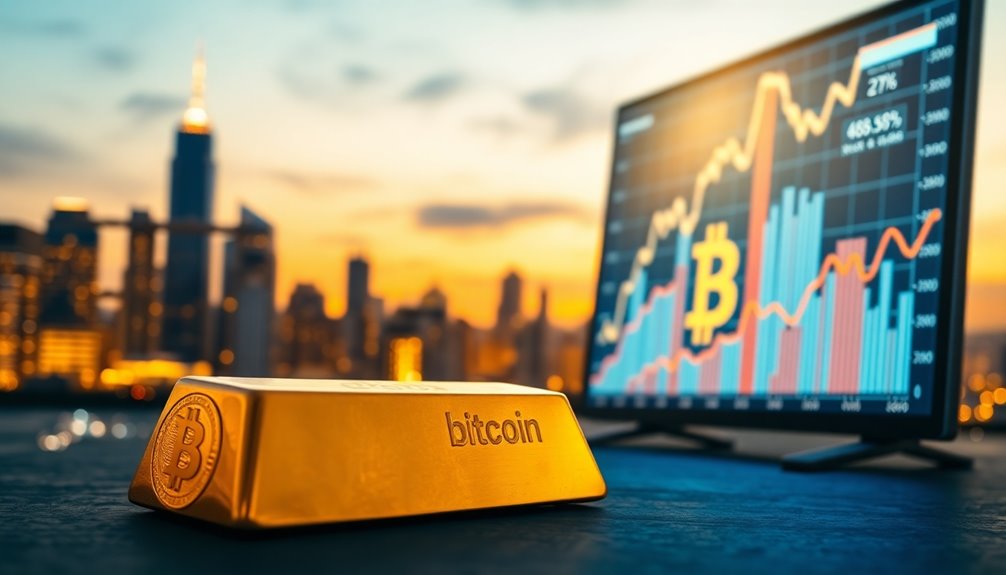

Bitcoin mining involves verifying transactions and forming new blocks by solving complex cryptographic puzzles. Miners gather unconfirmed transactions, verify them, and bundle them into a block. They then race to find a hash below a target by adjusting a nonce, using powerful hardware like ASICs. When successful, they broadcast the solution, earn rewards, and add the block to the blockchain. To understand how these steps create new coins, keep exploring further.
Key Takeaways
- Miners verify transactions from the mempool and compile them into a block for inclusion in the blockchain.
- They calculate a Merkle root and solve a cryptographic puzzle by adjusting a nonce to produce a valid hash.
- Successful miners broadcast their solution, which is verified by others, adding the block to the blockchain.
- Miners are rewarded with newly created bitcoins and transaction fees once a block is validated.
- The process involves high computational power, often through mining pools, and impacts the environment due to energy consumption.
Have you ever wondered how new bitcoins are created and transactions are securely added to the blockchain? The process is called Bitcoin mining, and it plays an essential role in maintaining the network’s integrity. When you send or receive bitcoins, your transaction is initially unconfirmed and sits in the mempool, waiting for miners to verify and include it in a new block. Miners gather these transactions, verify their validity, and compile them into a block. This step guarantees that only legitimate transactions are recorded on the blockchain, preventing fraud and double-spending.
Bitcoin mining verifies transactions and adds new blocks, ensuring blockchain integrity and preventing fraud.
Next, miners calculate a Merkle root, which is a cryptographic hash that summarizes all transactions within the block. This root helps efficiently verify the integrity of the entire block later on. Once the block is assembled, miners face the challenging task of solving a cryptographic puzzle. This puzzle involves generating a hash that falls below a specific target set by the network’s current difficulty level. To do this, miners use powerful hardware called ASICs—specialized chips designed solely for mining—and continuously adjust a nonce, a number they alter with each attempt, to find a matching hash. The process also depends on computational power to increase the likelihood of solving the puzzle quickly.
This process relies on the SHA-256 algorithm, which produces a fixed-length hash from input data. Miners keep trying different nonces and hashing the block data until they produce a hash lower than the target. This effort is known as proof of work, and it requires significant computational power and energy. The high energy consumption of mining has raised environmental concerns, prompting some in the industry to explore more sustainable practices. Additionally, innovations in mining hardware efficiency aim to reduce the environmental impact while maintaining profitability.
When a miner successfully finds a valid hash, they broadcast their solution to the network. Other miners then verify the correctness of the solution. If verified, the block is added to the blockchain, making the transactions within it permanent and transparent. The miner who solved the puzzle receives a reward—newly minted bitcoins—and transaction fees from the included transactions. This reward halves roughly every four years, controlling bitcoin’s supply and preventing inflation.
Because mining is competitive, many miners join forces in mining pools to combine their computing resources and improve their chances of earning rewards. However, the process consumes a lot of energy, raising environmental concerns. While some miners seek renewable energy sources to reduce their carbon footprint, the high power demand remains a significant aspect of Bitcoin mining’s impact on the environment.

Bitcoin Mining with Bitaxe: Complete Guide to Open‑Source ASIC Mining at Home
As an affiliate, we earn on qualifying purchases.
As an affiliate, we earn on qualifying purchases.
Frequently Asked Questions
How Does Bitcoin Mining Impact the Environment?
You should be aware that Bitcoin mining considerably impacts the environment. It consumes large amounts of electricity, much from coal, leading to high carbon emissions that contribute to global warming. Mining also causes air pollution, affects land and water resources, and strains local ecosystems. These activities increase health risks for nearby communities and make it harder to meet climate goals, emphasizing the need for cleaner energy solutions and stricter regulations.
Can Anyone Start Mining Bitcoin Today?
Yes, you can start mining Bitcoin today, but it’s not as simple as just plugging in a device. You’ll need powerful ASIC miners, which are expensive and consume a lot of energy. Plus, you must have a suitable space with good cooling and ventilation, a stable internet connection, and some technical knowledge. Consider costs, environmental impact, and your potential profitability before diving into mining.
What Hardware Is Best for Bitcoin Mining?
Ever wonder what hardware turns your efforts into real Bitcoin? You’ll want to look at top models like the Bitmain Antminer S21 Hyd or MicroBT Whatsminer M60S, which offer high hash rates and energy efficiency. These machines are built for serious mining, balancing power consumption and performance. By choosing the right hardware, you maximize your chances of success and profitability in the competitive world of Bitcoin mining.
How Long Does It Take to Mine One Bitcoin?
You wonder how long it takes to mine one Bitcoin. The time varies depending on your hardware, mining difficulty, and network factors. On average, mining a single Bitcoin solo could take years due to high competition and difficulty. Joining a mining pool can speed up the process, but it still depends on your equipment’s power and the network’s overall hash rate. Patience and technology are key here.
Is Bitcoin Mining Still Profitable With Current Difficulty Levels?
You might wonder if Bitcoin mining still pays off nowadays. With difficulty levels soaring and rewards halved, profitability depends on your setup. If you have access to low-cost electricity and top-tier hardware, you can still make a profit. But if your costs are high or your equipment outdated, it’s probably less profitable. Staying competitive means continually upgrading your hardware and finding affordable energy—key to surviving these tough conditions.
Conclusion
Now that you understand how Bitcoin mining works, you see it’s like a digital treasure hunt, constantly solving puzzles to release new coins. Every successful miner adds a new block to the blockchain, shaping the future of money. Remember, behind the scenes, this process keeps the system secure and decentralized, like an unbreakable chain. By grasping these basics, you’re stepping into the fascinating world of cryptocurrency’s heartbeat.