
In 2025, electric vehicles dominate the auto industry, with over 20 million sold globally, representing 25% of all new cars. China leads the market, followed by the U.S. and Europe, with emerging markets like India and Vietnam gaining fast. Major automakers like Tesla, GM, and Ford are shifting focus to EVs amid falling battery costs and supportive policies. If you want to see how this shift unfolds, there’s more to discover below.
Open a free Amazon Business account
Business pricing, bulk buying and tax-exempt orders.
As an affiliate, we earn on qualifying purchases.
Key Takeaways
- Global EV sales exceed 4 million in Q1 2025, representing 25% of new car sales worldwide.
- China dominates the market, accounting for nearly two-thirds of global EV sales, outpacing U.S. vehicle sales.
- Major automakers like Tesla, GM, and Ford are increasing EV production, with EVs becoming the industry standard.
- Falling battery costs and supportive policies accelerate EV adoption across emerging and developed markets.
- Market competition and technological advancements signal a clear shift toward electric vehicle dominance by 2025.
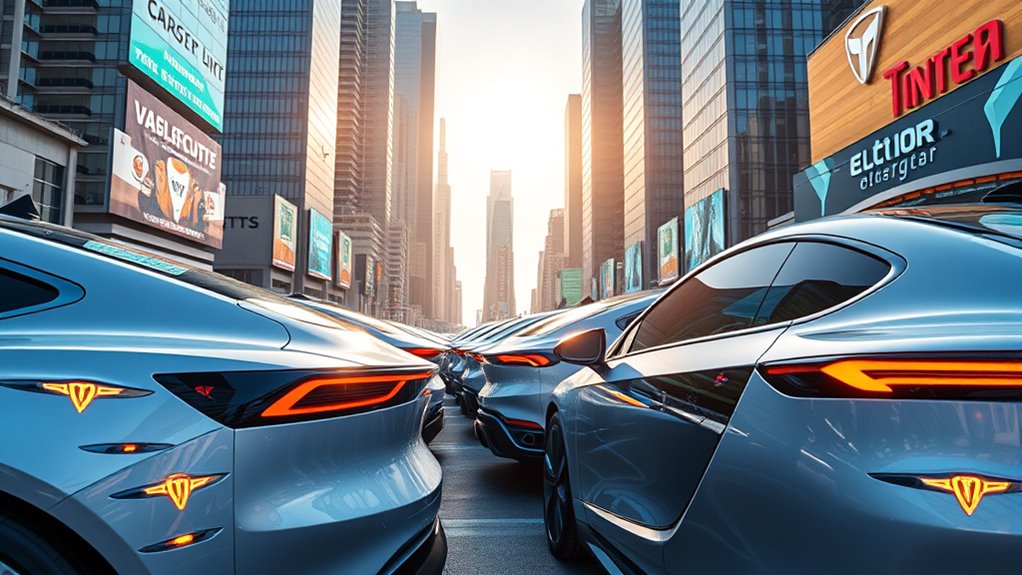
Electric cars are taking over the global automotive market, with sales soaring across all regions in 2025. More than 4 million electric vehicles were sold worldwide in the first quarter alone, marking a 35% jump from the same period last year. Experts predict that total sales for 2025 will surpass 20 million, making up about a quarter of all new car sales globally. While economic and policy uncertainties could influence these numbers, the overall trend remains clear: EV adoption is accelerating. Emerging markets are playing a vital role in this growth, with countries like India, Brazil, and Vietnam experiencing remarkable surges in EV sales. Vietnam’s sales, for example, nearly quadrupled compared to Q1 2024, reaching around 35,000 units, while Southeast Asia’s total EV sales doubled to over 100,000 units in the first quarter. These figures highlight the expanding footprint of electric vehicles beyond traditional markets. Emerging markets are contributing significantly to global EV growth.
In the United States, the EV market remains stable but faces slight shifts. Over 360,000 electric cars were sold in Q1 2025, accounting for roughly 10% of all vehicle sales, a figure consistent with the previous year. Tesla continues to dominate the U.S. market, holding a 46% share in Q2 2025, even as its sales declined by 10% year-over-year. Meanwhile, general automakers are ramping up their efforts: General Motors doubled its EV sales in the second quarter compared to last year, while Ford’s EV figures dipped slightly. The U.S. government’s federal EV tax credits, which are set to expire on September 30, 2025, are likely to cause a sales spike as consumers rush to take advantage before the incentives disappear. Despite the slight decrease in market share, the U.S. remains a significant player in the EV landscape. The ongoing battery cost reductions are making EVs more affordable and attractive to consumers.
Leading models in 2025 include Tesla’s Cybertruck, estimated at around 15,000 units sold, and Ford’s F-150 Lightning, with roughly 13,000 units. Compact crossovers like the Chevrolet Equinox EV and Hyundai Ioniq 5 are gaining popularity, reflecting consumers’ demand for versatile, affordable options. Globally, China continues to dominate the EV scene, representing nearly two-thirds of all sales, with sales volume expected to surpass the total new vehicle sales in the United States next year. Europe holds the second-largest share, accounting for about 17%, while the U.S. trails behind at approximately 7%. Falling battery costs, increased production of affordable EVs, and regulatory changes are fueling this shift, even as economic uncertainties and supply chain issues pose challenges. Automakers like Tesla and legacy brands such as General Motors are competing fiercely, but the undeniable trend points toward electric vehicles becoming the new standard in the auto industry.

ChargePoint HomeFlex Level 2 EV Fast Charger, J1772, Smart, Hardwired, 50A
- Reliable Home Charging: Builds dependable EV charging stations for home and business
- 24/7 Support Access: Round-the-clock assistance and station access
- Mobile App Control: Manage charger, set reminders, and connect to smart devices
As an affiliate, we earn on qualifying purchases.
As an affiliate, we earn on qualifying purchases.
Frequently Asked Questions
How Will Charging Infrastructure Expand by 2025?
You’ll see charging infrastructure expand considerably by 2025, with nearly 200,000 public charging ports already in place. To support millions of EVs, about a million more chargers, including 170,000 fast chargers, will be installed, especially in underserved areas. Investments in the market are rising, leading to more diverse charging locations like workplaces and residential buildings. This growth will help make EV charging more accessible, convenient, and equitable for everyone.
What Are the Environmental Impacts of Mass EV Adoption?
Think of mass EV adoption as planting a forest—each car contributes to cleaner air and a healthier planet. You’ll reduce tailpipe emissions, lower greenhouse gases, and improve air quality. While battery production has environmental impacts, their benefits outweigh the costs over time. By switching to EVs, you help accelerate a greener future, especially as renewable energy sources power your vehicle, making your choice a crucial part of fighting climate change.
How Will Traditional Automakers Compete With EV Startups?
You’ll see traditional automakers compete with EV startups by leveraging their established brands, extensive manufacturing capabilities, and dealer networks to produce affordable, diverse EV models quickly. They’re investing heavily in new technologies, expanding charging infrastructure, and forming strategic partnerships to stay competitive. Plus, they’re adapting to stricter regulations and market demands, using economies of scale to lower costs and attract more consumers to their electric offerings.
What Incentives Will Governments Provide for EV Buyers?
They say “the early bird catches the worm,” and that’s true with EV incentives. You’ll find federal tax credits of up to $7,500 for new EVs and up to $4,000 for used ones, both expiring in September 2025. Plus, there are credits for installing charging stations through June 2026. Many states and utilities also offer rebates, discounts, and special rates, making EVs more affordable and accessible.
Are There Enough Raw Materials for Global EV Production?
You might wonder if there’s enough raw materials for all the EVs coming. Currently, supply exceeds demand, which helps keep prices stable. However, mining companies face financial challenges and need to expand quickly. Recycling is becoming essential, with most batteries expected to be recycled by 2030, reducing raw material needs. Still, ensuring a steady, sustainable supply will require balancing new mining, refining, and recycling efforts globally.
Conclusion
As you embrace the electric revolution, remember that by 2025, EVs will dominate the roads like the roaring engines of the 20th century. This shift reshapes your driving future, blending cutting-edge tech with eco-consciousness. Just like the rise of the internet in the 1990s, EVs are transforming transportation faster than you can say “flux capacitor.” Get ready to ride into a cleaner, smarter era—your journey into the electric age starts now.
Flea & tick season Picks
flea and tick prevention
As an affiliate, we earn on qualifying purchases.