TL;DR

Get everyday essentials delivered free with Prime
- Fast, free delivery on millions of items
- Prime Video, Amazon Music and more included
- Member-only deals all year
Anthropic’s $965 billion valuation isn’t just a number; it’s a statement that compute power is the backbone of AI’s future. This capacity round shows how the race for massive, scalable infrastructure is reshaping industry dynamics and valuations. Learn more about the significance of compute investments in AI.
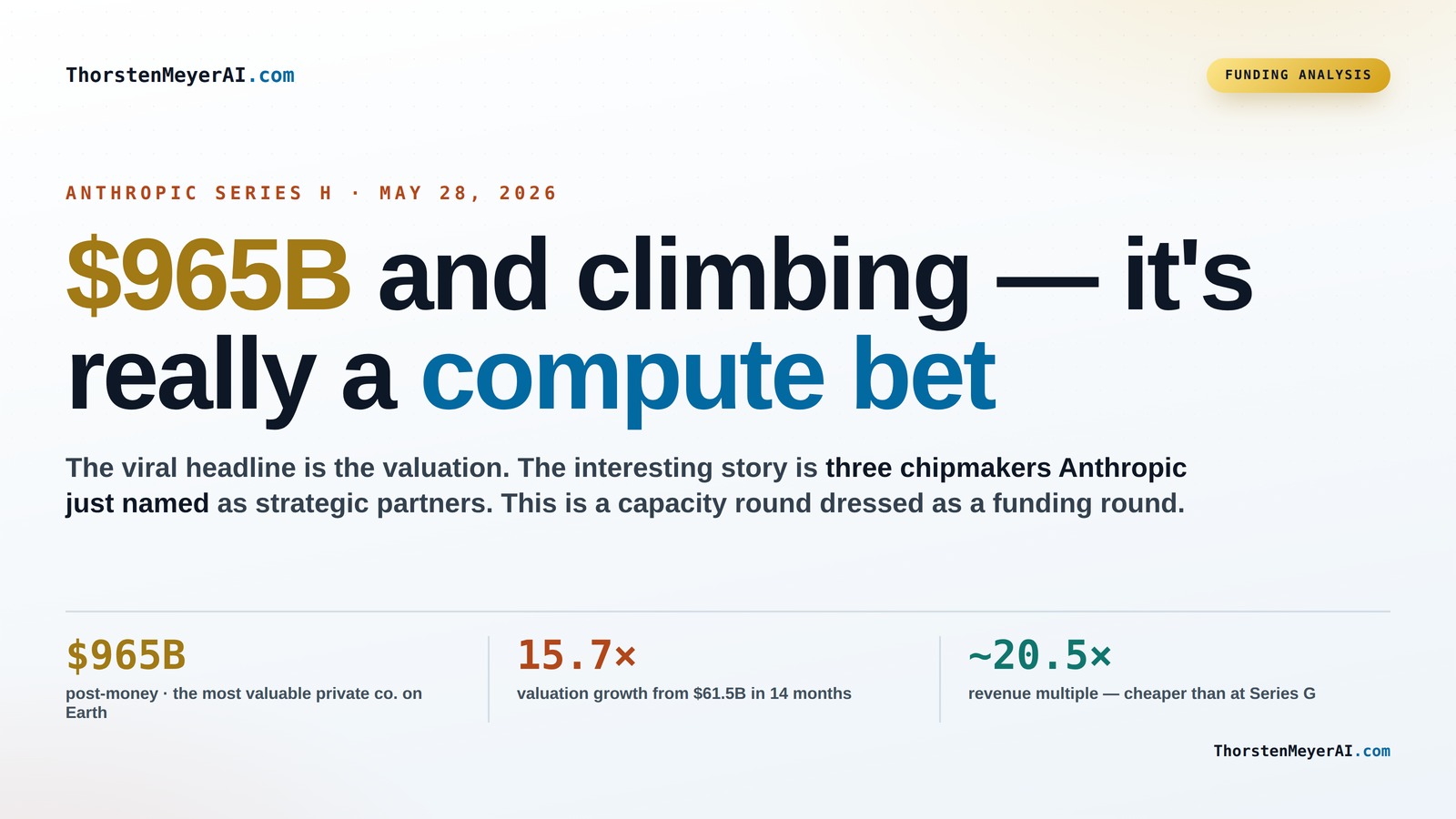
$965B and climbing — it’s really a compute bet
The viral headline is the valuation. The interesting story is in the press release’s middle paragraphs — and in three chipmakers Anthropic just named as strategic partners. This is a capacity round dressed as a funding round.
The numbers nobody can quite parse in sequence
Read together they describe a trajectory with no precedent in enterprise software. Read individually, each looks like a typo.
From $61.5B to $965B in fourteen months
Salesforce took roughly two decades to reach revenue numbers Anthropic just blew past. The sequence below is the part most coverage skips — it’s not the size, it’s the shape.
Anthropic’s valuation ladder · Mar 2025 → May 2026
Five rounds, fourteen months. Bar height is the valuation; the climb itself is the story. Tap any milestone for context.
The multiple actually got cheaper
Bubbles look like multiples expanding while revenue lags. Anthropic’s pattern is the inverse — the valuation tripled, but revenue grew faster, and the multiple compressed.
Revenue-to-valuation multiple · Series G → Series H
Same company, three months apart. The denominator (revenue) is outrunning the numerator (valuation) — exactly the opposite of what a bubble narrative predicts.
10+ gigawatts and three chipmakers
When you name Micron, Samsung & SK hynix alongside your equity backers, you’re saying the binding constraint isn’t demand or model quality — it’s the physical supply of memory chips. The Series H is a capacity round.
Compute commitments backing Anthropic’s capacity bet
$200B+ in announced compute spend across multi-year contracts. The $65B Series H raise has to be read against that bill, not against operating losses.
A genuinely durable bet — or a structural exposure?
Both readings can be true at once. The answer arrives over the next 18–24 months as the gigawatts come online and either fill with paying demand or don’t.
Revenue growth has no precedent in B2B software ($1B → $47B in 17 months). The multiple is compressing, not expanding. Claude is the only frontier model on all 3 major clouds. Enterprise AI spend share went from ~10% to >65% in a year. Compute commitments are tied to specific contracts with capacity dates.
20× revenue is not cheap by any historical software-investing standard. Revenue is reported gross of cloud-reseller pass-throughs, which inflates the top line. Profitability is 2 years out. Amodei’s own warning: a 12-month delay in AI progress “would make him bankrupt” — the compute commitments are a structural exposure to demand persistence.
The valuation race — and the IPO context
Anthropic shipped Opus 4.8 the same morning as Series H — not a coincidence. One week after OpenAI filed confidentially for IPO. The late-2026 frame is set: two frontier AI companies racing to public markets, each pitching durability.
Key Takeaways
- AI valuations now fundamentally hinge on compute capacity, not just revenue or user metrics.
- Anthropic’s funding is a clear signal: infrastructure and hardware are the new gold in AI.
- Revenue growth can outpace valuation increases, compressing multiples — a sign of real scale, not hype.
- Strategic hardware partnerships are shaping how the next wave of AI models will be built and scaled.
- Smaller startups will need to find innovative ways to access massive compute or risk falling behind.
As an affiliate, we earn on qualifying purchases.
Why Anthropic’s valuation is really a bet on compute power
Anthropic’s eye-watering valuation signals more than just investor confidence — it’s a clear bet that compute capacity is the bottleneck between today’s AI capabilities and what’s coming next. Unlike traditional tech, where user growth or revenue metrics reign supreme, AI’s true power lies in raw processing muscle. For example, building models like Claude requires hundreds of thousands of GPUs running in tandem, with data flowing like a high-speed river through massive data centers.
A real-world analogy: it’s like owning a fleet of supercharged engines — without enough fuel or hardware, your engine’s just a shiny paperweight. Anthropic’s recent funding, with strategic partners like Micron, Samsung, and SK hynix, confirms that infrastructure is now the core asset. They’re not just developing AI; they’re building the warehouse of the future for AI’s raw materials: compute and hardware.
Why does this matter? Because in AI, the quality of your models is directly tied to the hardware that trains and runs them. The more compute you have, the larger and more complex your models can be, leading to better performance and capabilities. This is why infrastructure is now the core of AI valuation. This shift means that hardware and infrastructure are no longer just supporting tools but are now strategic assets that determine who leads in AI innovation. The tradeoff? Heavy investments in hardware can be costly and slow to scale, but they also create high barriers to entry for competitors, potentially consolidating power among the hardware giants and large AI labs.

How this capacity round rewrites the AI funding playbook
This isn’t a typical funding round. It’s a capacity round — a giant leap in infrastructure investment. While previous rounds focused on AI talent, algorithms, or user numbers, this one is about capacity. The $65 billion raised is aimed at expanding what’s possible in hardware, data centers, and chip manufacturing.
Imagine a race where the winner isn’t just about who runs fastest but who has the biggest, most powerful engine. Anthropic’s strategic partnerships with chipmakers like Samsung and Micron show they’re betting on a future where AI models grow exponentially larger, and the bottleneck shifts to hardware. For example, they’ve committed over 10 gigawatts of compute capacity — enough to power hundreds of the most advanced AI models in the world. Discover more about AI compute commitments.
This shift in funding philosophy has profound implications: it signifies a move from investing solely in software or talent to prioritizing the physical infrastructure that enables AI breakthroughs. See how infrastructure investments are shaping AI’s future. The tradeoff here is that infrastructure investments are capital-intensive and less flexible than software development, but they offer a competitive moat — control over hardware means control over the AI future itself. This approach could redefine industry standards, with hardware capacity becoming the primary determinant of who stays ahead in AI innovation.

Compare: Anthropic vs. OpenAI — Who’s really more expensive?
| Metric | Anthropic | OpenAI |
|---|---|---|
| Valuation | $965B | $852B |
| Revenue (2025) | $47B (run-rate) | ~$13B |
| Multiple (valuation/revenue) | 20.5× | ~65× |
Surprisingly, Anthropic’s multiple is lower than OpenAI’s, even though it’s valued higher. This indicates that Anthropic’s rapid growth and larger valuation are driven by its strategic focus on infrastructure, making its valuation more justified relative to its revenue. Conversely, OpenAI’s higher multiple reflects expectations of even faster growth but also indicates a market that perceives higher risk or less tangible assets. The implication? While valuations are often viewed as a simple number, the underlying drivers—such as infrastructure investments—are critical to understanding these differences. The tradeoff is that high multiples can lead to volatility if growth slows, but they also reflect optimism about future capabilities enabled by hardware advancements.

Why revenue growth is the real story behind the valuation
Between Series G and H, Anthropic’s revenue exploded — growing roughly 5.4× in just fourteen weeks. That’s faster than most tech companies see in years. For example, their revenue hit $47 billion annualized, and projections show it surpassing $50 billion by June.
But why does this rapid growth matter? Because it’s a direct reflection of how effectively their massive infrastructure investments are translating into marketable AI solutions. When a company can quickly convert hardware capacity into revenue, it indicates a highly scalable and efficient model. This rapid revenue ramp-up also suggests that the industry’s valuation is increasingly tied to tangible outputs—large-scale AI services—rather than just speculative future potential. The tradeoff? Rapid growth can lead to operational challenges and require continuous investment, but it also cements the company’s position and justifies higher valuations based on actual performance, not just hype.

The real driver: massive compute commitments and strategic chip partnerships
Anthropic’s focus on infrastructure isn’t abstract — it’s concrete. The company has committed to over 10 gigawatts of compute capacity and partnered with giants like Samsung, Micron, and SK hynix. This isn’t just about buying hardware; it’s about building the foundation for AI that can scale beyond current limits. Explore how strategic hardware partnerships are transforming AI development.
Picture a city planning to build skyscrapers that stretch into the clouds. The key isn’t just the land or design but the steel and concrete that hold it up. For AI, the steel is the hardware. For example, their partnerships suggest they’re developing custom chips and data centers designed specifically for AI workloads. This kind of focus is rare and signals a shift toward hardware becoming the true value driver.
Why does this matter? Because these hardware commitments and partnerships are strategic assets that can create significant barriers to entry. They enable AI models to train faster, scale larger, and operate more efficiently, which directly impacts competitive advantage. The tradeoff? Such focus requires substantial capital and long-term planning, but it positions the company at the forefront of AI hardware innovation, effectively shifting the industry’s center of gravity toward infrastructure dominance.

What does this mean for smaller AI startups and the industry?
With Anthropic pouring billions into compute, smaller startups face a hard reality. Building large models or even competing on scale now requires access to enormous hardware, which comes with a hefty price tag. It’s like trying to run a marathon with a jet engine strapped to your back.
This push for infrastructure could widen the gap between giants and smaller players, creating a high barrier to entry that favors established companies with deep pockets. However, it also encourages innovation in alternative hardware solutions, like specialized chips or more efficient algorithms, to reduce dependence on massive infrastructure. The industry might see a consolidation of power among hardware giants, but it also sparks a new wave of innovation aimed at democratizing access or optimizing for less resource-intensive models. The tradeoff? Smaller players may need to pivot to niche markets or develop hardware-efficient models, which could slow overall industry democratization but intensify competition at the hardware and algorithm levels.

Frequently Asked Questions
Why does Anthropic’s valuation matter so much?
It signals that investors see AI’s future as driven by hardware capacity. The bigger the compute power, the bigger the potential for revolutionary AI models and applications.How does compute capacity impact AI progress?
Massive compute allows training larger, more capable models faster. It’s like giving AI a bigger brain and a faster body — the result is smarter, safer, and more useful AI systems.Will smaller AI startups be left behind?
Without access to huge compute resources, smaller startups may struggle to compete at scale. They’ll need to find niche markets or innovative hardware solutions to stay relevant.Are hardware partnerships a new trend?
Yes. Companies like Anthropic investing in chip partnerships mark a shift where hardware becomes a strategic weapon, not just a supporting player.What’s next for AI valuation and infrastructure?
Look for more capacity-driven funding rounds and hardware investments. As models grow larger, owning top-tier compute will become the most valuable asset in AI.Conclusion
This isn’t just about a trillion-dollar valuation; it’s about the hardware fueling AI’s exponential growth. As Anthropic invests billions into chips and data centers, it’s rewriting the rules of what’s possible — and who gets to play. The future belongs to those who own the biggest, fastest compute engines. Are you ready for an AI world powered by silicon and scale?Halloween Picks
halloween
As an affiliate, we earn on qualifying purchases.