TL;DR

Get everyday essentials delivered free — and shop member deals
- Fast, free delivery on millions of items
- Access to Prime Big Deal Days deals on October 6–7
- Prime Video, Amazon Music and more included
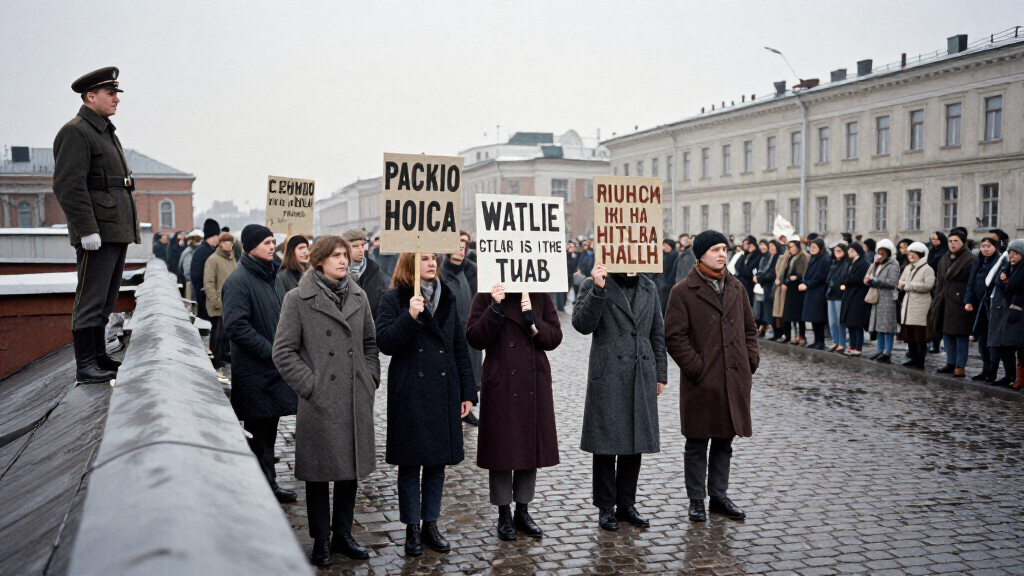
On Dec. 5, 1965, several dozen people gathered in Moscow’s Pushkin Square to demand that the Soviet government honor citizens’ right to an open trial. Organized by mathematician and poet Alexander Volpin, the brief rally was dispersed by authorities and received almost no coverage in Soviet newspapers. Meduza’s retrospective describes it as a milestone in the emergence of the Soviet dissident movement.
Several dozen people gathered in Moscow’s Pushkin Square in 1965 to demand that the Soviet government follow its own Constitution and respect citizens’ right to an open trial, according to a retrospective published by Meduza on Oct. 7, 2026. The rally, organized by mathematician and poet Alexander Volpin, lasted only a few minutes before authorities dispersed it, but Meduza describes it as a key early act in the formation of the Soviet dissident movement.
The demonstrators were not calling for a change of government or a broad program of political reform, Meduza reported. Their stated focus was narrower: that the state obey its own laws, including the right to a public trial. The gathering made that demand in public at a time when independent political demonstrations had long been suppressed.
Soviet newspapers gave the protest almost no coverage, according to Meduza. Its immediate scale was small and the rally ended quickly, but its method mattered: participants publicly invoked legal rights guaranteed by the state rather than presenting themselves as a revolutionary opposition. Meduza characterizes the action as the first public reminder to Soviet authorities of citizens’ right to an open trial.
The retrospective says the demonstration’s consequences extended beyond the square, helping mark the start of a dissident movement organized around public protest and appeals to Soviet law. It was published in English on Oct. 7, 2026, and was originally published in Russian in December 2025, Meduza said.
A Legal Demand in Public
The protest’s significance lay in its public and legal framing. Rather than demanding an immediate change of political system, the participants called on the government to honor rights already set out in Soviet law. That approach exposed a gap between the state’s formal guarantees and how its authorities handled sensitive cases.
Meduza presents the rally as an early model for dissent: a small group could make a public demand, document that it had been made, and challenge officials using the government’s own legal language. The gathering did not reverse state policy, and the source does not suggest that it did. Its historical importance, as described in the report, was that it helped establish a visible form of opposition after decades in which independent demonstrations had been driven out of political life.
As an affiliate, we earn on qualifying purchases.
From the Thaw to Pushkin Square
The protest came after a period of limited cultural opening known as the Thaw, which followed Joseph Stalin’s death. Young people gathered around the Mayakovsky monument in Moscow to read poetry and discuss ideas. That space offered more room for expression, but it did not amount to permission for independent political action.
Meduza points to the Novocherkassk massacre in June 1962 as a warning about the limits of the era. Workers protesting price rises and wage cuts were met with gunfire; the authorities then held closed trials and classified information about the events, the report says. In early 1965, the literary group SMOG also drew official pressure after young poets held readings and circulated uncensored writing.
Against that background, the trial of writers Andrei Sinyavsky and Yuli Daniel became a focus of public concern. They had published work abroad under pseudonyms after being unable to publish it in the Soviet Union. Volpin’s rally turned that concern into a direct demand for an open proceeding, linking a particular case to a stated legal right.
“They sought neither a change of government nor political reforms.”
— Meduza’s retrospective
What the Record Leaves Open
The source material does not give a precise count of those who attended, identify every participant, or detail how authorities dispersed the group. It also does not establish what happened to individual demonstrators after the rally. Meduza describes the gathering as a milestone in the dissident movement’s emergence, but the material provided does not quantify its direct influence on later protests or trace specific organizational links.
The account is a retrospective, not a new announcement about a current political development. The source says the original Russian article appeared in December 2025 and the English version was published on Oct. 7, 2026; it does not provide additional archival documents or responses from people involved.
Further Historical Documentation
No immediate event or policy change is announced in the retrospective. The next step for readers seeking a fuller account is to consult Meduza’s complete feature and any cited archival material, including records concerning the demonstration, the Sinyavsky–Daniel case, and the authorities’ response. The source provided here does not specify whether further reporting or publication is planned.
Key Questions
What did the 1965 Moscow protesters demand?
They called on the Soviet government to obey its own Constitution and respect citizens’ right to an open trial, according to Meduza.
Who organized the Pushkin Square rally?
Meduza identifies Alexander Volpin, a mathematician and poet, as the organizer.
How large was the demonstration?
The retrospective describes several dozen people gathering in Pushkin Square. It does not provide an exact attendance figure.
How did Soviet authorities respond?
Authorities dispersed the rally after a few minutes, Meduza reported. The source material does not provide details about arrests or other individual consequences.
Why is the protest considered significant?
Meduza describes the rally as an early public challenge to state conduct using the Soviet government’s own legal commitments, and as a milestone in the emergence of the Soviet dissident movement.
Source: rss
Fall Picks
fall essentials
As an affiliate, we earn on qualifying purchases.