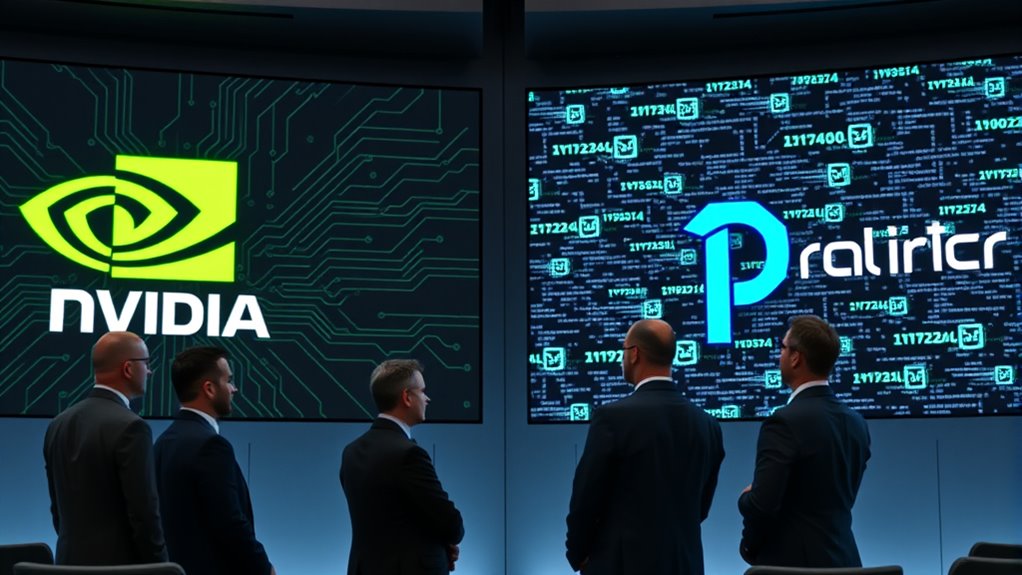

Investors are comparing Nvidia’s rapid growth in AI hardware with Palantir’s steady, software-driven approach. Nvidia dominates the AI hardware market, offering high-growth potential but faces risks from competition and valuation concerns. Palantir provides stable, long-term subscription revenue focusing on AI software for operational insights, which appeals to those seeking less volatility. Understanding each company’s strengths and risks will help you see how they fit into the future AI landscape—more details ahead.
Key Takeaways
- Nvidia offers rapid growth through AI hardware sales, attracting investors seeking high-tech hardware exposure.
- Palantir provides stable, subscription-based AI software with long-term contracts, appealing to risk-averse investors.
- Nvidia’s high valuation multiples raise concerns about growth sustainability amid hardware market competition.
- Palantir’s focus on operational AI insights and autonomous agents offers potential long-term differentiation.
- Both companies’ growth prospects depend on AI market evolution, influencing their respective investment appeal.

As the AI industry accelerates, investors are carefully comparing Nvidia and Palantir to determine which company offers the best growth prospects. Nvidia dominates the AI hardware space with its powerful GPUs, which are essential for training and running AI models. Many analysts see Nvidia’s stock as undervalued compared to Palantir’s, especially given its significant market position. Nvidia’s hardware sales benefit from the growing demand for AI processing capabilities across tech giants and data centers. However, there’s a potential risk if AI hyperscalers decide to develop their own chips in-house, which could cut into Nvidia’s market share. Additionally, Nvidia’s revenue is quite sensitive to the cycles of AI hardware demand. A downturn in AI hardware spending could lead to a slowdown in income, highlighting the company’s dependency on hardware sales. Despite these risks, Nvidia remains a key player in AI hardware and continues to lead the market, though increased competition and internal shifts among large cloud providers pose challenges for future growth. Regular engagement in creative practice could enhance problem-solving skills that benefit tech innovation.
Nvidia leads AI hardware with powerful GPUs but faces risks from in-house chip development and market demand fluctuations.
On the other hand, Palantir focuses on AI software that transforms large data sets into actionable insights. Its platform, which turns “data in, insights out,” offers autonomous AI agents that can operate within client businesses to boost operational efficiency. Palantir’s customer base spans both government agencies and commercial clients, providing a diversified revenue stream. Its subscription-based revenue model creates sticky relationships—clients face high switching costs because of the complex integration of Palantir’s software into their operations. As AI spending grows, Palantir benefits from increased software sales, though its growth remains slower than Nvidia’s. Its revenue growth has been accelerating, but it still trails Nvidia’s rapid expansion driven by hardware sales.
When comparing growth trajectories, Nvidia’s quarterly year-over-year revenue growth outpaces Palantir’s. Nvidia’s performance is fueled by strong GPU sales to AI-focused enterprises, whereas Palantir’s steady subscription model offers more predictable, long-term income. Yet, Nvidia faces notable competitive risks. Companies developing custom AI chips for hyperscalers threaten to erode Nvidia’s hardware dominance, especially if cloud providers choose to build in-house solutions. Fluctuations in AI hardware demand could also impact Nvidia’s revenue base, and its reliance on GPU architecture might limit flexibility as AI workloads diversify. There’s also market concern that hardware commoditization could pressure Nvidia’s valuation. Furthermore, the company’s valuation is increasingly scrutinized as its growth prospects are weighed against its high price multiples.
Palantir’s competitive advantages include high switching costs due to the complexity of its software integration and its focus on real-time AI insights, which are highly valued for operational decision-making. The subscription model offers more stability, even amid AI market volatility. Its long-standing contracts with government and commercial clients create diversification, and its autonomous AI agent technology could be a significant differentiator moving forward. For investors, Nvidia appeals if you’re aiming for high-growth exposure to AI hardware, accepting some volatility risks. Palantir attracts those who prefer software stability and long-term subscription revenue, even if its growth pace lags behind Nvidia’s. As the AI landscape evolves, each company’s unique strengths and risks will shape their investment appeal.

HP Color LaserJet Pro MFP 3301fdw Wireless All-in-One Color Laser Printer, Office Printer, Scanner, Copier, Fax, ADF, Duplex, Best for office (499Q5F)
FROM AMERICA'S MOST TRUSTED PRINTER BRAND – Perfect for small teams printing, scanning and copying professional-quality color documents...
As an affiliate, we earn on qualifying purchases.
Frequently Asked Questions
How Do Nvidia and Palantir’s AI Strategies Differ?
You see that Nvidia’s AI strategy focuses on hardware, creating powerful GPUs and infrastructure that support AI training and inference across industries. In contrast, Palantir emphasizes software, developing platforms that integrate data and provide real-time insights for enterprises and government clients. Nvidia leverages hardware-software synergy to maximize performance, while Palantir offers flexible AI tools that help organizations make better, faster decisions by analyzing vast data sets.
What Are the Potential Risks of Investing in Nvidia or Palantir?
You face risks when investing in Nvidia or Palantir, including valuation concerns and market volatility. Nvidia’s high expectations could lead to sharp drops if growth slows, while Palantir’s overvaluation and insider selling add caution. Both confront technological competition, regulatory hurdles, and geopolitical tensions that could disrupt supply chains or limit market access. Market sentiment shifts quickly, so you should stay aware of how these factors might impact your investment’s value.
How Do Their AI Product Offerings Compare in Market Reach?
You’ll find Nvidia’s AI hardware dominates globally, reaching hyperscalers, data centers, and multiple sectors with its GPUs, making it highly influential. Palantir, on the other hand, offers AI software with a strong presence in enterprise and government clients across various industries. While Nvidia’s reach is broader due to hardware distribution, Palantir’s software provides specialized insights, creating a different but valuable market footprint for each.
What Recent Innovations Have Nvidia and Palantir Announced?
Imagine stepping into a future shaped by cutting-edge innovations. Nvidia recently unveiled the GB10 AI superchip, GeForce RTX 5090 GPU, and Blackwell Ultra GPUs, boosting AI power and efficiency. They also launched Project DIGITS, a personal AI supercomputer. Palantir, on the other hand, announced new data integration tools and advanced analytics platforms. Both push boundaries, but Nvidia’s hardware breakthroughs create a vivid landscape of AI possibilities.
How Might Regulatory Changes Impact Their AI Growth?
Regulatory changes could slow your AI growth by increasing compliance costs and creating market uncertainties. For NVIDIA, export restrictions and supply chain rules might limit hardware sales and expansion, while Palantir faces stricter data privacy and government contract regulations that could delay product launches. These hurdles may reduce revenue streams, inflate operational costs, and slow innovation, making it harder for both companies to maintain their competitive edge in the rapidly evolving AI landscape.

Brother Color Laser Printer with Wireless Printing Fast 19 PPM Output, Duplex Feature, Mobile Device Compatible, 250-Sheet Paper Tray for Professional Home Office Printing (HL-L3220CDW)
Professional Quality: Brother Genuine color laser printer delivers stunning business documents with crisp text and vibrant graphics at...
As an affiliate, we earn on qualifying purchases.
Conclusion
As you consider Nvidia and Palantir, it’s clear both companies hold strong AI potential, but Nvidia’s dominance in hardware may give it the edge for rapid growth. While Palantir’s data analytics excel in specific sectors, Nvidia’s broader ecosystem fuels innovation across industries. It’s a tempting theory that Nvidia’s integrated approach will outperform in AI gains, and investing now could position you ahead of the curve as AI continues to reshape the tech landscape.

HP LaserJet Pro MFP 3101sdw Wireless All-in-One Laser Printer, Office Printer, Duplex, Best-for-Small Teams (9D2X4F)
FROM AMERICA'S MOST TRUSTED PRINTER BRAND – Perfect for small teams printing professional-quality black-and-white documents and reports. Print...
As an affiliate, we earn on qualifying purchases.
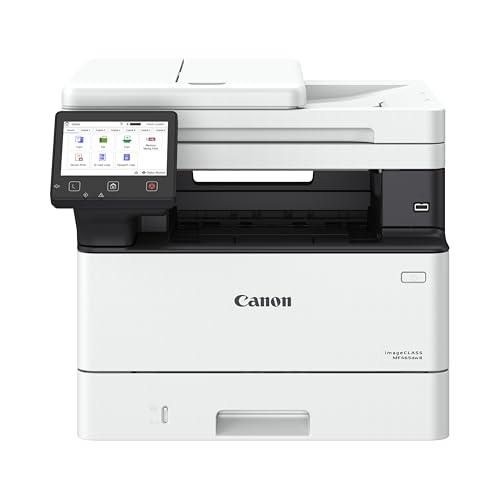
Canon imageCLASS MF465dw II - Monochrome Wireless Duplex Laser Printer with Print, Copy, Scan, Fax, Expandable Paper Capacity and 3 Year Limited Warranty, 42 PPM
Monochrome Wireless, Duplex 4-in-1: Print, Scan, Copy, Fax
As an affiliate, we earn on qualifying purchases.