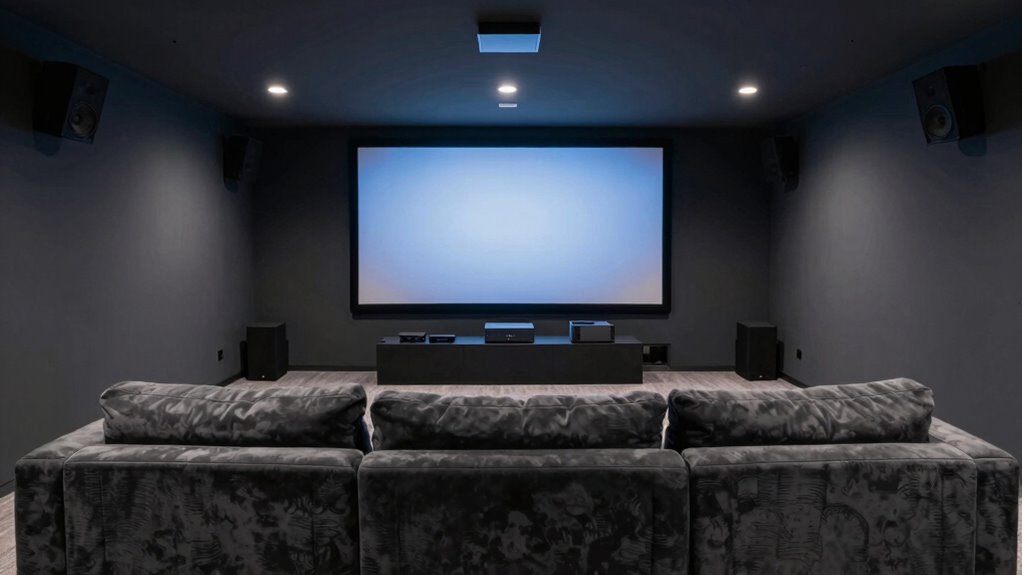

To set up your home theater speakers without confusion, start by positioning your front left and right speakers at ear level, forming a 22-30 degree angle from your seating. Place the center speaker directly above or below the screen at ear height for clear dialogue. Surround speakers should be slightly behind and to the sides, also at or above ear level, creating an immersive sound field. Proper room acoustics and symmetrical placement guarantee balanced sound—keep exploring for detailed tips to perfect your setup.
Key Takeaways
- Place front speakers at ear level, forming a 22-30 degree arc from the listening position for immersive sound.
- Align the center channel directly in line with the screen and at ear height for clear dialogue.
- Position surround speakers slightly behind and to the sides, at or above ear level, for enveloping sound.
- Use soft furnishings and acoustic treatments to reduce reflections and enhance clarity.
- Maintain symmetry and experiment with angles and distances to achieve balanced, natural sound blending.

Have you ever wondered how to create the perfect home theater layout? One of the most vital aspects is getting your speaker positioning right. Proper speaker placement can make a huge difference in your listening experience, but it’s easy to get overwhelmed by all the options and advice out there. To start, consider the shape and size of your room, as these factors directly influence how sound travels and how you should position your speakers. For the best soundstage, your front speakers—left, center, and right—should be placed at ear level when you’re seated. The center channel should be directly in line with your screen and aimed at ear height to guarantee dialogue clarity. The left and right speakers should be positioned at an angle of about 22 to 30 degrees from your listening position, forming an arc that creates a balanced, immersive sound field. If you have surround sound speakers, place them slightly behind and to the sides of your seating area, roughly at ear level or slightly above, to envelop you in sound without overwhelming your space.
Room acoustics play a vital role in how well your speakers perform. Hard surfaces like glass, tile, or bare walls reflect sound waves, which can lead to echo and muddiness. Conversely, soft furnishings such as carpets, curtains, and upholstered furniture absorb sound, reducing echo and improving clarity. To optimize acoustics, consider adding acoustic panels or diffusers on walls to control reflections and prevent sound from bouncing around unpredictably. Positioning your speakers correctly also helps manage room acoustics—keeping them away from corners and reflective surfaces minimizes unwanted reverberations. Understanding room acoustics and their impact on sound quality can greatly enhance your listening experience. You should aim for symmetry in your speaker placement to ensure a balanced sound experience; uneven positioning can lead to imbalanced soundstage and distract from immersion. Experiment with speaker angles and distances, listening for a natural, seamless blend of sounds, especially during dialogue-heavy scenes or dynamic action sequences. Remember, the goal is to create an environment where sound feels natural and surrounds you, not one where it feels disjointed or muffled.
Ultimately, mastering speaker positioning and understanding room acoustics will elevate your home theater from good to outstanding. It’s about creating a space where every sound detail is crystal clear, and the experience feels as close to a commercial theater as possible. Take your time to experiment with placement, listen carefully, and adjust as needed. With a little effort, you’ll optimize your room’s acoustics and speaker setup, transforming your home theater into an immersive audio haven.
Frequently Asked Questions
How Do I Optimize Sound for Uneven Room Shapes?
To optimize sound in uneven room shapes, you should focus on minimizing sound reflection issues. Place your speakers strategically, aiming for symmetry to reduce uneven sound distribution. Use sound-absorbing panels or carpets to dampen reflections caused by irregular walls. Adjust speaker angles slightly to target listening positions directly. These steps help balance sound, ensuring clearer audio regardless of your room’s shape, creating an immersive home theater experience.
What Are the Best Speaker Types for Small Rooms?
It’s no coincidence that compact speakers fit small rooms perfectly. You should opt for small, bookshelf or satellite speakers, as their size makes placement easier without overwhelming the space. Keep speaker size in mind, and position them close to walls or corners to maximize sound. Proper speaker placement enhances clarity and immersion, ensuring you get the best audio experience in your small room without feeling crowded.
How Can I Hide Wires for a Cleaner Look?
To hide wires for a cleaner look, you can use wire concealment options like in-wall cable management or raceways that blend with your walls. Conceal cables behind furniture or under baseboards, and opt for wireless speakers when possible to reduce clutter. Cable clips and sleeves also help organize and secure wires along walls or along the back of furniture, giving your home theater a sleek, tidy appearance without sacrificing performance.
Should Speakers Be Placed Near Windows or Curtains?
Did you know that 75% of sound is reflected by windows? It’s best to keep your speakers away from windows because reflective surfaces can distort sound. Curtains influence acoustics too—thick curtains absorb sound, so placing speakers near them can dampen sound quality. To get the clearest audio, position your speakers away from windows and curtains, ideally in open areas, and use acoustic treatments if needed to optimize sound performance.
How Often Should I Recalibrate My Home Theater System?
You should recalibrate your home theater system about once every six months to guarantee the best sound. Regular speaker calibration helps maintain sound optimization, especially if you move the system or change the room layout. If you notice sound quality issues or unusual audio discrepancies, it’s a good idea to recalibrate sooner. Consistent calibration keeps your speakers performing at their best, delivering immersive audio and enhancing your overall viewing experience.
Conclusion
Now that you know the ideal speaker placement, creating your perfect home theater feels less like a puzzle and more like a plan. Think of it as balancing a fine recipe—precision matters, but so does enjoyment. With your speakers in the right spots, you’ll experience cinema-quality sound without the chaos of confusion. So, set up with confidence, and let your home theater become the ultimate escape—without the headache of guesswork.