
TL;DR
APEC leaders are meeting in Shenzhen on November 19, with draft proposals on AI, digital trade and a free trade area before them. Earlier ministerial commitments cover AI in trade and workers’ skills, while China announced $20 million for APEC cooperation. The leaders’ declaration had not been published as of 05:45 UTC, and APEC decisions are voluntary.
Senior officials sent leaders a proposed statement on the digital economy and AI, a Trade Digitalization Cooperation Framework for 2027–2030, and a draft statement on a Free Trade Area of the Asia-Pacific, according to an APEC Secretariat release on November 16. These were proposals for leaders to consider, not adopted outcomes. The leaders’ declaration had not been published at the time of the source material’s latest update.

Get everyday essentials delivered free with Prime
- Fast, free delivery on millions of items
- Prime Video, Amazon Music and more included
- Member-only deals all year
Some related commitments were already on record. At a May meeting, APEC trade ministers committed to “harnessing AI’s benefits for trade” and encouraged economies to share AI policies with smaller firms. Labor ministers adopted a joint statement in September covering jobs, vocational skills and social security. Xi also announced that China would provide US$20 million for APEC cooperation and establish institutions focused on digital technology, cross-border data flows, clean energy and small businesses.
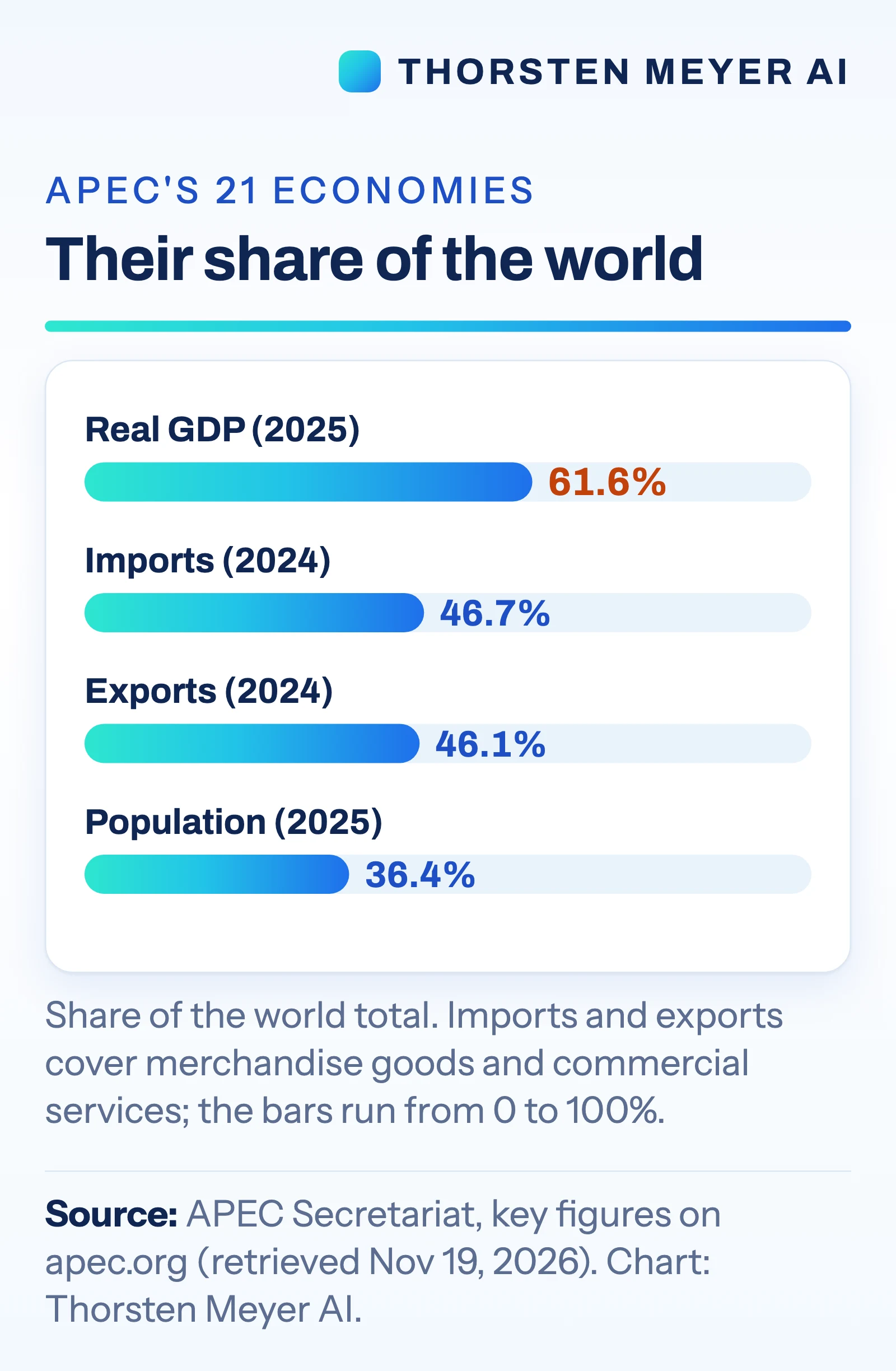
The proposals reach a forum whose members represent 61.6% of global GDP in 2025 and about 46% of global trade in goods and commercial services in 2024, according to APEC figures cited in the source material. Those figures describe the economies’ combined weight; they do not mean the meeting’s proposals have been implemented.
AI Rules Meet Trade Realities
Any shared direction on AI and digital trade could matter to companies operating across the Pacific, including small firms navigating different policies and cross-border data rules. For workers, the labor ministers’ statement puts skills and social protection alongside the technology agenda, though it does not itself set enforceable standards.
The economic outlook adds urgency but also uncertainty. APEC’s Policy Support Unit raised its 2026 regional growth forecast to 3.4%, from 3.2%, and attributed strength in part to technology investment and trade. It reported that export values rose 22.5% year over year in the first half of 2026, with semiconductor demand supporting growth. The unit also warned that technology investment’s benefits could be uneven. These are regional indicators, not evidence that the Shenzhen meeting has caused a change.
APEC says its decisions are made by consensus and are voluntary and non-binding. A declaration can signal priorities and encourage coordination, but the text alone does not alter national laws, tariffs or chip rules. The practical effect depends on what individual economies do afterward.
Popular right now

Vitamix 5200 Blender with 64 oz. Container, Black

Samsung 55-Inch S90H OLED 4K UHD Smart TV Bundle with Full-Motion Mount and Surge Protector

Dyson Cyclone V10 Origin Cordless Vacuum
As an affiliate, we earn on qualifying purchases.
A Year of APEC Preparations
The Shenzhen summit followed a sequence of ministerial and officials’ meetings. Trade ministers met in Suzhou on May 22–23; labor ministers issued their joint statement in Nanjing on September 21. Foreign and trade ministers met by video on November 3 to prepare the leaders’ agenda, followed by senior officials in Shenzhen on November 14–15, who advanced the draft texts.
APEC was founded in 1989 and has 21 members, which it refers to as “economies.” Its Secretariat’s figures put the group at about 3.0 billion people, or 36.4% of the world population in 2025. Its 2026 outlook forecast regional growth of 3.4% that year and 3.1% in 2027, while projecting inflation of 3.2% in 2026 and 2.8% in 2027.
Xi welcomed U.S. President Donald Trump in Shenzhen on November 18. The source material also said Xi was due to hold a China-Russia-U.S. summit with Trump and Russian President Vladimir Putin on November 19. It noted that the U.S. had recently tightened rules on remote access to advanced AI chips, but did not specify the rules or establish that they were part of APEC’s agenda.
““Harnessing AI’s benefits for trade.””
— APEC trade ministers, joint statement from their May 22–23 meeting
Drafts Await Leaders’ Decision
As of 05:45 UTC on November 19, the leaders’ declaration had not been published. It was therefore unclear whether leaders would adopt, revise or set aside the proposed AI statement, the digitalization framework and the free trade area statement, or what wording any final text would contain.
The source material did not establish how the proposed cooperation institutions would operate, when they would be set up, or how the announced US$20 million would be allocated. It also did not detail the implementation plans economies might pursue for the earlier trade and labor commitments. Any effects on workers, businesses, data flows or trade rules remain dependent on later decisions.
Watch for the Final Declaration
The next key development is publication of the leaders’ declaration and any final statements from the Shenzhen meeting. Those texts will show which proposals received consensus and how leaders described future cooperation. The source material said the declaration was still expected, without giving a publication time.
After the summit, the practical test will be whether member economies take domestic or joint steps to carry out the voluntary commitments on AI, trade digitalization, skills and social protection. APEC’s statements can set direction, but implementation details and any resulting policy changes will need to be confirmed separately.
Key Questions
What are APEC leaders discussing in Shenzhen?
The agenda includes draft proposals on the digital economy and AI, a Trade Digitalization Cooperation Framework for 2027–2030, and a statement on a possible Free Trade Area of the Asia-Pacific.
Have the AI proposals been adopted?
That was not known as of 05:45 UTC on November 19. Senior officials had sent draft proposals to leaders, but the leaders’ declaration had not yet been published.
What has APEC agreed on workers and AI so far?
In May, trade ministers committed to harnessing AI’s benefits for trade and encouraged sharing AI policies with smaller firms. In September, labor ministers adopted a joint statement on jobs, vocational skills and social security.
Can an APEC declaration change laws or tariffs?
No. APEC decisions are voluntary and non-binding. A declaration can set shared priorities, but changes to national laws, tariffs or chip rules require action by the relevant governments.
Source: Thorsten Meyer AI