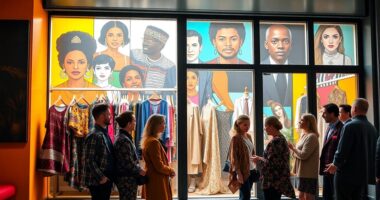
The AI revolution in Hollywood is rapidly transforming the industry, with digital actors becoming more realistic and accessible. These virtual performers can express emotions, perform dangerous scenes, and lower production costs, challenging the need for human actors. While some see this as the future, ethical concerns and job security remain. If you want to understand how this shift could reshape entertainment, keep exploring what’s happening behind the scenes.
Key Takeaways
- AI enables the creation of highly realistic digital actors, potentially replacing human performers in many scenes.
- Virtual actors offer cost savings, performance consistency, and safety benefits for productions.
- Ethical concerns surround consent, ownership rights, and job displacement for human actors and crew.
- Industry efforts focus on balancing AI innovation with protections for performers through contracts and regulations.
- AI-driven storytelling tools are transforming script development, but human creativity remains central to authentic narratives.
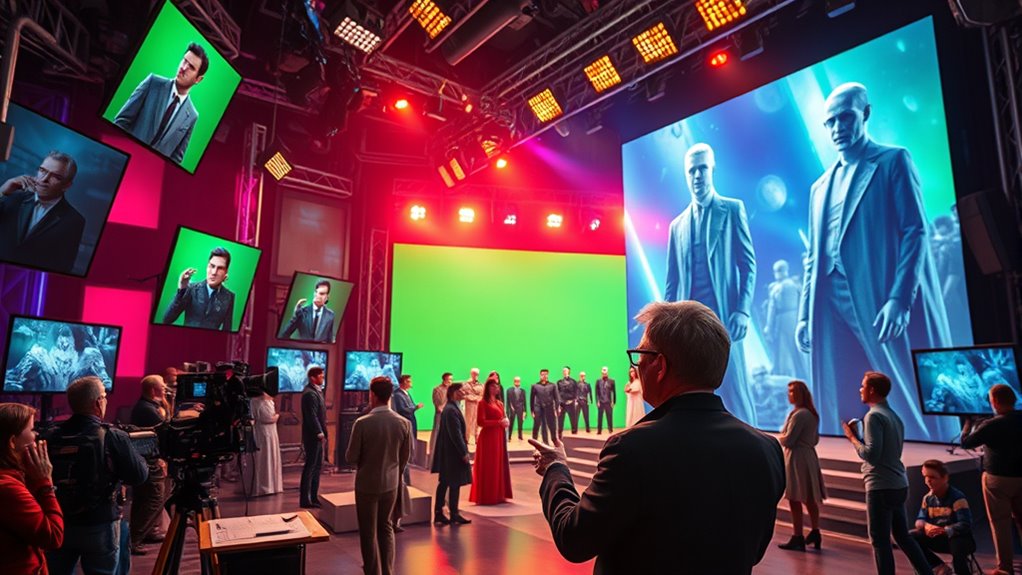
The Hollywood film industry is undergoing a rapid transformation fueled by artificial intelligence. By 2025, AI is expected to enable the creation of entire movies made entirely with AI, revolutionizing how films are produced. You’ll see a surge in AI-generated content that’s not only faster but also substantially cheaper than traditional filmmaking methods. This shift is powered by huge investments—venture capital in AI hit $55.3 billion by September 2024—fueling rapid innovation. As a result, studios can produce high-quality visual effects, animations, and even entire scenes without the extensive costs or time constraints of conventional methods. However, this progress raises questions about job security, especially for those working in visual effects, animation, and acting. Industry stakeholders are starting to develop agreements to balance the advantages of AI with protections for creative professionals, but the transition remains challenging.
One of the most groundbreaking developments is AI-generated virtual actors. Using advanced machine learning combined with CGI, these digital personas can be crafted with remarkable detail, capable of expressing complex emotions and performing a wide array of actions. You might be surprised to learn that these virtual actors can replace humans in dangerous or impractical scenes, reducing risks on set and cutting costs related to talent fees, scheduling, and physical logistics. These digital actors are powered by data-driven animation and neural networks, allowing them to deliver lifelike performances that rival human actors. Industry pioneers are already showcasing these virtual performers in prominent roles, hinting at a future where casting decisions could increasingly favor AI. This technology is increasingly accessible, making it feasible for smaller studios and independent creators to utilize digital actors in their projects. Additionally, the integration of machine learning algorithms enhances the realism and adaptability of digital performances, further expanding their potential uses.
AI-generated virtual actors are revolutionizing film with detailed, lifelike performances that reduce risks and costs on set.
The benefits of AI virtual actors are clear: they provide consistency, eliminating unpredictable performances; they reduce on-set injuries; and they open up creative possibilities that are difficult or impossible with human actors. Filmmakers can craft stories with fantastical or diverse characters more easily, giving rise to new narrative possibilities. Yet, these technological advances aren’t without controversy. During the 2023 SAG-AFTRA strike, concerns about job displacement intensified, with fears that AI could replace background actors or even lead to the unauthorized digital replication of performers without proper consent or compensation. Industry contracts are now trying to address these issues, establishing protections for actors and setting boundaries for digital likeness use. Still, the ethical landscape remains complex, with ongoing debates about consent, bias in AI training data, and transparency in AI’s role in storytelling.
AI’s influence extends beyond acting—it’s transforming screenwriting and story development as well. AI tools analyze vast collections of scripts to identify patterns that resonate with audiences, helping writers craft more engaging stories. Platforms like ScripAI and RunwayML assist in generating drafts tailored to specific genres or demographics, enabling more personalized storytelling. This data-driven approach allows filmmakers to better align narratives with audience preferences, potentially reshaping how movies are conceived from the ground up. As AI continues to evolve, it’s clear that the future of Hollywood will be shaped by a blend of human creativity and digital innovation, raising questions about what it truly means to be an actor or storyteller in the digital age.

Wicked – Bonus X-Ray Edition
As an affiliate, we earn on qualifying purchases.
As an affiliate, we earn on qualifying purchases.
Frequently Asked Questions
Can Ai-Created Actors Evoke Genuine Emotional Responses From Audiences?
You might wonder if AI-created actors can genuinely evoke emotional responses. While they can generate complex emotions and even foster empathy, their authenticity often falls short due to subtle differences and the uncanny valley effect. Advances like biosensors could improve their emotional intelligence, but current limitations mean your emotional connection may still feel somewhat artificial. Over time, technology may bridge this gap, making AI actors more convincing and emotionally impactful.
What Are the Legal Implications of Using Digital Actors?
The legal implications of using digital actors involve complex issues around consent, rights, and compensation. You need to guarantee clear agreements that protect digital likeness rights and prevent unauthorized use. State laws like California’s require explicit consent, and unions like SAG-AFTRA advocate for fair compensation and safeguards. Without proper legal measures, you risk infringing on actors’ rights, facing lawsuits, or damaging your reputation through misuse or unauthorized replication.
How Affordable Are AI Actors Compared to Human Performers?
You might think AI actors are just a cheap alternative, but the truth is, they’re remarkably affordable. While human performers cost $300 to $800 per video, AI options are only $20 to $50, saving you thousands. Plus, AI speeds up production, eliminates multiple rounds of auditions, and cuts costs on reshoots. However, remember, AI lacks human emotional depth, so blending both might be the smartest way to balance cost and quality.
Will AI Actors Ever Win Acting Awards or Receive Recognition?
You wonder if AI actors will ever win awards or gain recognition. Currently, AI plays supporting roles or assists human actors but isn’t credited as the main performer in major awards. Industry experts believe AI may earn recognition through specialized tech awards rather than traditional acting categories. As AI-generated performances become more realistic, this could change, but for now, human creativity and emotion still dominate award recognition processes.
How Do Audiences Feel About Digital Actors Replacing Humans?
You might find it surprising, but only about 30% of audiences fully trust digital actors to deliver authentic performances. Many feel uneasy about replacing human talent, fearing it could diminish genuine emotion and storytelling depth. You may worry about losing the personal touch that real actors bring, and ethical concerns about AI copying styles or replacing creativity. Overall, audiences are cautious, valuing authenticity while grappling with the evolving role of technology in entertainment.

Grok AI – Artificial Intelligence for Software Programmers Tote Bag
Grok AI is at the frontier machine learning research with truth-seeking answers, real-time insights, advanced reasoning and a…
As an affiliate, we earn on qualifying purchases.
As an affiliate, we earn on qualifying purchases.
Conclusion
As the curtain falls on this new era, you stand at the crossroads of innovation and tradition. Digital actors shimmer like stars born from code, promising endless creativity yet casting shadows of uncertainty. The Hollywood stage is transforming into a labyrinth of possibilities, where human touch and artificial precision dance in an intricate ballet. Ultimately, your choice will determine whether this digital dawn becomes a shining new chapter or a ghostly echo of the past.
CGI character creation kit
As an affiliate, we earn on qualifying purchases.
As an affiliate, we earn on qualifying purchases.

HUE Animation Studio: Complete Stop Motion Animation Kit (Camera, Software, Book) for Windows/macOS (Black)
COMPLETE STOP MOTION ANIMATION KIT including the HUE HD USB camera with integrated microphone, easy-to-use stop motion software…
As an affiliate, we earn on qualifying purchases.
As an affiliate, we earn on qualifying purchases.