
TL;DR

Get everyday essentials delivered free with Prime
- Fast, free delivery on millions of items
- Prime Video, Amazon Music and more included
- Member-only deals all year
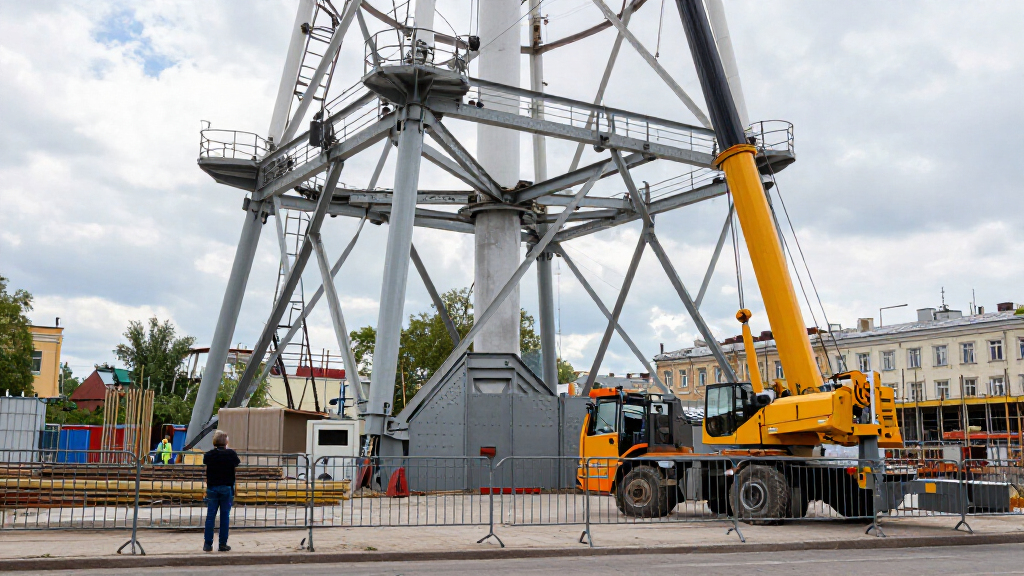
Moscow’s state-owned broadcaster RTRS plans to dismantle almost all of the Shabolovka Tower this fall and replace its original steel as part of a project scheduled for completion by 2028. Preservation specialists quoted by Meduza argue that retaining the original metal is essential to preserving engineer Vladimir Shukhov’s work. The project’s detailed schedule and the amount of original material that would remain are unclear from the available report.
Moscow’s Russian Television and Radio Broadcasting Network (RTRS), owner of the 1922 Shabolovka Tower, plans to dismantle almost all of its original steel this fall and replace it with a replica by 2028, according to a report by Meduza published September 30. Specialists quoted in the report say replacing the metal would destroy a material part of engineer Vladimir Shukhov’s landmark work, even if the tower’s shape is reproduced.
The planned work concerns the lattice tower in Moscow’s Shabolovka neighborhood, one of Shukhov’s best-known structures. Meduza reports that RTRS intends to dismantle nearly the entire tower and replace it with a replica. The network owns the structure; the report does not provide a detailed construction schedule or say how much original material would be retained.
Preservation specialists cited by Meduza argue that the tower’s historic value lies in its original steel as well as its recognizable form. Their objection is that reproducing the outline while replacing almost all the metal would not preserve the original structure in a meaningful material sense. RTRS’s stated plan, as described in the report, is to complete the replica by 2028.
The tower was built from 1919 to 1922 and stands 144 meters (about 470 feet) tall. Its interlaced steel rods form a series of hyperboloid sections. Shukhov developed this structural approach to create strong, relatively light towers that used less metal than conventional designs; the lattice also allows wind to pass through. The planned replacement therefore affects an example of a specific engineering method, not just a familiar Moscow silhouette.
Preserving Shukhov’s Original Steel
The dispute turns on what it means to restore an engineering landmark. A replica could reproduce the tower’s visible profile, but the specialists quoted by Meduza say the original steel is part of the work’s historic value. If almost all of it is removed, future visitors may see a structure that looks like Shukhov’s tower without encountering most of the material he designed and built.
The decision also matters because the Shabolovka Tower is a prominent feature of its neighborhood and a record of Soviet engineering in the early 1920s. Its lightweight lattice design was an influential expression of Shukhov’s work. The proposed project could preserve the form while changing the physical object that carries that history. How RTRS weighs structural work against material conservation will shape what remains of the landmark after the project.
Top picks for "moscow about restore"
As an affiliate, we earn on qualifying purchases.
From Radio Landmark to Television Tower
The tower was built during the Russian Civil War, when materials were scarce. Shukhov originally proposed a structure reaching 350 meters (about 1,150 feet), but the completed tower had six sections and stood 144 meters. Meduza’s account says there was not enough metal to build the taller design. The project was backed by Vladimir Lenin, who saw radio as a powerful communications tool.
When it opened in 1922, the structure was known as the Comintern Radio Tower and became the country’s main radio transmitter. It first carried a television signal in 1937, with regular broadcasts beginning on March 10, 1939. It served as the Soviet Union’s main television tower until the Ostankino Tower was built. Its appearance in photographs by Alexander Rodchenko and on a book cover by Vladimir Mayakovsky also helped establish it as a cultural landmark.
Shukhov’s lattice hyperboloid designs date to the late 19th century. They use straight rods set at angles and secured by rings, distributing weight across the structure. The method allowed towers to use comparatively little metal and required relatively shallow foundations. The Shabolovka Tower’s design has 48 supports, according to the report.
“Preserving the original metal matters as much as preserving the tower’s shape.”
— Preservation specialists quoted by Meduza
How Much Original Steel Remains
The report does not specify the engineering grounds for dismantling the tower, the condition of its steel, or why RTRS considers replacement necessary. It also does not detail the work sequence, identify which components might be retained, or provide the full project schedule beyond a planned start this fall and completion by 2028. Those details would help clarify how much of the historic structure could survive.
There is also a separate uncertainty in the tower’s construction history. Some accounts say a cable snapped while a section was being lifted and a worker died; Bagautdinov told Meduza that official sources do not indicate a death in that incident. He said two people died during construction under other circumstances. The report says the story of Shukhov receiving a “suspended death sentence” appears in his diary, but supporting archival evidence has not been established.
RTRS’s Planned Work Through 2028
RTRS is expected to begin dismantling work in fall 2026, according to Meduza, with the replica planned for completion by 2028. The report does not identify an exact start date or say whether the timetable has received any revisions.
Further information from RTRS about the project’s engineering rationale, conservation approach, and plans for the original steel would clarify what the completed tower is expected to preserve. The dispute will depend in part on whether the project retains historic material or reproduces the design using replacement metal.
Key Questions
What is Moscow planning to do to the Shukhov Tower?
RTRS plans to dismantle almost all of the tower’s original steel this fall and replace it with a replica scheduled for completion by 2028, according to Meduza.
Why do preservation specialists object?
Specialists quoted by Meduza say the tower’s original metal is part of its historic value. Reproducing its shape while replacing nearly all the steel would leave a replica rather than preserve most of the original structure.
Who owns the tower?
The Russian Television and Radio Broadcasting Network (RTRS) owns the Shabolovka Tower, according to the report.
When was the tower built?
Construction took place from 1919 to 1922. The completed tower stands 144 meters tall.
What remains unknown about the project?
The report does not give the technical reasons for replacing the steel, the detailed schedule, or the amount of original material that would be retained. RTRS’s full conservation plans are not specified in the available account.
Source: rss
Fall Picks
fall essentials
As an affiliate, we earn on qualifying purchases.