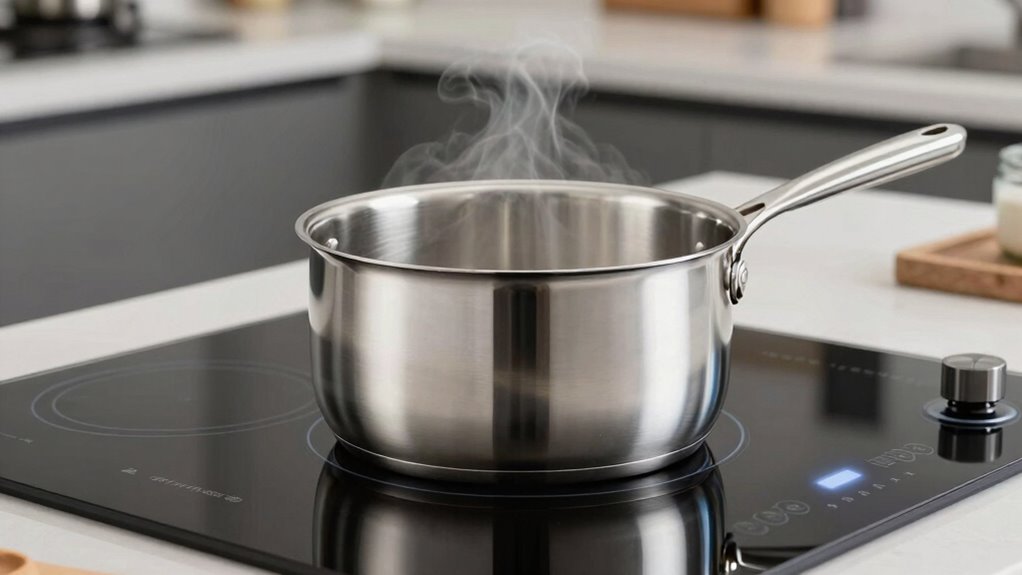

To find out if your cookware works on induction, check for labels that say “induction-compatible” or look for symbols indicating so. The easiest way is to test with a strong magnet—hold it against the bottom. If it sticks firmly, your cookware is likely suitable. If it doesn’t, it probably isn’t unless you use a special adapter. For more tips, you’ll discover how material and construction impact induction compatibility.

Get everyday essentials delivered free with Prime
- Fast, free delivery on millions of items
- Prime Video, Amazon Music and more included
- Member-only deals all year
Key Takeaways
- Look for “induction-compatible” labels or symbols on the cookware.
- Use a strong magnet to test if it sticks firmly to the bottom.
- Confirm if the cookware is made of ferromagnetic materials like cast iron or stainless steel.
- Check for layered or magnetic bases that enhance induction performance.
- Consider using an induction adapter if non-magnetic cookware is your only option.
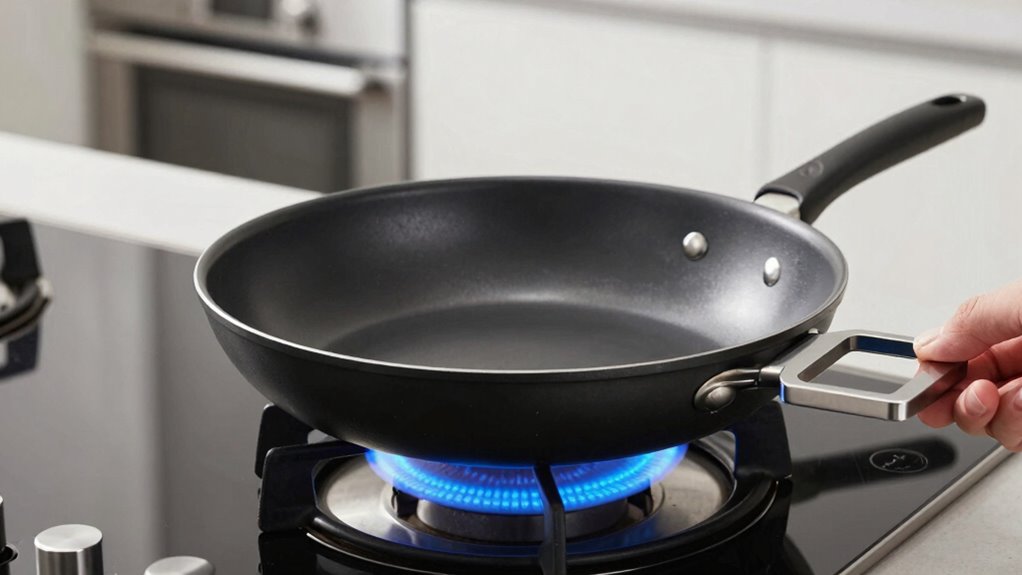
If you’re wondering whether your cookware is compatible with induction cooking, there’s a simple way to find out. The key lies in understanding material compatibility and performing a quick magnetic test. Induction cooktops work by creating a magnetic field that heats cookware directly, so not all materials work equally well with them. Knowing whether your pots and pans can harness this technology saves you time and money, ensuring you don’t buy unnecessary replacements or face frustration in the kitchen.
Start by examining the bottom of your cookware. Many brands label their products as “induction-compatible” or display symbols indicating this feature. If there’s no label, don’t worry—your next step is to test the material compatibility yourself. The magnetic test is straightforward and reliable. Grab a magnet, preferably a strong one like a neodymium magnet, and hold it against the bottom of your cookware. If the magnet sticks firmly, your cookware is likely suitable for induction. If the magnet doesn’t stick or only weakly adheres, then your cookware probably isn’t compatible with induction cooktops.
Use a strong magnet to quickly test if your cookware works with induction stoves.
Understanding material compatibility is crucial because induction cooking relies on ferromagnetic metals. Cast iron and most stainless steel cookware usually work well since they are magnetic. Aluminum, copper, glass, and pure non-magnetic stainless steel won’t heat up on induction stoves unless they have a special magnetic layer inside. So, even if your cookware is made of stainless steel, it might not be induction-compatible unless it’s ferromagnetic. Remember, the magnetic test is your quickest way to confirm this without any guesswork. It’s a simple, chemical-free method that provides immediate results. Additionally, knowing the magnetic properties of your cookware can help you determine its induction compatibility more accurately.
To ensure optimal performance, verify whether your cookware has an induction-compatible base, as some manufacturers design cookware with layered or magnetic bases specifically for this purpose. If you’re unsure about the composition, a material analysis can provide detailed information about the metals used. Moreover, some cookware may feature a layered construction to improve its magnetic response. Keep in mind that some cookware may be marketed as compatible, but the magnetic test offers an extra layer of certainty. If your magnet sticks, you’re good to go. If it doesn’t, you might consider investing in induction-specific cookware or using adapters designed to work with non-magnetic pots. These adapters sit between the cooktop and your cookware, allowing you to use your existing pots on induction stoves. However, they might not be as efficient or as fast as cookware specifically designed for induction.
As an affiliate, we earn on qualifying purchases.
Frequently Asked Questions
Can I Use My Non-Stick Pots on Induction Cooktops?
Yes, you can use your non-stick pots on induction cooktops if they’re compatible. To check, perform a magnetic test—place a magnet at the bottom of your pot. If it sticks firmly, your non-stick cookware is non-stick compatible with induction. If it doesn’t, it won’t work efficiently on induction cooktops. Always verify non-stick compatibility through this simple test to confirm your cookware suits your induction stove.
Do All Stainless Steel Cookware Work With Induction?
Not all stainless steel cookware dances on induction’s magnetic tune. Some materials are like a locked door, unresponsive to induction’s magnetic pull, while others are open arms ready to embrace the heat. To test, hold a magnet to your cookware; if it sticks firmly, your stainless steel is magnetically compatible. If not, you might need a special base or choose cookware explicitly designed for induction.
How Can I Test My Cookware Without a Magnet?
You can perform a magnet test to check your cookware’s material compatibility with induction cooking. If a magnet sticks firmly to the bottom, it’s likely induction-compatible, even without knowing the specific material. This quick test helps you identify suitable cookware without relying solely on labels. Keep in mind, though, some non-magnetic stainless steel may still work, so double-check with manufacturer info if possible.
Are Induction-Compatible Pans More Expensive?
Induction-compatible pans tend to be more expensive, mainly due to material differences and the manufacturing process. You’ll see a higher cost comparison because quality magnetic stainless steel or cast iron costs more than standard cookware. These materials guarantee efficient heat transfer and durability. So, yes, induction-compatible pans usually come with a higher price tag, but they offer better performance and longevity, making them a worthwhile investment for induction cooking.
Can I Convert My Existing Cookware for Induction Use?
Yes, you can convert your existing cookware for induction use with a magnetic interface disk or induction adapter plate. This method guarantees induction safety and enhances cookware durability, allowing your current pots and pans to work on induction stoves. Just place the adapter between the cooktop and your cookware, making sure it’s compatible with your pan’s material. This simple conversion saves money and extends the life of your cookware.
Conclusion
Think of your cookware as a key, and your induction stove as a lock waiting to be opened. When they fit perfectly, the magic happens—your pots and pans heat up swiftly, making cooking a breeze. If they don’t click into place, it’s like trying to open a lock with the wrong key. So, test your cookware with a magnet—if it sticks, you’re ready to access the full potential of your induction cooktop and enjoy seamless cooking adventures.
Halloween Picks
halloween
As an affiliate, we earn on qualifying purchases.