
Time-weighted returns measure how well your investments perform ignoring the timing of cash flows, making them ideal for comparing fund managers or strategies. Money-weighted returns, like IRR, account for the actual timing and amount of your contributions or withdrawals, showing your personal investment results. Understanding these helps you see performance from different perspectives. Keep exploring to discover how choosing the right metric can impact your investment analysis and decision-making.
Key Takeaways
- Time-weighted returns measure investment performance ignoring cash flow timing, focusing on the fund’s skill or market movement.
- Money-weighted returns (IRR) account for cash flow timing, reflecting individual investment behavior and personal results.
- Time-weighted returns are ideal for comparing fund manager performance; money-weighted returns evaluate personal investment success.
- Time-weighted returns are less sensitive to cash flow timing, while money-weighted returns are highly affected by contribution and withdrawal timing.
- Both metrics serve different purposes: one for objective performance comparison, the other for personal portfolio evaluation.
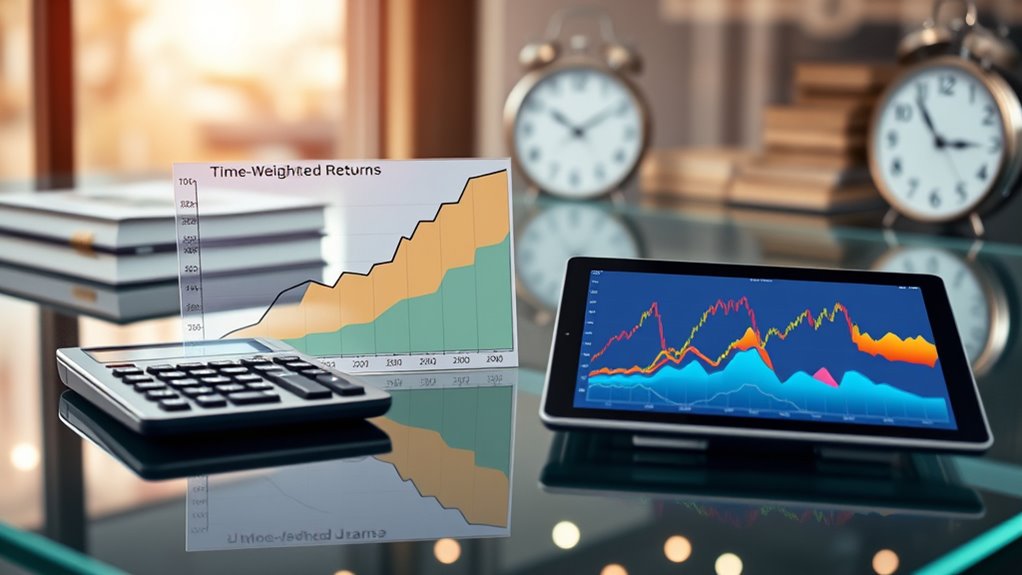
When evaluating investment performance, understanding the difference between time-weighted and money-weighted returns is essential. These two metrics serve distinct purposes and can influence how you interpret your investment’s success. Time-weighted returns focus on the investment’s performance itself, unaffected by the timing of your cash flows. This method employs a cash flow analysis to break down your investment period into segments, calculating growth within each, and then compounding these results to determine overall performance. It’s especially useful when comparing funds or managers, as it isolates the investment’s ability to generate returns regardless of how much or when you added or withdrew money.
Time-weighted returns measure investment performance independent of cash flow timing.
On the other hand, money-weighted returns, often called internal rate of return (IRR), take your specific cash flow timing into account. If you’re actively adding or withdrawing funds, this method provides a personalized view of your investment’s performance, reflecting the impact of your decisions. In this case, cash flow analysis becomes critical, as the timing and size of your transactions directly influence the calculated return. Money-weighted returns give you a clearer picture of how well your investments have performed considering your actual investment behavior, making them particularly relevant when evaluating your personal investment performance.
You need to recognize that the choice between these two metrics depends on what you want to measure. If you’re interested in understanding how well the underlying investment itself has performed, regardless of your cash flows, the time-weighted return is more appropriate. It removes the effect of inflows and outflows, offering a pure measure of investment skill or market movement. Conversely, if your goal is to evaluate the success of your overall strategy, including the timing of your contributions and withdrawals, then money-weighted returns give a more accurate reflection.
Both approaches require careful cash flow analysis, but they serve different analytical purposes. Time-weighted returns are less sensitive to your personal cash flow timing and are more useful for benchmarking or comparing investments. Money-weighted returns, however, are highly sensitive to when and how much you invest, making them better suited for judging your individual investment performance over a specific period. By understanding these differences, you can better interpret your investment results, make informed decisions, and set realistic expectations for future performance. Ultimately, knowing which return method aligns with your goals helps you evaluate your investments more accurately and manage your portfolio more effectively.
McCook® Knife Sets, German Stainless Steel Kitchen Knife Block Sets with Built-in Sharpener
【Exclusive Built-in Sharpener】Kitchen knife set with sharpener is amazing. The self-sharpening block keeps the knives razor sharp effectively....
As an affiliate, we earn on qualifying purchases.
Frequently Asked Questions
How Do Returns Impact Investment Decision-Making Differently?
Returns influence your investment decisions by shaping your risk perception and market timing strategies. If you see strong returns, you might feel confident to take on more risk or try market timing. Conversely, poor returns can make you cautious, delaying or adjusting investments. Understanding how different returns reflect performance helps you make smarter choices, balancing risk and timing to meet your financial goals effectively.
When Should Investors Prefer Time-Weighted Over Money-Weighted Returns?
Think of choosing between time-weighted and money-weighted returns like selecting a map over a compass; you need the right tool for the journey. You should prefer time-weighted returns when evaluating a fund’s performance comparison across periods, especially when risk adjustment matters. It isolates manager skill from cash flow effects, giving you a clearer picture of consistent performance, ideal for comparing different investments objectively.
Can Returns Be Misleading Without Context of Investment Goals?
Returns can definitely be misleading without understanding your investment context. If you focus only on raw numbers, you might misinterpret performance, especially if your goals involve specific time horizons or risk levels. Always consider your investment goals when interpreting returns, as they shape how you evaluate success. Without this context, you risk making decisions based on incomplete information, which can lead to poor performance interpretation and misguided investment choices.
How Do Withdrawals and Deposits Affect the Calculation Methods?
Withdrawals and deposits substantially impact the calculation methods by introducing cash flows that affect the results. With time-weighted returns, these cash flows are excluded from the performance calculation, minimizing timing effects. Conversely, money-weighted returns incorporate cash flows, making them sensitive to the timing of deposits and withdrawals. This means your investment’s performance could look different depending on when you add or take out funds, highlighting the importance of considering cash flow timing.
Are There Tools to Automatically Calculate These Return Types?
Imagine holding a powerful tool in your hands that reveals your true investment performance. Yes, automated calculators and software tools exist to automatically compute these return types. They simplify complex calculations, accounting for deposits and withdrawals, and save you time. With just a few inputs, you get precise results. These tools make analyzing your investments effortless, helping you make smarter decisions and unleash your financial potential more easily than ever before.

Knife Set, Astercook 15 Pieces Knife Sets for Kitchen with Block, Dishwasher Safe Kitchen Knife Set with Built in Sharpener Block, German Stainless Steel Knife Block Set, Valentine's Gift
【15 Pieces Multipurpose Knife Set】 15 pieces knife set includes: 8" Chef knife, 8" Slicing knife, 7" Santoku...
As an affiliate, we earn on qualifying purchases.
Conclusion
Understanding the difference between time-weighted and money-weighted returns helps you evaluate your investments better. Remarkably, studies show that over the long term, the average investor’s money-weighted returns can lag behind time-weighted returns by up to 2%, mainly due to timing mistakes. By knowing which measure reflects your true experience, you can make smarter decisions and avoid common pitfalls. Remember, tracking both gives you a clearer picture of your investment performance and helps you stay on course.

HENCKELS Statement Premium Quality 15-Piece Set with Block, Natural, Razor-Sharp, German Engineered Informed by 100+ Years of Mastery, Lightweight and Strong, Dishwasher Safe
ULTRA-SHARP BLADES: Superior professional-level sharpness that ensures precision cutting.
As an affiliate, we earn on qualifying purchases.

Brother HL-L2480DW Wireless Compact Monochrome Multi-Function Laser Printer with Copy and Scan, Duplex, Mobile, Black & White | Includes Refresh Subscription Trial(1), Works with Alexa
BEST FOR SMALL OFFICES & WORK FROM HOME – Engineered for efficiency, the Brother HL-L2480DW Monochrome (Black &...
As an affiliate, we earn on qualifying purchases.