
TL;DR

Get everyday essentials delivered free with Prime
- Fast, free delivery on millions of items
- Prime Video, Amazon Music and more included
- Member-only deals all year
Halloween party supplies fall into six categories: decorations, tableware, serveware, balloons and banners, favors, and costumes or accessories. According to the National Retail Federation, US Halloween spending has topped $10–12 billion annually, with average households spending roughly $100–170 — but a complete party is doable for $50–100 if you buy in September and mix dollar-store finds with one or two statement pieces.
Your neighbors put a twelve-foot skeleton in their yard in August. It’s not even fall yet, and somehow you’re already behind. Welcome to modern Halloween, where 70%+ of Americans plan to celebrate and US spending has pushed past $10–12 billion a year [1].
Here’s the good news: throwing a memorable Halloween party isn’t about outspending the yard-haunt guy next door. It’s about buying the right supplies at the right time, in the right quantities. This guide gives you the full checklist, a budget breakdown, and the timing tricks most people learn too late.
Think of this as your research brief for one great party — decorations, tableware, that cauldron punch bowl you’ve been eyeing, and everything in between.
Shop the six supply categories — decorations, tableware, serveware, balloons/banners, favors, costumes — and split your budget roughly 50/30/20 across the firs…
Mid-September to early October is the sweet spot: full stock plus frequent sales. November 1 clearance (50–75% off) is for stocking up on next year.
Buy basics at dollar stores, splurge only on 2–3 statement pieces like a cauldron punch bowl or photo backdrop that guests actually interact with.
Plan 2.5 plates and 2–3 cups per guest, plus 10% extra favor bags for plus-ones.
Pick your theme before shopping — it cuts decision fatigue and prevents impulse buys that don’t match anything.
The 6 Categories of Supplies Every Halloween Party Actually Needs
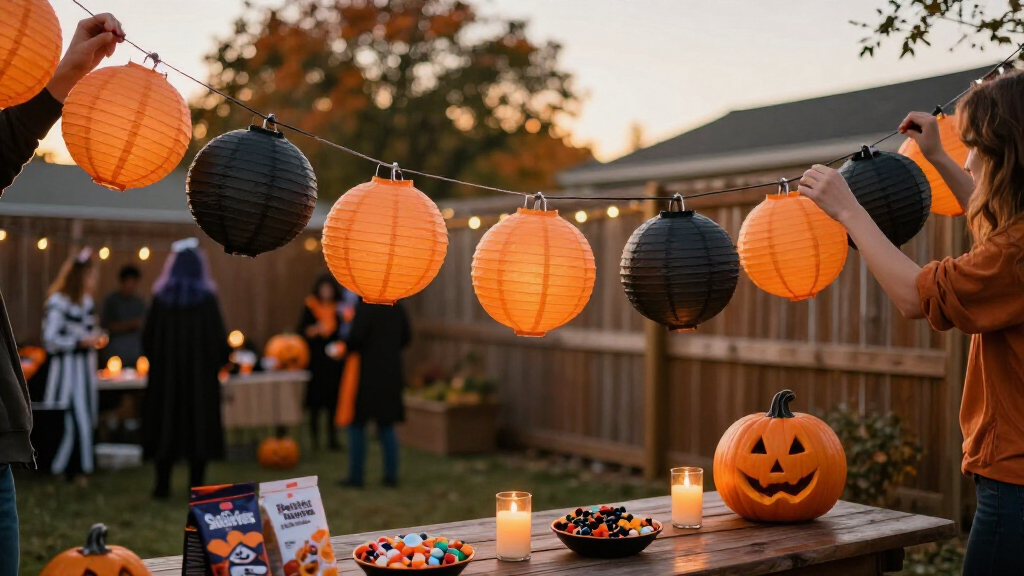
Halloween party supplies break down into six practical categories: decorations, tableware, serveware and food presentation, balloons and banners, party favors, and costumes or accessories. Skip one and you’ll feel it — a party with great décor but plain white plates falls flat, like a haunted house with the lights on.
Here’s the full rundown:
- Decorations: inflatables, string lights, spider webs, window clings, tombstones, smoke machines, and projection lights.
- Tableware: themed plates, cups, napkins, tablecloths, and utensils.
- Serveware & food presentation: cauldron punch bowls, skull serving trays, themed cupcake toppers.
- Balloons & banners: latex and foil (mylar) balloons, photo backdrops.
- Party favors & treat bags: mini toys, stickers, candy bags.
- Costumes & accessories: adult, kids’, pet costumes, and group themes.
Last October I watched a friend host 20 people with nothing but stretchy spider webs, purple string lights, orange plates from the dollar store, and a dry-ice punch bowl. Total cost: about $60. Guests took more photos at that party than at a $400 catered event, because every corner had something to point at.
Rule of thumb: decorations create the atmosphere, but tableware and serveware are what guests actually touch. Split your budget roughly 50/30/20 across those three.
Pick Your Theme First — It Cuts Your Shopping List in Half
Choosing a theme before you shop is the single biggest money-saver in Halloween party planning, because it filters out every tempting-but-wrong item. A theme is a decision-making machine: once you’ve picked gothic dinner party, the pumpkin tumblers and cartoon ghost banners stop being options.
Popular themes right now split cleanly by crowd:
| Theme | Best For | Signature Supplies |
|---|---|---|
| Classic spooky (ghosts, witches, skeletons) | All ages, safe default | Spider webs, tombstones, orange/black everything |
| Spooky-cute / kawaii | Kids’ parties | Smiling ghosts, pastel pumpkins, friendly bat banners |
| Horror-movie aesthetic | Adult parties | Projection lights, smoke machines, blood-red tablecloths |
| Elegant gothic dinner party | Grown-up entertaining | Black candles, gold-rimmed plates, velvet textures |
| Vintage / retro Halloween | Mixed crowds | Orange honeycomb balls, die-cut cats, paper lanterns |
| Día de los Muertos crossover | Multigenerational | Marigolds, sugar skull décor, papel picado banners |
Here’s how this plays out in real life. A colleague of mine planned a kids’ party for her 7-year-old and picked spooky-cute from the start — smiling ghost plates, pastel pumpkin centerpieces, and friendly bat banners. Her cart total came to $55, and she skipped the $30 horror animatronic she’d almost grabbed “because it was cool” but would have terrified the guest of honor. Compare that to a host who shops without a theme: they end up with a mix of pastel pumpkins, blood-red candles, and a pirate banner that all fight each other — usually $150+ of stuff that looks like three different parties happened in one room.
The elegant gothic Halloween dinner party trend has exploded on Pinterest and TikTok in the past few years, and it’s a smart pick if you hate cluttery décor — black taper candles and a skeleton centerpiece do more work than twenty cheap props. Picture a long table with a skeleton lounging among the candelabras like a dinner guest: that single $20 setup photographs better than a garage full of inflatables.
How Much to Buy: Per-Guest Math That Prevents Waste
For a Halloween party, plan on 2–3 plates and 2–3 cups per guest, one napkin per plate, and one favor bag per person — people graze at parties, and running out of plates mid-party is worse than having extras. This is where amateur hosts consistently underestimate.
Here’s a quick per-guest cheat sheet for a 3-hour party:
- Plates: 2.5 per guest (dinner + dessert round)
- Cups: 2–3 per guest, more if it’s warm or the punch is popular
- Napkins: 3 per guest — themed cocktail-size napkins are cheap multipurpose workhorses
- Favor bags: 1 per guest, plus 10% extra for plus-ones
- Punch: about 1 gallon per 10 guests
For a 20-person party, that means roughly 50 plates, 50 cups, 60 napkins, and 22 favor bags. Round up — leftover Halloween napkins store fine and you’ll use them next year.
To see why the math matters, picture the classic disaster: a first-time host buys exactly 20 plates for 20 guests. By 9pm, the dessert round has no plates, guests are balancing cupcakes on napkins, and someone’s using a plastic cup as a bowl. Meanwhile, the host who bought 50 plates spent maybe $6 more at dollar-store prices — and the extras go straight into a bin for next year’s party. Overbuying perishable food is waste; overbuying $2 plates is just early shopping.
When to Buy: The Timing That Saves You 50% or More
The best time to buy Halloween supplies is mid-September, when selection is full but pre-rush prices and sales are common; the worst-value window is the last week of October, when pickings are slim and discounts are zero. Thanks to retail lessons from past supply chain crunches, stores now stock Halloween as early as July and August [1].
The seasonal rhythm works like this:
- July–August: Seasonal sections appear (Target’s Bullseye’s Playground, Spirit Halloween pop-ups open). Best selection, average prices.
- Mid-September to early October: Peak purchasing season. Sales are frequent and stock is still deep. This is your window.
- Last week of October: Slim pickings, full price. Avoid.
- November 1 onward: Clearance hits 50–75% off. This is when you buy next year’s decorations, not this year’s.
Think of it like buying a Christmas tree on December 26th versus December 23rd — same tree, half the price, you just have to wait a year to use it. One neighbor of mine buys all her décor on November 3rd every single year. Her garage looks like a Spirit Halloween warehouse by December — and she spends about a third of what everyone else does. Case in point: the $60 twelve-foot skeleton that sold out at full price in October was sitting on clearance at 70% off the first week of November. Same skeleton, $18 difference, one year of patience.
Where to Shop: Budget Picks vs. Statement Pieces
Dollar stores, Target, Walmart, and Michaels are your best bets for budget Halloween supplies, while Amazon and Etsy shine for specific, personalized, or last-minute items with fast shipping. Party City and pop-up stores like Spirit Halloween dominate the seasonal specialty space but carry specialty prices [1].
The winning strategy is tiered shopping: buy the invisible basics cheap, and splurge on the two or three things guests will actually notice.
| Item Type | Best Source | Rough Cost |
|---|---|---|
| Plates, napkins, cups | Dollar store | $1–3 per pack |
| Spider webs, window clings | Dollar store / Walmart | $1–5 |
| Themed tableware sets | Target, Party City | $5–15 |
| Cauldron punch bowl, skull trays | Amazon, HomeGoods | $15–40 |
| Custom banners, personalized favors | Etsy | $10–35 |
| Inflatables, animatronics | Home Depot, Walmart | $25–150+ |
Dollar-store Halloween décor has become a massive content category on TikTok for a reason — a $1 pack of spider webbing stretched across a doorway looks nearly identical to the $6 version. Spend your savings on the punch bowl people will photograph.
5 Food Presentation Tricks That Look Expensive but Cost Under $20
Halloween food presentation works best when ordinary food gets one creepy rename and one themed prop — you don’t need a baking degree, you need a skeleton hand. Guests remember the punch bowl and the serving trays more than the actual food.
- Serve punch from a cauldron: a plastic witch’s cauldron bowl ($15–25) with dry ice or frozen berry “eyeballs” instantly becomes the party’s centerpiece.
- Skull tray for snacks: a skull-shaped serving tray makes plain chips feel intentional.
- Themed cupcake toppers: $5 packs of tiny ghosts and bats elevate store-bought cupcakes completely.
- Rename everything: “monster intestines” (pigs in a blanket), “witch fingers” (breadsticks with almond nails). Free, and guests love it.
- Orange and black layering: stack black tablecloth under orange platters — instant depth for under $10.
According to NRF surveys, decorations rank among the top three Halloween spending categories alongside candy and costumes [1] — but presentation supplies deliver more photo moments per dollar than almost anything else you’ll buy.
Eco-Friendly Swaps That Still Look Great
Eco-friendly Halloween supplies — reusable tableware, fabric banners, and compostable plates — have surged in demand as shoppers push back on single-use plastic décor. The swaps are genuinely easy, and most save money by year two or three.
Practical swaps that don’t sacrifice the vibe:
- Fabric or felt banners instead of plastic ones — fold flat and reuse for years.
- Paper straws and compostable plates instead of styrofoam and plastic.
- LED string lights and flameless candles instead of disposable tea lights — safer around kids, too.
- Real pumpkins and gourds as compostable centerpieces.
- Canvas or cotton treat bags kids can keep and reuse.
DIY culture deserves credit here too: Pinterest and TikTok are full of tutorials for “dupes” of expensive store-bought décor, from cheesecloth ghosts to rolled-paper pumpkins. A homemade cheeseloth ghost draped over a lamp costs about $2 and looks like a $25 boutique prop.
Frequently Asked Questions
How much should I budget for Halloween party supplies?
A solid Halloween party for 15–20 guests costs $50–100 in supplies: roughly $25–40 on decorations, $15–25 on tableware, $10–20 on serveware and favors. According to NRF surveys, the average US household spends $100–170 on Halloween overall, so a well-planned party comes in under the national average [1]. Splurge only on one or two statement pieces guests will photograph.
When do stores start selling Halloween supplies?
Most major retailers stock Halloween as early as July and August, with Spirit Halloween pop-ups typically opening by late August and Target’s seasonal section launching in late summer. Peak selection and pricing hit mid-September through early October. Shop then — the last week of October means picked-over shelves at full price.
Where can I find cheap Halloween party supplies?
Dollar stores are unbeatable for plates, napkins, spider webs, and window clings at $1–5 per item. Walmart, Target, and Michaels cover mid-range themed tableware, while Amazon offers fast shipping for last-minute needs and Etsy sells personalized banners and favors. Specialty stores like Party City have the widest selection but the highest prices on comparable items.
How many plates and cups do I need per guest?
Plan on 2–3 plates, 2–3 cups, and 3 napkins per guest for a three-hour party, since guests graze rather than eat one sit-down meal. For 20 guests, buy about 50 plates, 50 cups, and 60 napkins, plus 10% extra favor bags for unexpected plus-ones. Leftover themed napkins store easily for next year.
Are Halloween decorations reusable, and how should I store them?
Most quality decorations — fabric banners, LED string lights, inflatables, and plastic cauldrons — are fully reusable for 3–5+ years. Store them in labeled plastic bins by category (décor vs. tableware) in a cool, dry space, and buy replacements during November clearance at 50–75% off. Paper plates and napkins also keep fine if stored away from moisture.
Conclusion
If you remember one thing: theme first, timing second, tiered spending third. Pick a theme in August, buy 90% of your supplies at dollar stores and Target in mid-September, and save your real budget for the cauldron punch bowl and one great backdrop. That formula throws a $100 party that photographs like a $400 one.
And on November 1st, while everyone else is thinking about turkey, you’ll be calmly filling a cart with 75%-off skeletons. Your future self — the one hosting next October — will thank you.
Fall Picks
fall essentials
As an affiliate, we earn on qualifying purchases.