
If you’re choosing a robot vacuum, consider how it maps your space. Lidar systems use laser sensors for precise, real-time maps, easily detecting obstacles and adapting to changes. Camera-based models rely on visual sensors, performing well in good lighting but needing more power. Random navigation cleaners don’t create maps, leading to less efficiency and more missed spots. To discover which system suits your home best, continue exploring the differences in more detail.
Key Takeaways
- Lidar provides highly accurate, real-time maps and obstacle detection, ideal for complex environments.
- Camera-based systems offer detailed visual mapping but depend on good lighting conditions.
- Random navigation lacks mapping capabilities, leading to less efficient cleaning and higher collision risks.
- Lidar systems adapt quickly to environmental changes, ensuring comprehensive coverage.
- Choice depends on environment complexity, lighting conditions, and desired cleaning precision.
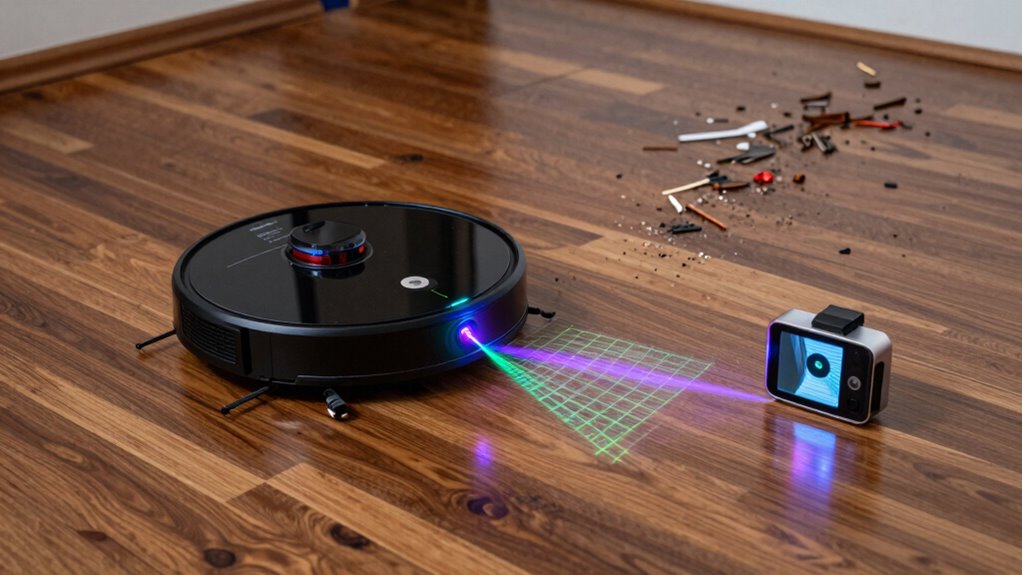
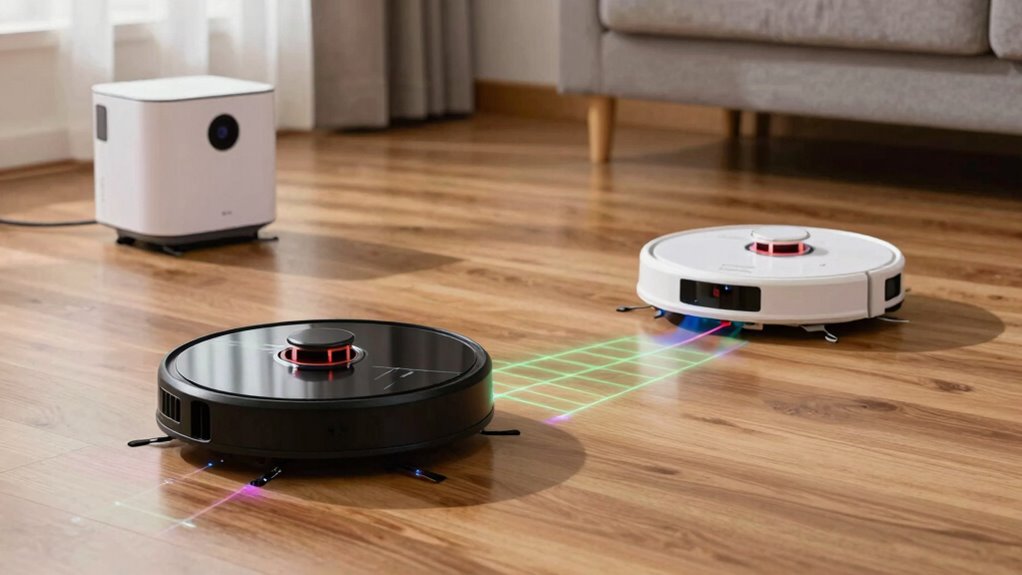
Robot vacuum mapping has revolutionized home cleaning by allowing devices to navigate efficiently and clean thoroughly. When it comes to mapping accuracy, the technology used plays a vital role in how well your robot can understand and maneuver around your space. The more precise the mapping, the better your vacuum can plan its route, avoid missed spots, and optimize cleaning time. Different systems utilize various methods to achieve this, with lidar, cameras, and “random” navigation standing out as the most common approaches.
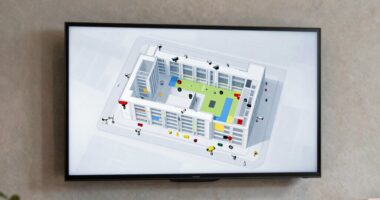
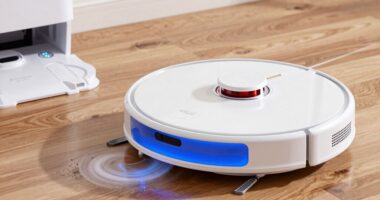
Lidar-based mapping employs laser sensors to scan your environment, creating detailed, real-time maps. This technology excels at mapping accuracy because it provides precise distance measurements and spatial details. With lidar, your robot can recognize walls, furniture, and obstacles with high confidence, even in low-light conditions. Obstacle detection becomes highly reliable, allowing the vacuum to identify and avoid objects before collision occurs. This results in fewer bumps, scratches, and missed spots. The system’s ability to quickly adapt to changes — like moving furniture or new clutter — ensures thorough coverage and efficient cleaning paths. Overall, lidar offers a significant advantage in environments with complex layouts or many obstacles, making it ideal for meticulous cleaning.
In contrast, camera-based systems rely on visual sensors to map your home. These vacuums use image processing and depth perception to understand their surroundings. While they can produce detailed maps, their mapping accuracy can vary depending on lighting conditions and the quality of the camera. Cameras excel in obstacle detection when there’s good lighting, allowing the robot to recognize objects and plan routes accordingly. However, in dim or overly bright environments, their performance may decline, potentially leading to missed spots or collisions. Cameras also tend to require more processing power, which can impact battery life and speed. Still, they can offer benefits like identifying specific objects or even recognizing rooms, which lidar may struggle with. Additionally, advancements in European cloud computing infrastructure are fostering smarter algorithms that improve visual processing in these devices.
Lastly, some robot vacuums use “random” navigation, which relies on simple algorithms guiding the device to move in patterns until the entire area is covered. This method doesn’t create maps or detect obstacles proactively but instead depends on thorough coverage over time through repeated, random movements. While this approach is straightforward and less costly, it sacrifices mapping accuracy and obstacle detection capability. As a result, cleaning can be less efficient, with more missed spots and potential collisions, especially in cluttered spaces.
Ultimately, your choice depends on your home’s complexity and your priorities. If you want precise mapping, reliable obstacle detection, and efficient cleaning, lidar is the top option. For environments where visual detail matters or where lighting is consistent, cameras can perform well. If you’re on a budget or have minimal clutter, a robot with random navigation might suffice, but it won’t match the efficiency of the other methods.

Lefant LiDAR Robot Vacuum and Mop, Smart Mapping and Obstacle Avoidance, Tangle-Free Pet Hair, 2.4G/5G WiFi App Control, Slim Design for Wider Coverage, Carpet Detection, M330 Pro
【dToF Navigation & Multi-Floor Mapping】With advanced dToF navigation, the Lefant M330 Pro lidar robot vacuum efficiently scans up…
As an affiliate, we earn on qualifying purchases.
As an affiliate, we earn on qualifying purchases.
Frequently Asked Questions
How Does Robot Vacuum Mapping Affect Cleaning Efficiency?
Your robot vacuum’s mapping considerably boosts cleaning efficiency by improving obstacle detection, so it avoids furniture and falls, and optimizes its path. With better navigation, it covers more area faster, reducing cleaning time. Plus, efficient mapping helps with battery management, preventing unnecessary recharging, and ensuring thorough cleaning without interruptions. Overall, effective mapping means a cleaner home with less effort and more reliable performance from your vacuum.
Can Mapping Technology Identify Specific Room Types?
Yes, mapping technology can identify specific room types through room type recognition, enhancing your cleaning efficiency. You benefit from sensor accuracy, which allows the robot to distinguish between spaces like kitchens or bedrooms. This enables the vacuum to tailor cleaning patterns, prioritize high-traffic areas, and avoid unnecessary overlaps. With precise sensors, your robot becomes smarter at steering your home, ensuring thorough and efficient cleaning tailored to each room’s needs.
What Are the Maintenance Requirements for Different Mapping Systems?
Think of maintaining your robot vacuum’s mapping system like tuning a musical instrument. You’ll need to regularly calibrate sensors, ensuring accuracy over time, especially for lidar and camera systems. Lidar demands less frequent calibration but can be affected by dust or obstructions, while cameras may need cleaning. Keep an eye on power consumption, as more advanced systems might drain your battery faster, and clean sensors to prevent errors.
Do Sensors Work Equally Well on All Floor Types?
Sensors don’t work equally well on all floor types. Lidar sensors offer high accuracy and reliable obstacle detection on smooth, reflective surfaces but can struggle with transparent or dark floors. Cameras provide good obstacle detection on varied surfaces but may be affected by lighting conditions. Random navigation relies less on sensors and may have inconsistent sensor accuracy, making it less effective on complex or uneven floors.
How Does Mapping Impact Future Navigation Improvements?
Mapping is like giving your robot vacuum a detailed map of your home, which boosts its navigation adaptability and accuracy. When mapping improves, your vacuum learns to avoid obstacles and cover all areas efficiently, making future upgrades smoother. Better mapping means smarter navigation, reducing missed spots and accidents. Fundamentally, accurate mapping sets the foundation for continuous improvements, ensuring your vacuum gets better at cleaning and adapting to your home’s evolving layout.

Eureka E20 Robot Vacuum with Bagless Self Emptying Station, Robotic Vacuum and Mop Combo, 45-Day Capacity, Upgraded 8000Pa Suction and Anti Hair-Tangling Brush, LiDAR Navigation, App Control
【Bagless Self-emptying Station】Say farewell to messy, wasteful cleaning with eureka E20 Plus bagless self-emptying station. This system keep…
As an affiliate, we earn on qualifying purchases.
As an affiliate, we earn on qualifying purchases.
Conclusion
In the battle of mapping methods, lidar, camera, and random navigation each have their perks. But if you want your robot vacuum to conquer your entire home like a tiny cleaning superhero, lidar’s precision and reliability make it the clear winner. Don’t settle for a vacuum that wanders aimlessly—you deserve a device that maps your space better than a detective on a case. Choose wisely, and watch your floors sparkle without lifting a finger!
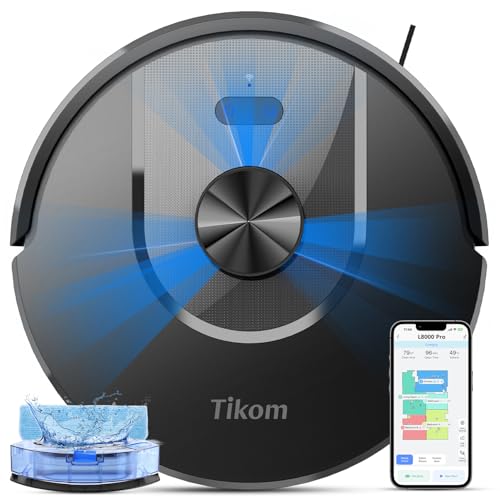
Tikom Robot Vacuum and Mop Combo, 6000Pa Automatic Robotic Vacuum Cleaner, Smart Mapping, 150 Min Max, Ideal for Pet Hair, Hardfloors, Carpets, Home(L8000 Pro)
6000Pa Powerful Suction: The vacuum cleaner boasts a 6000PA suction capability, effortlessly removing pet hair and dust from…
As an affiliate, we earn on qualifying purchases.
As an affiliate, we earn on qualifying purchases.
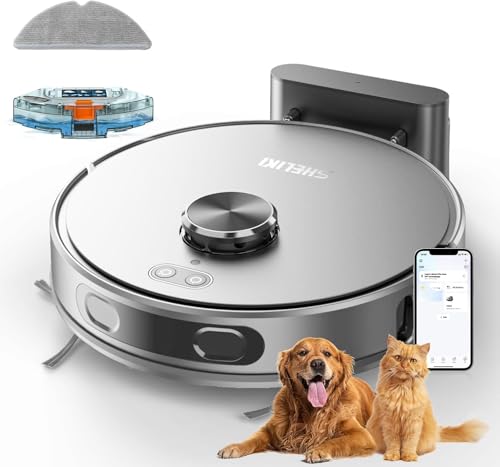
Robot Vacuum and Mop, Mapping Robotic Vacuums Cleaner with LiDAR Navigation Smart & Strong Suction, WiFi/App/Alexa/Voice Control, Obstacle Avoidance, for Home, Wood/Hard Floors, Pet Hair -Gray
360° LiDAR Smart Navigation: D60S robotic vacuum features advanced LiDAR mapping technology that scans your home in real-time,…
As an affiliate, we earn on qualifying purchases.
As an affiliate, we earn on qualifying purchases.